 Skip to content
How Should an OEM Evaluate Surface Treatments for Spiral Freezer Belts: Pickling vs. Electropolishing?
Are you trying to choose the best surface treatment for your equipment? The choice between pickling1 and electropolishing2 seems technical, but it directly impacts your customer's success. Don't let this detail become a future problem.
OEMs should evaluate surface treatments by comparing pickling1's standard cleaning against electropolishing2's functional upgrade. Pickling is a baseline for cleanliness, while electropolishing2 provides a smoother, more corrosion-resistant, and easier-to-clean surface, which directly improves end-user operations and food safety.

I've seen this choice make or break a project's long-term value. It's a conversation that goes far beyond the initial quote. Let's look beyond the spec sheets and talk about what really matters on the production floor.
How does pickling affect the surface and performance of a spiral freezer belt?
Are you looking for a standard, compliant way to clean stainless steel belts? Pickling1 has been the go-to method for decades, but it's important to understand its limitations and what it truly delivers for your customer.
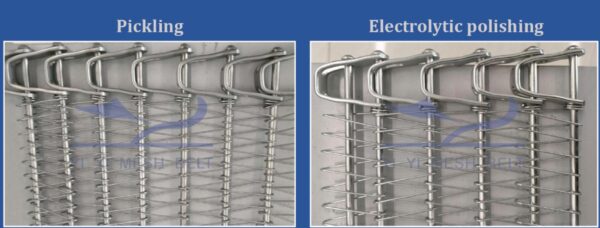
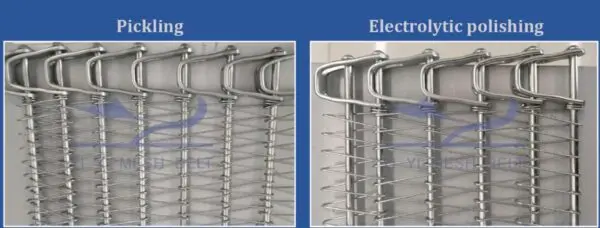
Pickling1 is a chemical process that removes surface impurities like weld scale and oxides. It leaves the belt clean and compliant, but it also creates a uniform, matte-white finish that is slightly rougher than the original material, which can impact long-term cleanability.
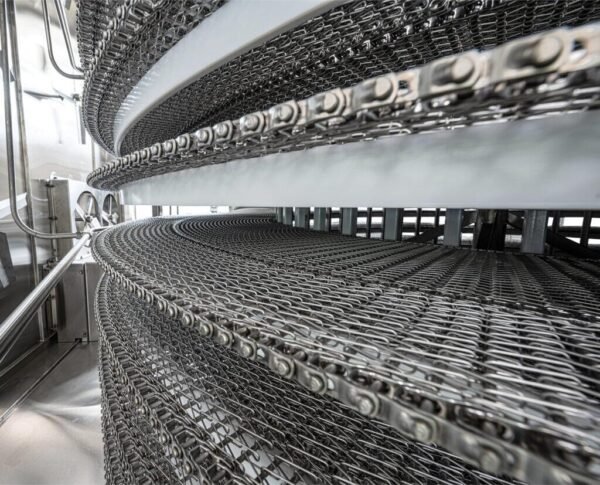

In my three decades of experience, especially with European spiral freezer belt suppliers, pickling is the "traditionally correct" choice. It's a reliable process that involves immersing the stainless steel in a bath of strong acids, typically nitric and hydrofluoric acid. This potent chemical mix aggressively eats away the outer layer, removing heat tint from welding and any other contaminants. The result is a surface that is metallurgically clean. After the chemical bath, the stainless steel surface loses its natural brightness and takes on that characteristic matte, whitish appearance. The belt is clean, it meets regulations, and it's stable. However, from a functional standpoint, I see it as meeting the "qualified" standard, not achieving an "optimized" one. The chemical etching, by its very nature, slightly increases the microscopic surface roughness. This creates more peaks and valleys for particles to cling to. It's a solid baseline, but it's not the final form of surface engineering.
How does electropolishing improve cleanability and corrosion resistance for IQF spiral belts?
Do you want to offer your clients a belt that's not just clean, but functionally superior? Electropolishing moves beyond simple cleaning and enhances the very nature of the stainless steel surface, providing significant operational advantages for years to come.
Electropolishing is an electrochemical process that smooths the metal surface at a microscopic level. This greatly reduces surface roughness, enhances corrosion resistance by forming a superior passive layer, and creates a bright, highly cleanable finish ideal for food-grade applications.

In the Chinese spiral belt manufacturing ecosystem, I've noticed a much higher adoption of electropolishing. I see this as a "functional upgrade." The process is the reverse of electroplating. The belt becomes the anode in an electrolytic bath, and a current is applied. This process preferentially dissolves the microscopic high points, or "peaks," on the surface, leveling the material without the stress of mechanical grinding. The result is an incredibly smooth, stress-free surface. More importantly, this process enriches the surface with chromium, which reacts with oxygen to form a thicker, more uniform, and more durable chromium oxide passive layer. This is what gives stainless steel its "stainless" property, and electropolishing supercharges it. For IQF applications like bread cooling, proofing, or flash-freezing foods, a smoother surface means less product residue, faster and more effective cleaning, and a lower risk of cross-contamination. For the end-user at the food plant, this isn't just a belt upgrade; it's an upgrade to their entire operational workflow and product yield.
Why does microscopic surface texture matter so much in IQF systems?
Are you frustrated by cleaning cycles that take too long? The invisible landscape of your belt's surface could be trapping microscopic particles, leading to much bigger problems down the line for your customers.
Microscopic surface texture is critical because rough surfaces, even from standard pickling, create sites for bacteria to attach and form biofilms. Smoother, electropolished surfaces minimize these anchor points, making cleaning faster, more effective, and drastically reducing contamination risks.
I often explain it to my clients like this: think of a freshly pickled surface as a rugged landscape full of tiny hills and valleys. Now, imagine bacteria as tiny campers looking for a place to set up a tent. Those valleys are perfect shelters, protecting them from the "wind and rain" of your cleaning cycle. In these protected spots, they can multiply and create a slimy, protective layer called a biofilm. Once a biofilm is established, it's incredibly difficult to remove and becomes a persistent source of contamination. An electropolished surface, in contrast, is like a wide-open, flat plain. There are very few places for those bacteria to hide. This concept is fundamental to hygienic design and principles like HACCP. It's not just about being clean; it's about being easy to keep clean. Furthermore, this smoothness reduces the coefficient of friction, meaning products are less likely to stick. For delicate or coated items, this can directly increase product yield by preventing damage or loss on the belt.
How do pickling and electropolishing compare for food-grade spiral freezer applications?
Are you struggling to decide which treatment offers the best real-world value? Seeing the two side-by-side in action is often the clearest way to understand their fundamental differences and impact on your equipment's performance.
While both prepare a belt for service, pickling is a subtractive cleaning process, whereas electropolishing is a finishing process that refines and enhances the surface. For food applications, this difference translates directly into cleanability, corrosion resistance, and long-term hygiene.
I have a great story about this. A client from Brazil, an IQF equipment manufacturer, had always used European belts with a standard pickled finish. At an international baking exhibition in Shanghai, he visited our booth and picked up an electropolished spiral freezer belt sample. His first reaction wasn't to ask about the price. Instead, he kept running his hand over the surface and asked, "Why is it so smooth?" That moment was his turning point. The tangible difference was more powerful than any data sheet. He understood that a smoother surface meant better performance for his customers. That experience led him to switch all his future IQF equipment projects to electropolished belts. To make the differences even clearer for a technical evaluation, I've put together this detailed comparison table based on my years of observation:
| Comparison Metric | Pickling | Electropolishing |
|---|---|---|
| Core Purpose | Cleaning & activation, removes scale | Finishing & functional improvement |
| Principle | Pure chemical corrosion reaction | Electrochemical anodic dissolution |
| Surface Effect | Uniform corrosion, slightly increases roughness | Micro-level leveling, significantly reduces Ra |
| Material Removal | Less controllable, can be uneven | Highly controllable, uniform (10–80 µm) |
| Appearance | Matte, greyish-white | High gloss, true metallic luster |
| Corrosion Resistance | Indirectly improved by cleaning | Significantly enhanced (chromium-rich layer) |
| Cleanability | Standard | Excellent |
| Best For | Heavy scale, post-weld cleaning | Food, pharma, IQF, medical applications |
| Complexity | Lower | Higher (requires precise process control) |
| Environmental Safety | High risk (uses hydrofluoric acid) | More controllable, less hazardous chemistry |
What is the real total cost of ownership for these surface treatments?
Is the cheaper upfront option really saving you money? The initial price tag of a component is only a small part of its true cost over the equipment's lifetime, a fact every experienced OEM knows well.
The total cost of ownership (TCO) for electropolishing is often lower than pickling, despite a higher initial price. This is due to significant long-term savings from reduced cleaning time, lower chemical and water use, less product waste, and longer belt life.


When a customer asks about the price difference, I ask them to think about their end-user's daily operational budget. The initial investment in electropolishing pays dividends every single day. Let's run a simple, conservative scenario. Suppose daily cleaning of a pickled belt line takes 2 hours. Due to the smoother surface, the same cleaning protocol on an electropolished belt takes only 1.5 hours. That's 30 minutes saved per day. Over a year, that's over 180 hours of saved labor. Now add the reduced consumption of expensive cleaning chemicals and hot water. Then, factor in a conservative 0.5% reduction in product waste due to less sticking. For a high-volume food processor, that 0.5% can translate into tens of thousands of dollars saved annually. When you present it this way, the higher upfront cost of electropolishing doesn't look like an expense; it looks like a smart investment in efficiency and profitability.
How should OEM IQF freezer manufacturers choose between pickling and electropolishing?
As an OEM, how do you make the final call for your project? The decision shouldn't be based on tradition or cost alone, but on the long-term value and performance you want to build into your equipment and your brand.
The choice depends on the application's specific demands. You must weigh the initial cost against the long-term benefits of enhanced cleanability, improved product yield, and lower operational costs for your client, aligning the choice with their goals.


I always emphasize one thing: Pickling or Electropolishing is not about preference, but about application. Pickling still has its place. For heavy industrial applications where fine cleaning isn't the priority, it's a perfectly valid and cost-effective choice. But for food, pharmaceutical, or any hygienically sensitive application, the conversation must shift towards electropolishing. The key is to ask the right questions: What are your customer's cleaning standards? Are they dealing with sticky, sugary, or high-fat products? Are they trying to minimize allergen cross-contamination? What are their long-term goals for operational efficiency? The story of the European end-user who replaced 880 meters of belt is the perfect example. They switched from pickled to electropolished and immediately saw shorter cleaning times and smoother operation. That is the ultimate validation. So, what kind of surface treatment should be in your next-generation equipment? My answer is always the same: choose the one that makes your customer's life easier, safer, and more profitable.
Conclusion
Choosing between pickling and electropolishing is deciding between a standard clean surface and a functionally optimized one. For modern IQF applications, electropolishing delivers superior long-term value, enhancing both hygiene and operational efficiency.


