Choose by process or belt structure. Every belt is built to your approved drawing, with a first article confirmed before production.
Send Your Drawing WhatsAppEach flagship belt is checked on the line with a test that matches how it runs in your equipment.

An engineered metal conveyor belt for spiral and turning conveyor systems.

An engineered belt for self-supporting, self-stacking conveyor systems.

An open metal conveyor belt made of eye-shaped links joined by cross rods.

A structured wire conveyor belt selected by pitch, wire diameter, space count, width and edge.
Spiral, open-structure, woven and chain belts, plus matching sprockets.

A spiral freezer belt built for a 1.1 turn ratio, a small-radius geometry that supports compact spiral systems.
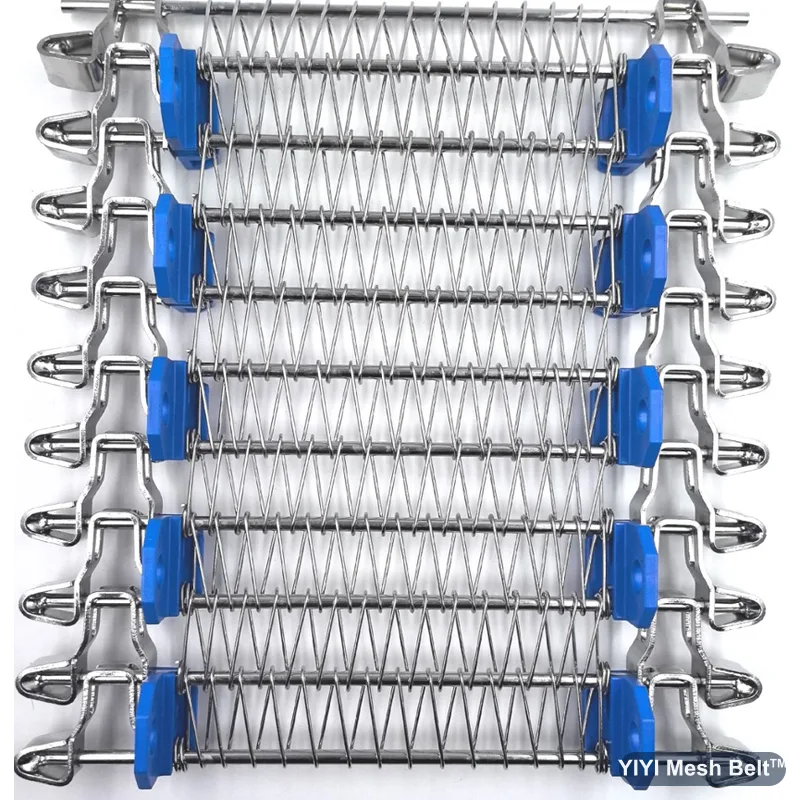
SPIRALA side-driven, side-guided spiral belt where the drive works on the belt edge.

A flat-strip metal conveyor belt connected by cross rods, with a flat carrying surface and an open honeycomb structure.

A woven metal conveyor belt built from alternating left- and right-hand spirals joined by crimp wires, so the belt tracks straight.

A dense woven metal conveyor belt for continuous conveying where the product needs close support.

A mesh belt carried and driven by side chains.

A conveyor system of steel plates carried on rods and chains.

Stainless and polymer sprockets matched to your belt pitch; bore, keyway and teeth confirmed on drawing.
No belt listed for this process yet — send your drawing and we will review it.
Reference ranges from our technical specifications. The approved drawing sets the final values.
| Belt type | Typical processes | Belt width | Key dimension |
|---|---|---|---|
| Spiral Freezer Belt | Freezing, cooling, spiral baking, frying | 300–2900 mm | Turn ratio 1.15–2.5 |
| Spiral Freezer Belt (Small Turning Radius) | Compact spiral freezing and cooling | 300–1200 mm | Turn ratio 1.1 |
| Self-Stacking Belt | Spiral freezing, cooling, proofing | 420–760 mm | Guard 60–120 mm |
| Side Driven Belt | Spiral and curved conveying, freezing, cooling | 300–1100 mm | Turn ratio 1.63 |
| Eye Link Belt | Washing, drying, meat & seafood, heavy-duty | 300–3000 mm | Rod pitch 25.4–76.2 mm |
| Flat Wire / Honeycomb Belt | Baking, cooling, drying, washing | 200–4000 mm | Rod pitch 12.7–50.8 mm |
| Trapezoidal Mesh Belt | Frying, coating, custom conveyors | 76–2352 mm | Pitch 4–23.8 mm |
| Balanced Weave Belt | Baking, heat treatment, general conveying | 200–5000 mm | Spiral pitch 2.8–40 mm |
| Compound Weave Belt | Small products, close conveying surface | 200–3000 mm | Pitch 6–20 mm |
| Chain Driven Belt | Heat treatment, parts washing, heavy-duty | 300–5000 mm | Chain pitch 12.7–63.5 mm |
| Chain Plate / Plate Link Belt | Heavy-duty, solid surface conveying | 300–4000 mm | Plate pitch 25.4–63.5 mm |
Start from your process and product: temperature, product size, load and how the belt is driven. Then confirm width, pitch, material and edge on a drawing. Our engineers review this before quoting.
Yes, after review. Send the drawing, the current belt or a sample, and we confirm geometry and drive relationship before production.
SUS304 and SUS316 stainless steel, and mild or carbon steel for selected belt types. Every incoming batch is checked by spectral and hardness testing.
Yes. Each belt type has a technical specification in mm and inch on the Downloads page.
Yes. Third-party inspection is supported on request, and customer factory visits are welcome.
Send your drawing, a photo or a worn sample. An engineer reviews it before we quote.
Sunny or one of our engineers will get back to you promptly · No obligation · Your details are used only to reply to you.