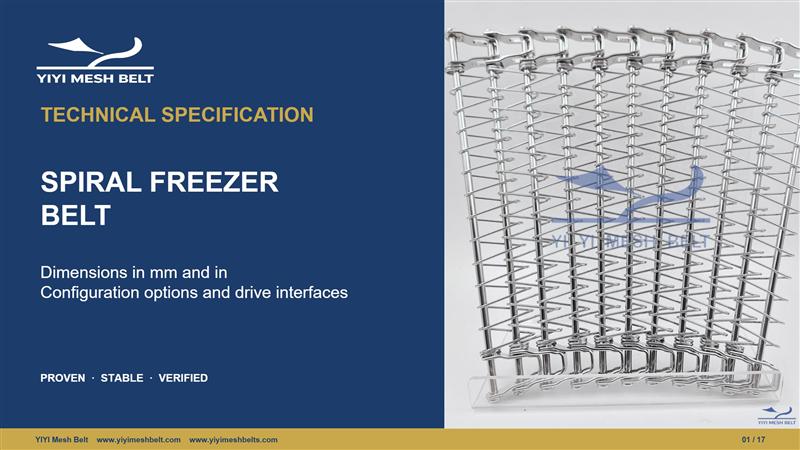
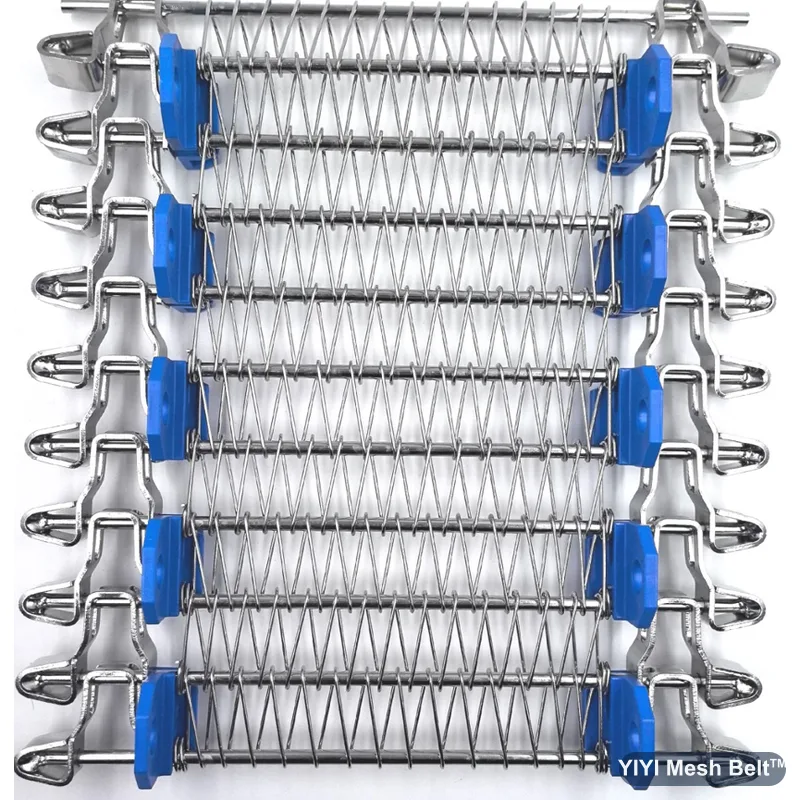
A spiral freezer belt is a stainless steel (SUS304 / SUS316) conveyor belt that travels in a continuous helix around a rotating drum in spiral freezers, proofers and coolers. In the turn its inner edge collapses while the outer edge extends, so turn ratio, drum diameter and edge type must match the freezer. Because every belt is built around your turn ratio, drum geometry and drive, width and length alone are never the starting point — your approved drawing is.
Spiral Freezer Belt documents
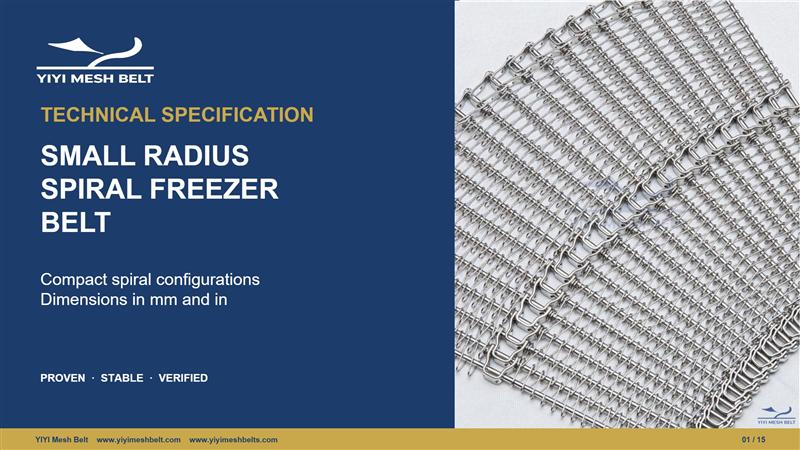
Documents from our Document Library: the dimensions and options to compare with your current belt, and how the belt is made and inspected at our factory in Ningjin, Shandong.


Buyers also call it a spiral belt or a spiral conveyor belt. Our reference turn ratio is 1.10–2.5, and it can be built to your requirement. The approved drawing sets the final turn ratio, pitch and edge.
Watch how a spiral freezer belt is made and inspected at our Ningjin factory.
We measure your old belt or sample, prepare a drawing for your approval, build a trial section and confirm the first article before the full length is made. Every spiral freezer belt order is tested on a drum before shipment.
| Material | SUS304 or SUS316, chosen for your process conditions |
| Surface | Spiral wire and cross rods form the carrying surface |
| Open area | Set by spiral pitch and rod pitch on the approved drawing |
| Drive | Reviewed with the drum and drive; sprockets per project |
| Edge options | Button, flat-hat, rod welded, button cap or clinched |
| Specifications | Spiral pitch 5–23 mm; rod pitch 19.05–40 mm; rod 5 / 6 mm; spiral wire 1.2–1.8 mm; width 300–2900 mm; turn ratio 1.10–2.5, custom to customer requirement |
| Applications | Food: freezing, cooling, baking and oven, frying lines. Industrial: turning conveyor sections, confirmed per project |
| Edge | What it is |
|---|---|
| Button welded | Compact retained rod end |
| Flat-hat welded | Low-profile finished end |
| Rod welded | Direct welded retention |
| Button cap welded | Confirmed on the approved drawing |
| Clinched | Confirmed on the approved drawing |
Reference ranges in mm and inch, not free combinations. The approved drawing sets the final values.
| Parameter | Metric (mm) | Inch (in) |
|---|---|---|
| Material | SUS304 / SUS316 | — |
| Spiral pitch | 5–23 mm | 0.197–0.906 in |
| Rod pitch | 19.05 / 25.4 / 27 / 27.4 / 38.1 / 40 mm | 0.750 / 1.000 / 1.063 / 1.079 / 1.500 / 1.575 in |
| Rod diameter | 5 / 6 mm / custom | 0.197 / 0.236 in |
| Spiral wire | 1.2 / 1.4 / 1.5 / 1.6 / 1.7 / 1.8 mm | 0.047 / 0.055 / 0.059 / 0.063 / 0.067 / 0.071 in |
| Belt width | 300–2900 mm / custom | 11.81–114.17 in |
| Turn ratio | 1.10–2.5 (small radius version: 1.1) | — |
| Edge | Button / Flat-hat / Rod welded / Button cap / Clinched | — |
| Surface | Pickling / Electrolytic / Electropolishing, per project | — |

Every option is confirmed on the approved drawing before production.


Real checks on finished spiral freezer belts in our Ningjin factory, recorded before packing.


Pitch, wire diameter and belt width measured on the finished belt, then checked against your approved drawing.
Food: freezing, cooling, baking and oven, frying lines. Industrial: turning conveyor sections, confirmed per project. Suitability depends on belt specification, temperature and equipment design. We confirm it during specification review. See all 15 applications →
Real photos from our Ningjin factory. Every formal belt passes final inspection against your drawing before packing.


The questions we hear most, answered from how we actually build and check this belt.
Yes. Wire and round bar are drawn in our own workshop in Ningjin, Shandong, and rods are welded to the links by robot. Finished spiral belt output is approx. 350–400 m per day, which is capacity and not a lead time.
We confirm drum diameter or turn ratio before quoting, and turn a trial section on your drum diameter where the turn ratio requires it. Every spiral freezer belt order is tested on a drum before shipment.
We work from an old-belt sample, or from pitch measured over 10 pitches, before quoting, so the new belt is built to the pitch you actually run.
In a freezer the wire is cold and carries a layer of ice. Hard wire resists deformation in that service, while soft wire deforms and loses its flatness, so we specify hard wire for spiral freezer belts used in freezers.
Rod-to-link welds are made by robot for consistency, and every weld is checked before shipment. Cold welds are checked by touch, not by eye alone, and raised weld heads are not left to scrape the guide rail.
Before packing we flex the chain by hand along the full belt length, to find any stiffness from weld distortion or a rod fit that is too tight.
We draw wire and round bar in-house, and each incoming batch is checked for composition and hardness. Buyers often ask for a mill test report (MTR) or mill test certificate (MTC). Tell us which documents your order needs and we confirm them in the quotation.
Clean and dry, in waterproof film and plywood or fumigated wooden cases, with an English shipping list, for sea, air or rail.
It does not go to packing. It is recorded, reworked or remade, and inspected again. A 100% final inspection is not a zero-defect or lifetime guarantee, but you see measured photos and the inspection report of your own belt before shipment.
Lead time is confirmed per order in the quotation. Progress updates are agreed for each order, covering material and tooling status.
We need width and length, spiral pitch, rod pitch and diameter, spiral wire, edge type, turn ratio, drum geometry and drive type. A drawing is the most reliable basis; width and length alone are not enough.
Yes, after we review it. Send the drawing, the current belt or a sample, and we confirm geometry, turn ratio and drive relationship before quoting. A belt that doesn't fit should not have happened, so we check first.
Standard spiral freezer belts cover turn ratios from 1.10 to 2.5. Our small radius version is built for a turn ratio of 1.1.
Button, flat-hat, rod welded, button cap and clinched edges. The right edge depends on the drum, the drive and the approved drawing.
We review the drawing, make a complete first article for your approval, and check drum geometry where the project requires it. Final inspection includes drive operation matching where applicable.
Yes. Third-party inspection is supported on request, and customer factory visits are welcome. Don't take our word for it — inspect it.
Buyers often ask for a mill test report (MTR) or mill test certificate (MTC). Each incoming batch of wire and rod is checked against steel-mill material documentation, with spectral and hardness testing. Tell us which documents your order needs and we confirm them in the quotation. Read more about material documentation.
Send your drawing, a photo or a worn sample. An engineer reviews it before we quote.
We reply as soon as we see your message, within 8 working hours.
We reply as soon as we see your message, within 8 working hours · No obligation · Your details are used only to reply to you.