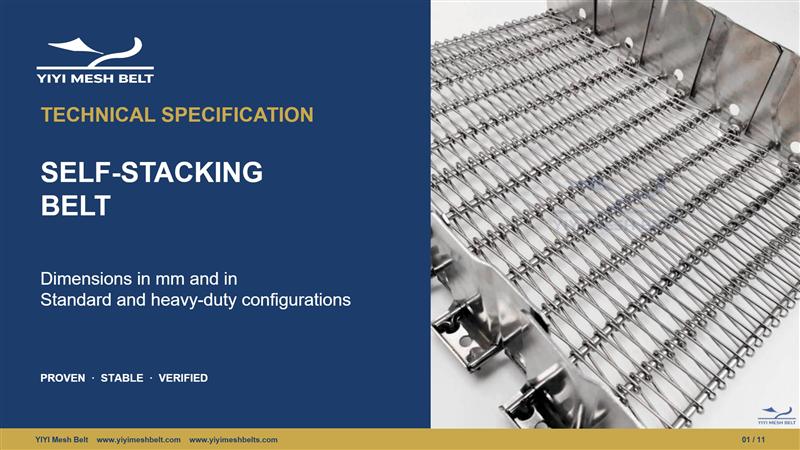
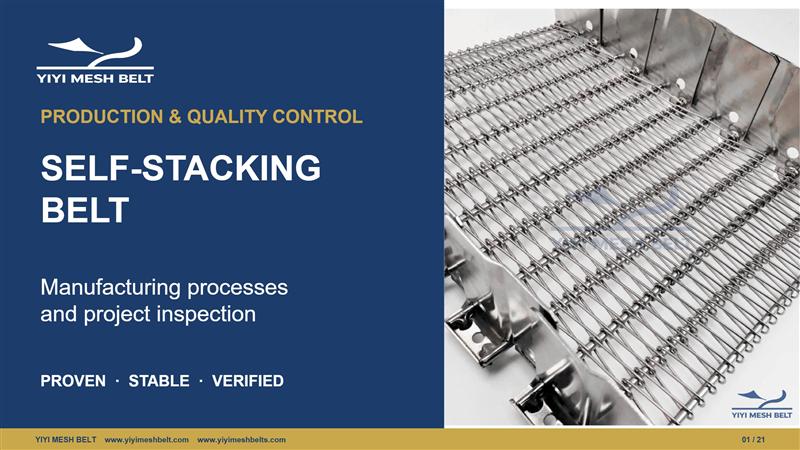
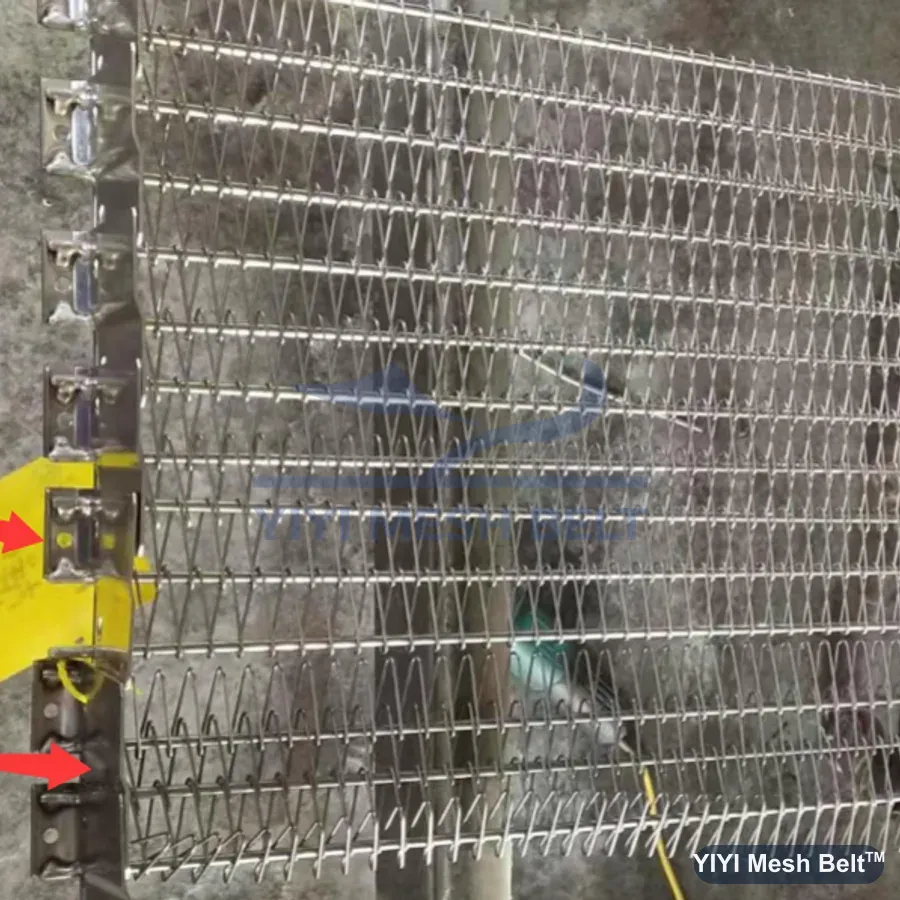
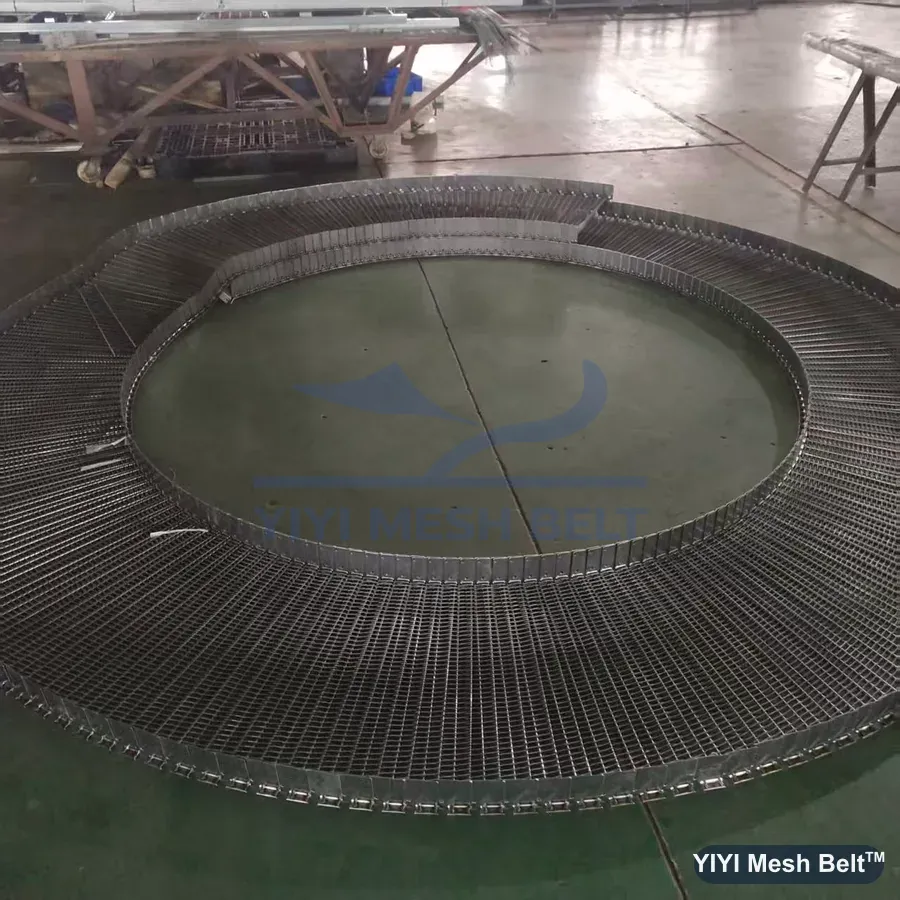
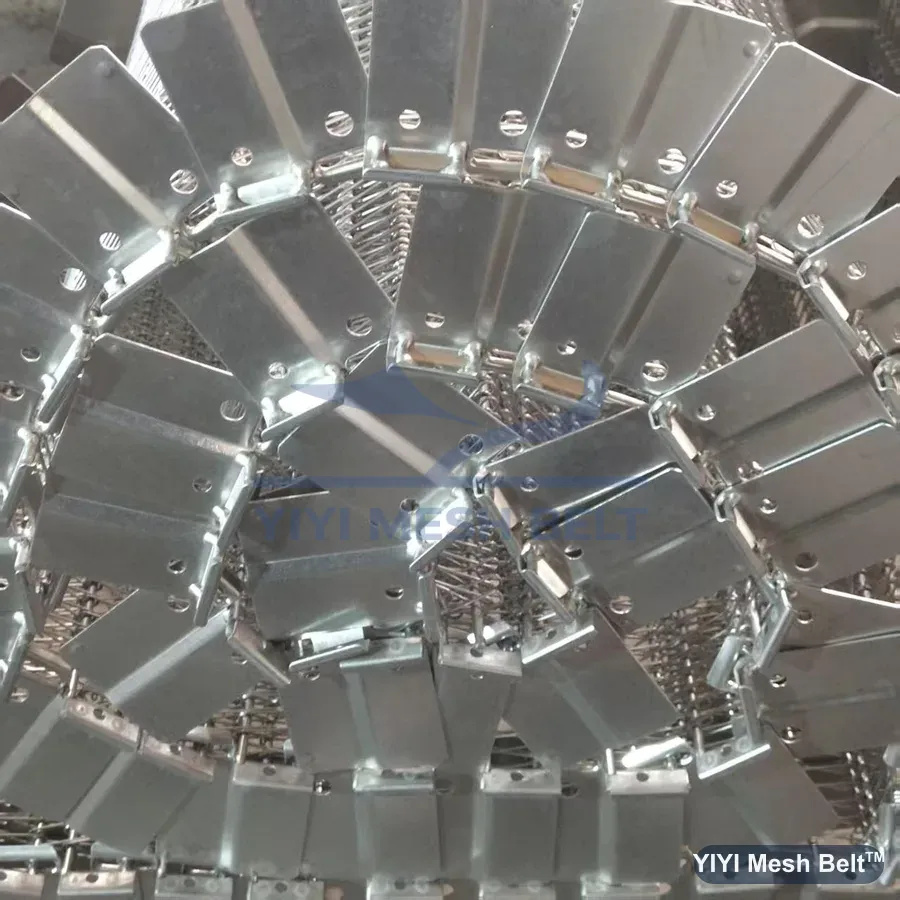
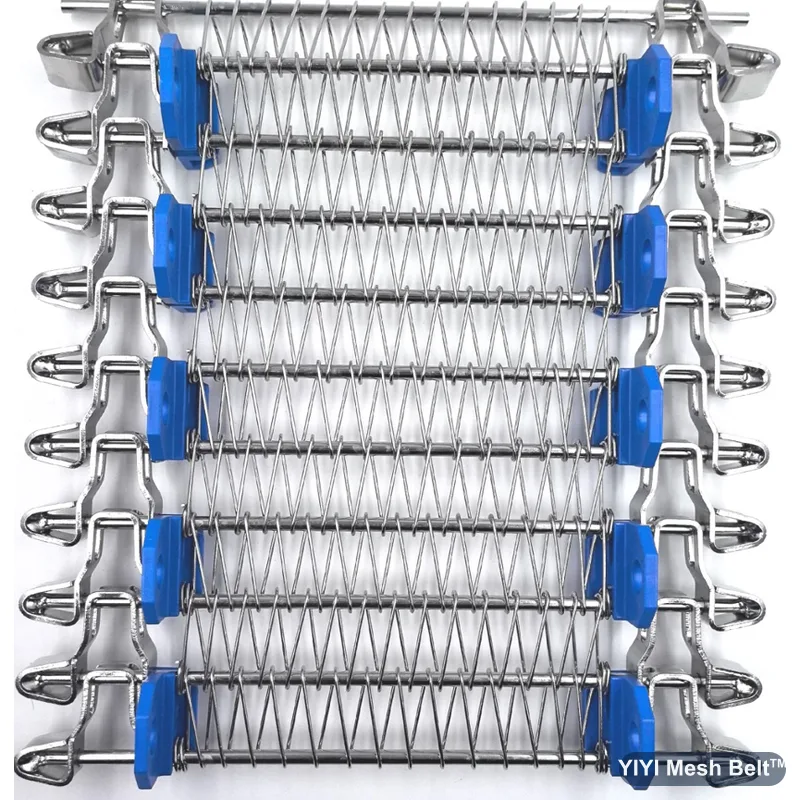
A self-stacking belt, also called a self-stacker belt, is a stainless steel spiral belt whose side plates carry each tier on the tier below, so the spiral stacks itself without an inner cage or support rails. Because each tier rests on the one below, stack geometry, guard height and the rod-end gap decide whether the stack runs true — so we confirm all three on your drawing.
Self-Stacking Belt documents
Two documents from our Document Library: the dimensions and options to compare with your current belt, and how the belt is made and inspected at our factory in Ningjin, Shandong.

Buyers also call it a self-stacking spiral belt. Guard height, stack plate angle and the rod-end gap decide whether the stack runs true, so we confirm them on your approved drawing.
Watch how a self-stacking belt is made and inspected at our Ningjin factory.
We measure your old belt or sample, prepare a drawing for your approval, build a same-width sample section and a trial section, and confirm the first article before the full length is made. Every self-stacking belt order is hand-stacked and checked at the turning diameter before shipment.
| Material | SUS304 or SUS316, chosen for your process conditions |
| Surface | Spiral mesh carried between stack guards |
| Open area | Set by spiral pitch and rod pitch on the approved drawing |
| Drive | Confirmed with the equipment; sprockets per project |
| Edge options | Side / stack guard, 60–120 mm standard |
| Specifications | Spiral pitch 6 / 9 / 13 mm; rod pitch 30 mm; rod 5 mm; width 420–760 mm; turn ratio 1.6 / 1.7; rod-end gap 1–2 mm |
| Applications | Food: freezing, cooling, proofing lines. Industrial: other self-stacking conveyor systems, reviewed per project |
Reference ranges in mm and inch, not free combinations. The approved drawing sets the final values.
| Parameter | Metric (mm) | Inch (in) |
|---|---|---|
| Material | SUS304 / SUS316 | — |
| Spiral pitch | 6 / 9 / 13 mm | 0.236 / 0.354 / 0.512 in |
| Rod pitch | 30 mm | 1.181 in |
| Rod diameter | 5 mm | 0.197 in |
| Side-guard thickness | 1.5 mm | 0.059 in |
| Guard height | 60 / 80 / 90 / 100 / 120 mm | 2.362 / 3.150 / 3.543 / 3.937 / 4.724 in |
| Belt width | 420 / 580 / 640 / 660 / 760 mm | 16.54 / 22.83 / 25.20 / 25.98 / 29.92 in |
| Turn ratio | 1.6 / 1.7 | — |
| Rod-end gap | 1–2 mm | 0.039–0.079 in |
| Surface | Pickling / Electropolishing (Electropolishing generally up to 90 mm stack plates; confirm before ordering for taller plates) | — |
For heavier loads and wider belts: larger rods, taller guards up to 150 mm, widths up to 1069 mm, and a reinforced version with 4 × 15 mm reinforcement pieces.
| Parameter | Metric (mm) | Inch (in) |
|---|---|---|
| Material | SUS304 / SUS316 | — |
| Spiral pitch | 6 / 9 / 13 mm | 0.236 / 0.354 / 0.512 in |
| Rod pitch | 30 mm | 1.181 in |
| Rod diameter | 6 / 7 mm | 0.236 / 0.276 in |
| Side-guard thickness | 1.5 mm | 0.059 in |
| Guard height | 80 / 100 / 150 mm | 3.150 / 3.937 / 5.906 in |
| Reinforcement piece | 4 × 15 mm (reinforced heavy duty, 7 mm rod) | 0.157 × 0.591 in |
| Belt width | 660 / 760 / 1069 mm | 25.98 / 29.92 / 42.09 in |
| Surface | Pickling / Electropolishing (Electropolishing generally up to 90 mm stack plates; confirm before ordering for taller plates) | — |


| Item | Option |
|---|---|
| Side / stack guard height | 60 / 80 / 90 / 100 / 120 mm; heavy duty 80 / 100 / 150 mm |
| Side-guard thickness | 1.5 mm |
| Rod-end gap | 1–2 mm |
| Drive | Confirmed with the equipment; sprockets per project |
Every option is confirmed on the approved drawing before production.


Real checks on finished self-stacking belts in our Ningjin factory, recorded before packing.


Pitch, wire diameter and belt width measured on the finished belt, then checked against your approved drawing.
Food: freezing, cooling, proofing lines. Industrial: other self-stacking conveyor systems, reviewed per project. Suitability depends on belt specification, temperature and equipment design. We confirm it during specification review. See all 15 applications →
Real photos from our Ningjin factory. Every formal belt passes final inspection against your drawing before packing.


Real orders, with customer details withheld.
Distributor, South Asia. A distributor sent the end user’s original belt as a sample. The belt runs in an IQF spiral freezer from the original equipment maker. We drew it, built a trial section of the same width, photographed it next to the original and sent it for approval before mass production. The repeat order was built to the same approved drawing.
| Width | 660 mm |
| Spiral | Wire 1.5 mm, pitch 13 mm, single right-hand |
| Cross rod | Ø 5 mm, pitch 30 mm |
| Side guards | 80 mm high, 1.5 mm plate |
| Material | SUS304, pickled |
| Duty | IQF at −40 °C, 16 h a day, cleaned daily |


The questions we hear most, answered from how we actually build and check this belt.
Yes. Wire and round bar are drawn in our own workshop in Ningjin, Shandong, and spirals, rods and side guards are assembled there to your order.
We confirm side-guard height and usable tier clearance on your equipment drawing before quoting. Stacking plate angle is measured with a protractor during production, and upper and lower tiers are stacked and checked for engagement before shipment.
Every self-stacking belt order is hand-stacked and checked at the turning diameter before shipment. Turn ratio and drum geometry are confirmed on the drawing first.
Send the old belt or a sample. We confirm spiral pitch, rod pitch and guard height from it before quoting, build a trial section of the same width, and compare the two before mass production.
Repeat orders are built to the approved drawing and data of the previous order, with the same measurements repeated and every order hand-stacked and checked at the turning diameter before shipment.
Too much heat can burn through a 1.5 mm side guard. Welds are inspected on every belt, and a burnt-through guard is reworked or replaced before packing.
We draw wire and round bar in-house, and each incoming batch is checked for composition and hardness. Buyers often ask for a mill test report (MTR) or mill test certificate (MTC). Tell us which documents your order needs and we confirm them in the quotation.
Clean and dry, in waterproof film and plywood or fumigated wooden cases, with an English shipping list, for sea, air or rail.
It does not go to packing. It is recorded, reworked or remade, and inspected again. A 100% final inspection is not a zero-defect or lifetime guarantee, but you see measured photos and the inspection report of your own belt before shipment.
Lead time is confirmed per order in the quotation. Progress updates are agreed for each order, covering material and tooling status.
A self-stacking belt carries its own tiers: side guards on each tier support the tier above, so the belt forms a self-supporting stack in a spiral system.
Guard heights of 60, 80, 90, 100 and 120 mm, and belt widths of 420, 580, 640, 660 and 760 mm, with a 30 mm rod pitch.
Our self-stacking belts are built for turn ratios of 1.6 or 1.7.
We build to a 1–2 mm gap from the rod end to the top of the side link, confirmed on the approved drawing and checked before packing.
Yes, after we review the equipment information, drawing and the current belt or a sample. We confirm stack geometry and guard height before quoting.
Yes. Third-party inspection is supported on request, and customer factory visits are welcome.
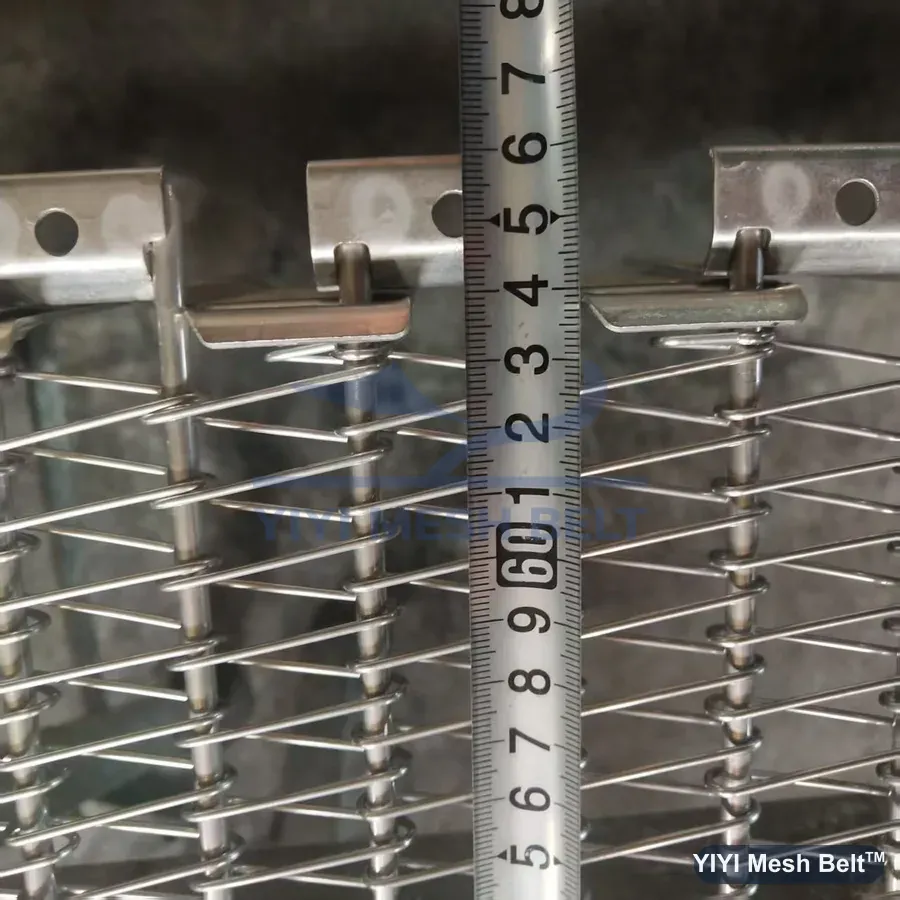
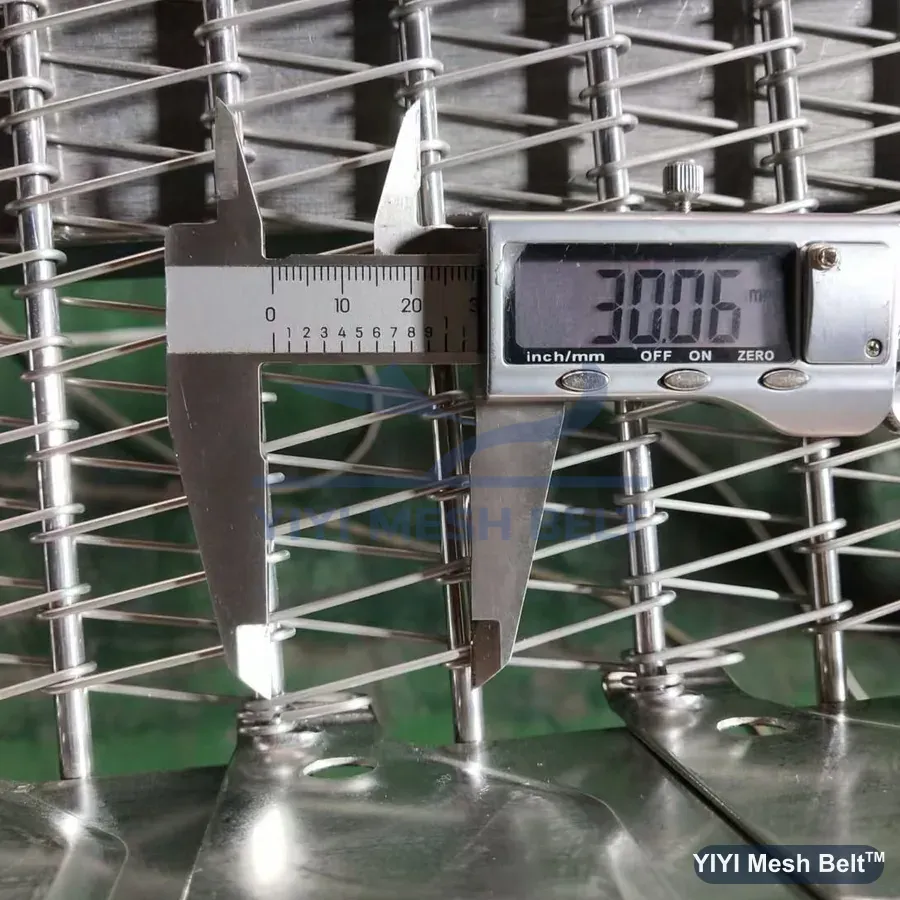
Buyers often ask for a mill test report (MTR) or mill test certificate (MTC). Each incoming batch of wire and rod is checked against steel-mill material documentation, with spectral and hardness testing. Tell us which documents your order needs and we confirm them in the quotation. Read more about material documentation.
Send your drawing, a photo or a worn sample. An engineer reviews it before we quote.
We reply as soon as we see your message, within 8 working hours.
We reply as soon as we see your message, within 8 working hours · No obligation · Your details are used only to reply to you.