
Two spiral belts with the same design can feel very different in the hand. The surface treatment is the reason, and it matters on the cleaning shift.
Pickling and electropolishing both clean stainless steel, but they do different jobs. Pickling removes weld heat tint and scale and leaves a clean matte surface. Electropolishing removes a thin layer electrochemically and leaves a smoother, brighter surface. Choose by product, cleaning routine and hygiene needs.
We are YIYI Mesh Belt, a metal conveyor belt manufacturer in Ningjin, Dezhou City, Shandong Province, China. Our manufacturing experience dates back to 1998, and we work on a 27,000 m² site with about 280 units of production and supporting equipment, including 9 welding robots. Our Spiral Freezer Belts can be supplied with pickling or electropolishing where the project requires it. I am Sunny Ye. Here is how I help OEMs and plants decide between the two.

At a Glance
| Product | Spiral Freezer Belt (also Small Radius, Self-Stacking and Side Driven belts where specified) |
|---|---|
| Treatments compared | Pickling and electropolishing of SUS304 / SUS316 |
| Key points to confirm | Product type, cleaning chemicals and frequency, hygiene requirements, weld finish |
| Buyer type | Spiral freezer OEMs, food plants, distributors |
| What to send for a quote | Belt drawing, product, cleaning routine, required surface treatment |
What Does Pickling Do to a Stainless Steel Belt?
Pickling uses an acid bath to remove weld heat tint, scale and surface contamination from stainless steel. It restores a clean surface so the protective chromium oxide layer can form evenly. The result is a uniform, matte, greyish-white finish. It is a cleaning step that makes a welded belt ready for service.
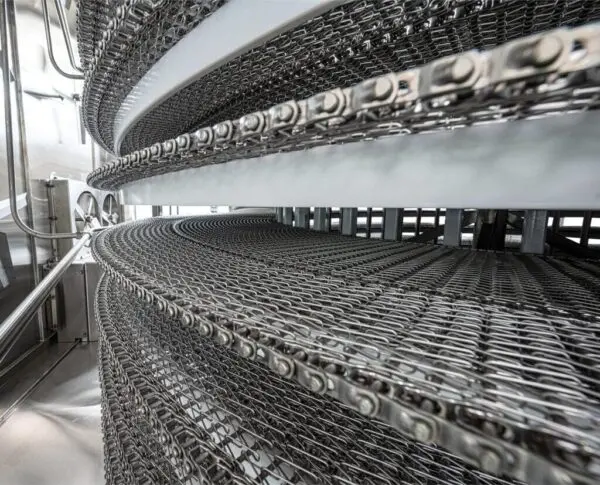
Welding a spiral belt leaves heat tint around the weld points. Heat tint is a coloured oxide layer, and the steel just under it has less chromium at the surface. Left in place, those areas are weaker against corrosion. Pickling removes them.
What pickling gives you
- Removal of heat tint and scale around welds
- A clean, even surface across the whole belt
- The conditions for the passive layer to re-form
What it does not do
- It does not smooth the surface. The acid attacks the surface evenly and leaves a matte finish.
- It does not change the shape or the dimensions of the belt in a meaningful way.
For many freezing lines, a pickled belt is a sound, practical choice. It is clean and stable, and it suits lines where the product and cleaning routine are not demanding.
Sunny's view: A pickled belt is a correct belt. Electropolishing is an upgrade for specific needs, not a fix for a wrong design.
What Does Electropolishing Add?
Electropolishing removes a thin layer of metal electrochemically, dissolving the microscopic peaks of the surface first. The belt comes out smoother and brighter, and the surface is rich in chromium, which supports a uniform passive layer. A smoother surface tends to hold less residue and release product more easily.

In electropolishing, the belt is the anode in an electrolyte bath. When current flows, metal dissolves from the surface, and the high points dissolve faster than the low points. The surface levels out at a microscopic scale without mechanical grinding.
What electropolishing gives you
- A smoother, brighter surface
- Fewer microscopic sites where residue can sit
- A chromium-rich surface that supports the passive layer
- Weld areas that look and feel more even
Because the surface is smoother, it is usually easier to clean, and sticky or delicate products tend to release better. That is why many OEMs ask for it on belts for bakery cooling, proofing and food freezing lines.
We do not quote a fixed saving in cleaning time or a fixed corrosion life. Those depend on the product, the chemicals and how the line is cleaned. What I can say is that the difference is easy to see and feel when you hold the two surfaces side by side.
Sunny's view: Ask your supplier for two small samples, one pickled and one electropolished, and run your fingers across them. That comparison explains more than any table.
How Do Pickling and Electropolishing Compare Side by Side?
Pickling and electropolishing compare as cleaning versus finishing. Pickling cleans and evens the surface after welding and leaves a matte finish. Electropolishing also cleans, but it smooths the surface and brightens it. Both suit food freezing, so the choice depends on product stickiness, cleaning routine and hygiene requirements.

| Point | Pickling | Electropolishing |
|---|---|---|
| Main purpose | Remove heat tint, scale and contamination | Clean and smooth the surface |
| Process | Chemical acid treatment | Electrochemical anodic dissolution |
| Surface | Matte, greyish-white | Bright, smoother |
| Residue and release | Standard | Usually easier to clean and release |
| Process control | Simpler | Needs tighter control of bath, current and time |
| Typical use | General freezing and cooling lines | Sticky or delicate products, demanding hygiene plans |
Both treatments leave a stainless steel belt ready for food service. Neither treatment turns SUS304 into SUS316, and neither one fixes a design problem such as the wrong turn ratio or edge. Decide the design first, then the grade, then the surface.
If grade is your question rather than surface, read how to verify stainless steel grade.
Sunny's view: I always settle the design and the grade first. Surface treatment is the last decision, not the first.
How Do We Apply Surface Treatments to Our Belts?
We build, weld and inspect the belt in our own factory, and pickling and electropolishing are carried out by specialist partners under our project specifications. The treated belt then comes back for our checks before packing. The approved drawing and order state which treatment the belt receives.

Core metal belt manufacturing and quality control are managed in-house: wire and round-bar drawing, forming, assembly, welding, straightening, in-process inspection and final inspection. Pickling and electropolishing are specialist processes, and we source them externally under our project specifications and finished-product requirements.
How the treatment fits into production
- The approved drawing and order state the surface treatment.
- We form, assemble and weld the belt in our factory.
- The belt is pickled or electropolished by a specialist partner.
- The belt returns for our 100% final inspection, including cleanliness, weld finish, flatness and dimensions.
- We pack the belt clean and dry for export.
I say this openly because buyers should know where each step happens. It also means the treatment is specified in writing. If you need a particular surface condition, put it on the drawing so everyone works to the same requirement.
Because the treatment happens after welding, the weld quality still comes first. A treatment can clean and smooth a good weld, but it cannot repair a weak one. That is why our final inspection checks that weld points are smooth and rounded, and why we recommend reading how we avoid weld burrs on spiral belts alongside this article.
Sunny's view: Write the surface treatment on the drawing. If it is not on the drawing, it is a conversation, not a requirement.
How Should an OEM Choose Between the Two?
An OEM should choose by the end user, not by habit. Look at the product, how sticky or delicate it is, the cleaning chemicals and frequency, and the hygiene requirements of the plant. Pickling suits general lines. Electropolishing suits sticky or delicate products and demanding hygiene plans.

Questions to ask your end user
- What products will run? Are they sticky, sugary, fatty or coated?
- How often is the belt cleaned, and with which chemicals?
- Does the plant have allergen or hygiene targets that make cleaning harder?
- Does the product leave residue on the current belt?
| If the line runs… | Usual direction |
|---|---|
| Raw meat, poultry or vegetables with standard cleaning | Pickling is often enough |
| Bakery, proofing, glazed or coated products | Review electropolishing |
| Frequent allergen changeovers or strict hygiene plans | Review electropolishing |
| Heavy industrial, non-food use | Pickling, or as specified |
Electropolishing adds a process step, so discuss it at the quotation stage, not after the drawing is approved. Our Spiral Freezer Belt references list pickling, electrolytic and electropolishing surfaces as project-specific options. For the full belt selection order, see how to choose a spiral freezer belt for IQF systems.
Sunny's view: Choose the surface your end user will thank you for at the cleaning shift, not the one that was on the last order.
When This Is Not the Right Approach
Electropolishing is not a cure for corrosion caused by the wrong grade or harsh chemicals. If salt or chlorides are the problem, review SUS316 first. It also cannot correct poor welds or a design that does not fit the freezer.
Pickling is not the wrong choice for food. A pickled belt is clean and ready for service. The real question is whether your product and cleaning routine benefit from a smoother surface.
From Our Engineering Experience
When an OEM asks us about surface treatment, we ask about their end user before we answer: the products, the cleaning chemicals, the cleaning frequency and any residue problems on the current belt. Then we recommend pickling or electropolishing and put the choice on the drawing.
Many buyers decide after holding the two surfaces in their hands. We can show both finishes on belt sections, and the difference in smoothness is easy to feel. That simple comparison usually answers the question faster than a long technical discussion.
FAQ
Is a pickled spiral belt safe for food lines?
Pickling leaves a clean stainless steel surface ready for service. Food-contact and hygiene requirements should be confirmed for the specific project and end user.
Does electropolishing make SUS304 as corrosion resistant as SUS316?
No. Electropolishing improves the surface, but it does not change the grade. Where chlorides are the issue, review SUS316.
Can you electropolish a belt after it is made?
Yes. The belt is formed and welded first, then treated by a specialist partner under our specifications, and returned for our final inspection.
Is electropolishing available on self-stacking belts?
Our Self-Stacking Belt references list pickling and electropolishing surfaces. The treatment is confirmed on the project drawing.
How do I specify the surface treatment?
State it on the approved drawing and in the order, for example pickled or electropolished, so the requirement is clear for production and inspection.
Conclusion
Pickling cleans; electropolishing cleans and smooths. Choose by product, cleaning and hygiene needs, and write the choice on the drawing.
Deciding on a surface treatment?
Tell us your product, cleaning chemicals and hygiene needs, and send your drawing. We recommend a surface and confirm it on the drawing with you.
See Spiral Freezer Belt specifications →WhatsApp Sunny📄 Spiral Freezer Belt Production & Quality Control (PDF) · Email: info@yiyimeshbelt.com
Related reading: How to choose a spiral freezer belt for IQF · How to verify stainless steel grade · How to avoid weld burrs on spiral belts · Quality control at YIYI (yiyimeshbelts.com)

Sunny Ye
Global Sales Director, YIYI Mesh Belt · 15 years in metal conveyor belt projects
I work with spiral freezer builders, distributors and plant teams on belt selection and replacement. Questions about this article? Send them to me directly.
Follow Sunny on LinkedIn · Last updated: 2026-10-14

