
Many self-stacking belts in use today have no drawing. The buyer has the old belt, or a piece of it, and needs the next belt to stack the same way.
We make a self-stacking belt to your sample in five steps: we measure the sample, turn it into a drawing you approve, make a short same-width sample section for your confirmation, build and inspect a trial section, and only then produce the full length. The approved sample then becomes the standard for every reorder.
I am Sunny Ye, Global Sales Director at YIYI Mesh Belt (Ningjin Yiyi Mesh Belt Co., Ltd.). A good part of our self-stacking belt work starts from a sample, not a drawing. Here is how we do it in our factory in Ningjin, and what you should send so the new belt stacks like the old one.
Contents
- What should you send with your sample?
- How do we turn a sample into a drawing?
- Why do we make a sample section before preparing material?
- What happens at the trial section?
- How does the approved sample control the full order and reorders?
- When this is not the right choice
- FAQ
At a Glance
| Item | Details |
|---|---|
| Product | Self-Stacking Belt, stainless steel SUS304 / SUS316 |
| Starting point | A section of your current belt, or clear photos with key dimensions |
| Steps | Measure the sample → drawing approval → sample section → trial section and first-article inspection → full length |
| Who approves | You approve the drawing, the sample section and the trial section |
| Before shipment | Every self-stacking belt order is tested on a drum before shipment |
What should you send with your sample?
A sample tells us the belt. It does not tell us the machine.
Send a sample section of your current belt, or clear photos with a ruler or caliper, plus the belt width, the equipment and application, the operating conditions, and the drive and stacking details. The sample gives us the belt geometry. The other information tells us whether that geometry still fits your system.
| Information | Why we need it |
|---|---|
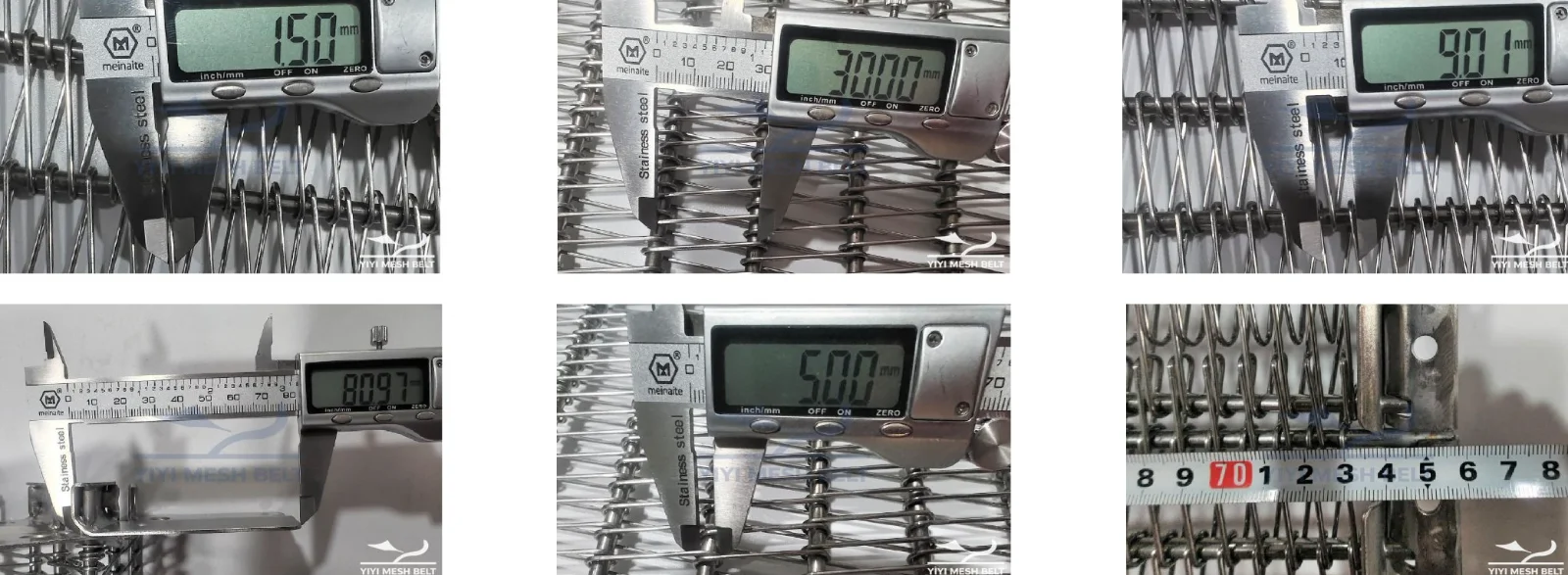
| Sample section or photos | Spiral pitch, rod pitch, rod diameter, side guard (side plate) height and edge construction |
| Belt dimensions (mm / in) | Width and total length for the order |
| Equipment and application | Freezing, cooling or proofing, and the spiral system the belt runs on |
| Operating conditions | Reviewed with the belt specification before production |
| Drive and stacking details | Rotation direction, drum geometry and tier clearance |
If you are not sure how to read rotation direction or stack plates on your old belt, see how to confirm rotation direction and stack plates on a self-stacking belt.
How do we turn a sample into a drawing?
We do not copy a sample by eye. We measure it.
We measure the spiral pitch, rod pitch, rod diameter, wire diameter, side guard height and belt width on your sample, compare them with our self-stacking belt range, and put the result on a drawing. You approve the drawing before we prepare any material. Sizes outside our listed range go to engineering review first.
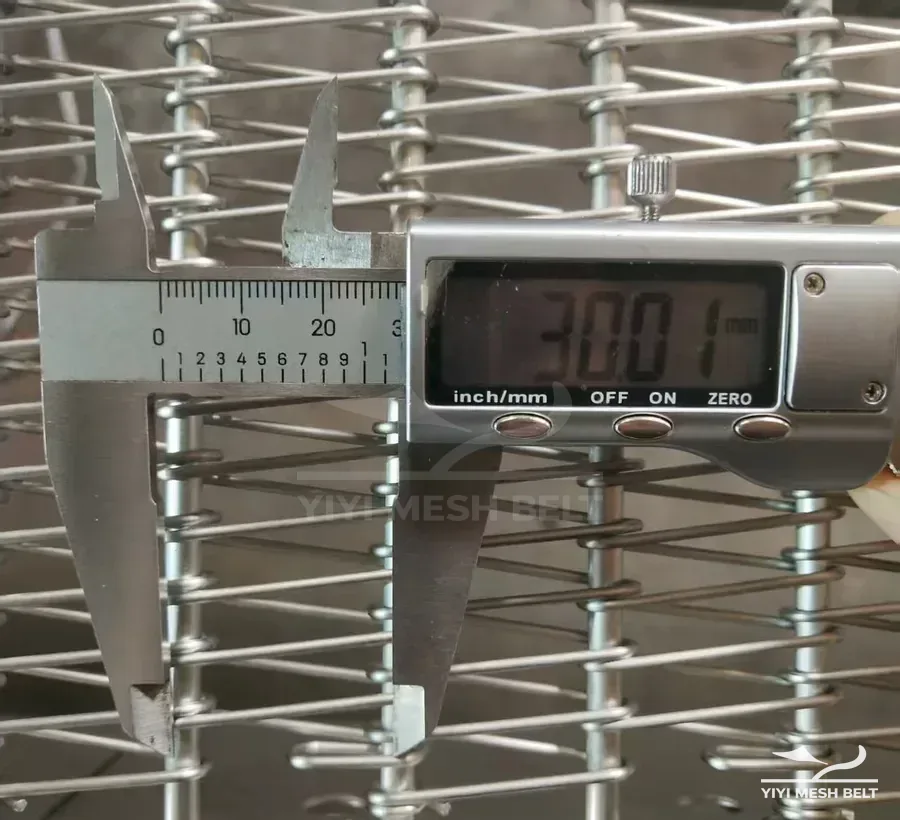
Most samples fall inside our standard range. Some do not, and that is fine, as long as we find out before production and not after. This is the range we check a sample against:
| Parameter | Standard (mm) | Heavy duty (mm) | Inch (in), rounded |
|---|---|---|---|
| Spiral pitch | 6 / 9 / 13 | 6 / 9 / 13 | 0.24 / 0.35 / 0.51 |
| Rod pitch | 30 | 30 | 1.18 |
| Rod diameter | 5 | 6 / 7 | 0.20 / 0.24 / 0.28 |
| Side guard height | 60 / 80 / 90 / 100 / 120 | 80 / 100 / 150 | 2.36 / 3.15 / 3.54 / 3.94 / 4.72 / 5.91 |
| Side guard thickness | 1.5 | 1.5 | 0.06 |
| Reinforcement piece | — | 4 × 15 | 0.16 × 0.59 |
| Turn ratio (reference) | 1.6 / 1.7 | To approved drawing | — |
| Rod-to-stack-plate gap | 1–2 | To approved drawing | 0.04–0.08 |
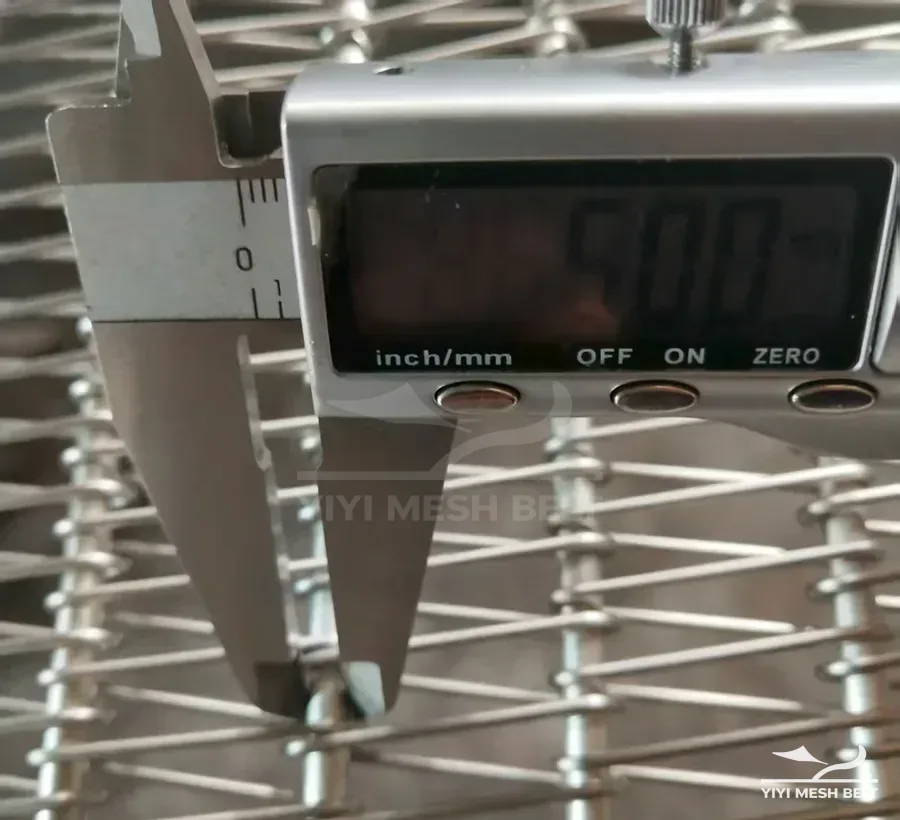
Millimetres are the working unit, and the approved metric drawing governs. A side guard height on the drawing is a component dimension. The usable tier clearance depends on your equipment, so we confirm it with the equipment arrangement, not with the sample alone.
Why do we make a sample section before preparing material?
A drawing is our reading of your sample. A sample section is how you check that reading.
For a new sample-based order, we first make a short sample section at the same width as your belt. You compare it with your old belt, or test it on your equipment. Only after you approve it do we prepare material for the order. Where we can, we keep a matching piece as our own reference.
For a project in Pakistan (South Asia), we made three short same-width sample pieces, kept one in our factory, and sent the others for approval. The side plates carried the customer's own engraved marking. Material was prepared only after the sample was approved. When the customer reordered, we checked the new order against the sample they sent back to us.
For a project in Australia (Oceania), the belt had 120 mm side guards. We sent a short same-width sample first. After approval we prepared material, and during production we checked how the upper and lower layers engaged before, during and after welding.
What happens at the trial section?
The trial section is the first real piece of your belt.
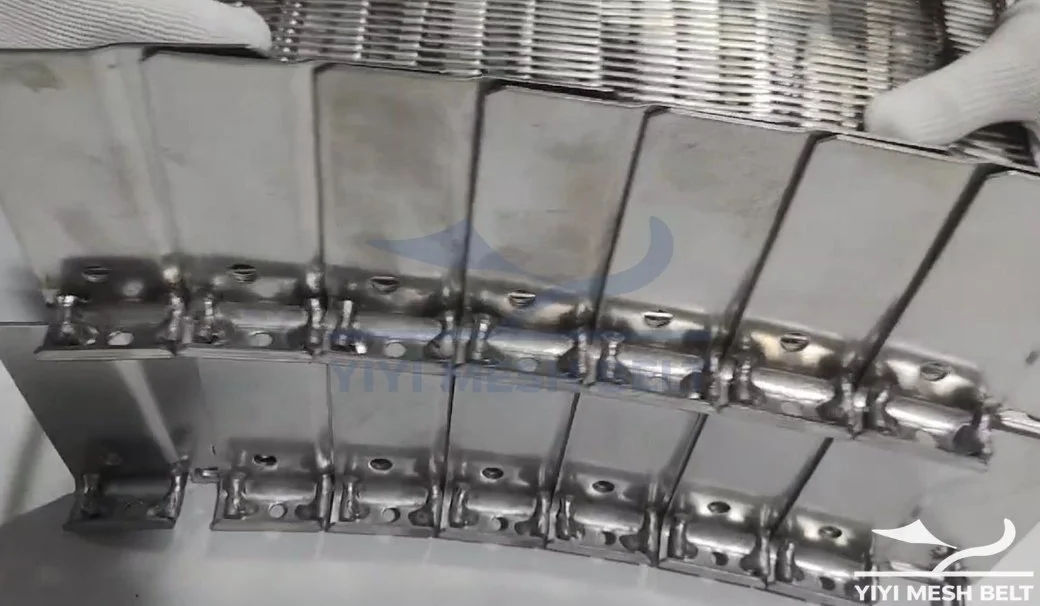
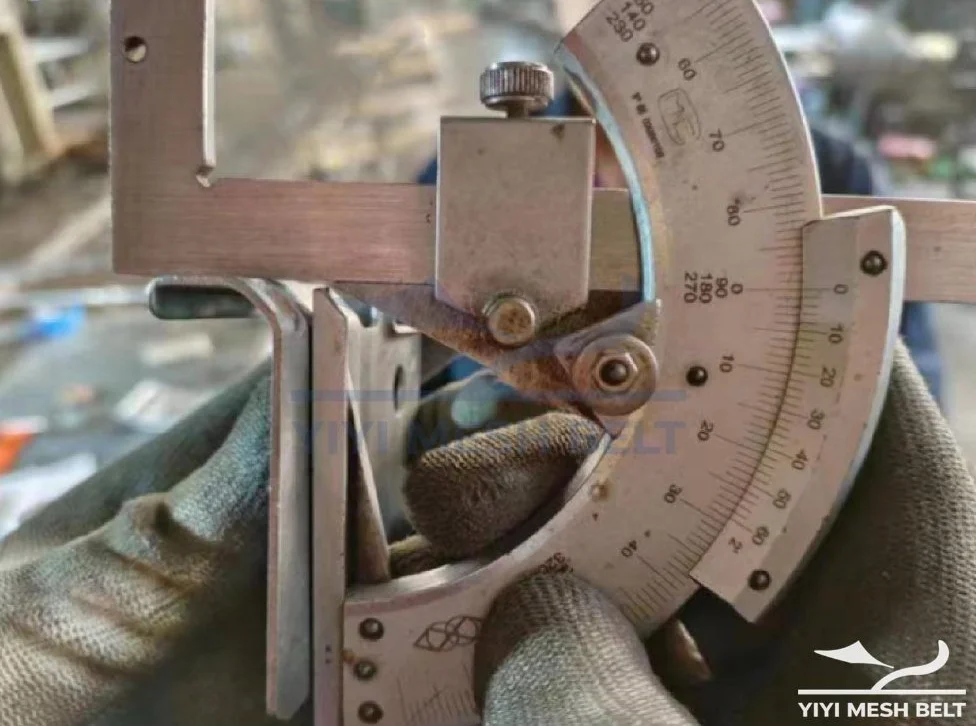
Customized self-stacking belt orders go through trial production and first-article inspection before mass production. We build a trial section to the approved drawing, check its dimensions, check the stack plate angle, stack it to check layer engagement, and send you photos or the piece for confirmation.
| Step | What happens | Who confirms |
|---|---|---|
| 1. Measure the sample | Pitch, rod, wire, side guard and width measured in mm / in | YIYI engineering |
| 2. Drawing approval | Measured data put on a drawing; sizes outside our range reviewed | Buyer |
| 3. Sample section | Short same-width section for comparison; reference piece kept where we can | Buyer |
| 4. Trial section and first article | Dimensions, plate angle and layer engagement checked | YIYI quality control, then buyer |
| 5. Full length | Built to the approved section; final inspection; drum test before shipment | YIYI production and quality control |
The trial section is also where we change things if we need to. On a heavy-duty project in South Korea (East Asia), a trial order with 7 mm rods and reinforcement pieces led us to adjust the link tooling before production continued. It is far cheaper to find that on a trial piece than on a full belt.
For a project in India (South Asia), we made a short test order to the customer's sample. The customer's next order was then written as "same data as the test order", and we built it that way.
How does the approved sample control the full order and reorders?
Once you approve a sample, it stops being your old belt. It becomes the standard.
We build the full length to the approved sample and trial section, inspect every finished belt before packing, and test every self-stacking belt order on a drum before shipment. We keep the approved drawing, inspection photos, your confirmations and any reference piece, so each reorder follows the same data.
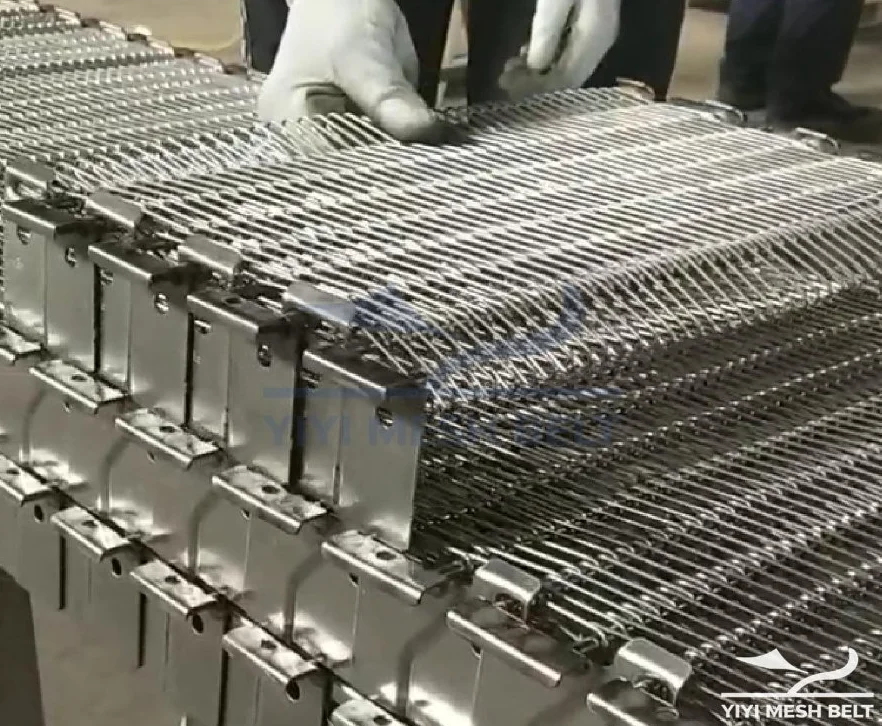
For a customer in Spain (Europe), we worked only from their sample. We made sample sections in a few pitches for approval, then a short first order. The engraved first pieces were photographed and confirmed before batch production. The customer has reordered repeatedly since, in two widths, and each production order follows the data of the one before.
You can see the photos of each production and inspection step in our Self-Stacking Belt Production and Quality Control document.
When This Is Not the Right Choice
Building to a sample is not always the right way. A worn or damaged sample shows the wear, not the original size, so we confirm critical dimensions with you or with your equipment drawing before we approve anything. If your freezer uses a drum-driven spiral with support rails, a Spiral Freezer Belt may be the right family, not a self-stacking belt. And if we cannot get a sample, clear photos or a drawing, we cannot verify the stack, and we will tell you so before we quote. Building from a guess risks tiers that do not seat, which only shows after installation.
From Our Engineering Experience
The question I hear most is "Can you copy my belt?" My honest answer is: we can match it, but only if we measure it and you approve what we measured. The sample section is the step buyers want to skip, because it takes a little time. It is also the step that has saved the most projects. One short piece, stacked on your old belt, tells you more than any drawing. Keep one piece yourself, and ask your supplier to keep one too.
Evidence From Our Work
| Item | Details |
|---|---|
| Situation | A new customer needed a 660 mm SUS304 self-stacking belt with a 13 mm spiral pitch, made to their sample |
| What we checked | Three short same-width sample pieces; one kept as our reference; side plates engraved with the customer's marking; material prepared only after approval |
| Why it matters | Without a drawing, the approved sample is the only standard both sides can measure against |
| Result | The customer reordered, and the repeat order was checked against the returned sample |
| Buyer lesson | Approve a same-width sample before material is prepared, and make sure both sides keep a piece |
FAQ
Can you make a self-stacking belt from my old belt sample?
Yes. Send us a sample section or clear photos with key dimensions. We measure it, put the data on a drawing for your approval, make a short sample section, and build a trial section before the full length.
What should I send with the sample?
Belt width and length, the equipment and application, operating conditions, and the drive and stacking details, such as rotation direction and drum geometry. The sample gives the belt geometry; this information tells us whether it fits your system.
Why do you make a sample section before the order?
A drawing is our reading of your sample. A short same-width sample section lets you check that reading on your old belt or equipment before we prepare material.
What if my sample is outside your standard range?
We put the measured sizes on the drawing and send anything outside our listed range to engineering review before production. We tell you the result before we quote.
Will a reorder match the belt built from my sample?
We keep the approved drawing, inspection photos, your confirmations and any reference piece. Each reorder refers to the previous order, so the new belt is built to the same data.
Conclusion
A sample-based self-stacking belt is only as good as the measurement and approval behind it. Measure, approve a drawing, approve a sample section, inspect a trial section, then build the full length.
Next step: Send us a sample section or photos of your current belt for a production review. You can also reach me at info@yiyimeshbelt.com or on WhatsApp at +86 134 5177 3742. Product details: Self-Stacking Belt. Related reading: how a self-stacking belt is made, from wire to the stack check and standard or heavy-duty self-stacking belt.
Technical Reviewer: Sunny Ye, Global Sales Director, YIYI Mesh Belt (Ningjin Yiyi Mesh Belt Co., Ltd.) · Last updated: 2026-10-22
© 2026 Ningjin Yiyi Mesh Belt Co., Ltd. All rights reserved. Photos, drawings and data on this page belong to YIYI Mesh Belt and may not be copied or reused without written permission.

