

You put a magnet on your new SUS304 belt and it sticks. Now you are worried the supplier cut corners, and your own customer may ask the same question.
A SUS304 Spiral Freezer Belt can attract a magnet because cold drawing, bending and forming turn part of its austenitic structure into martensite, which is magnetic. Weld zones also contain a little ferrite. Magnetism alone does not prove the grade is wrong. A composition check does.
We are YIYI MESH BELT (Ningjin Yiyi Mesh Belt Co., Ltd.), a metal conveyor belt manufacturer in Shandong, China, with manufacturing experience dating back to 1998. We run in-house stainless steel wire drawing and round-bar drawing, and we check incoming material by spectral analysis, so we see this question from both sides: as the maker, and as the supplier who has to answer it. Below is what causes the magnetism, where it shows up, and how to check the material the right way.
Table of Contents
- At a Glance
- Why does a SUS304 Spiral Freezer Belt attract a magnet?
- Which parts of a Spiral Freezer Belt are most magnetic?
- Can a magnet test tell SUS304 from a cheaper grade?
- How should you verify the material of a SUS304 belt?
- Does magnetism affect corrosion resistance or belt performance?
- When this is not the right choice
- From our engineering experience
- Evidence from our work
- FAQ
At a Glance
| Item | Summary |
|---|---|
| Product | Spiral Freezer Belt in SUS304 (SUS316 on request) |
| Application | Spiral freezers, spiral coolers and proofers in food processing |
| Key point | Cold-worked SUS304 can respond to a magnet. This is normal and does not change the grade. |
| Buyer type | Spiral freezer OEM engineers, QA inspectors, purchasing managers, plant maintenance teams |
| What to send for a quote | Belt width, rod pitch, rod and spiral wire diameter, turn ratio, material grade, and any magnetic or inspection requirements |
Why does a SUS304 Spiral Freezer Belt attract a magnet?
A magnet sticking to your belt feels like proof of a cheaper material. It usually is not, and returning a good belt for this reason costs you time on the project.
A SUS304 Spiral Freezer Belt becomes partly magnetic because SUS304 is a metastable austenitic stainless steel. When it is drawn, bent or formed at room temperature, part of the non-magnetic austenite transforms into martensite, which responds to a magnet. The chemistry stays SUS304.
Here is the simple version we give our customers.
SUS304 (AISI 304, EN 1.4301) contains about 18% chromium and 8% nickel. In the fully annealed condition, this chemistry holds an austenitic structure at room temperature. Austenite is essentially non-magnetic. That is why a sheet of annealed 304 in a kitchen barely reacts to a fridge magnet.
A Spiral Freezer Belt is not annealed sheet. Every component goes through heavy cold work:
- Wire drawing. Spiral wire is drawn down through a series of dies to reach its final diameter.
- Rod drawing. Cross rods are drawn from larger bar to the specified rod diameter.
- Forming. Spiral wire is coiled around tight radii. Rod ends are headed. Side links are bent and pressed.
- Welding. Rods and links are welded at the belt edges.
Cold work makes the austenite less stable. Part of it transforms into martensite. Martensite is ferromagnetic, so the belt now reacts to a magnet. Metallurgists call this deformation-induced (or strain-induced) martensite. It is a well-documented property of 300-series stainless steels, not a sign of a substitute grade. The Australian Stainless Steel Development Association and the British Stainless Steel Association both describe the same effect in their technical notes on magnetic properties.
Weld zones add a second, smaller source. Austenitic weld metal is normally designed to contain a little ferrite, because a small amount of ferrite helps prevent hot cracking during solidification. Ferrite is also magnetic. So a magnet may catch slightly at weld points too.
The amount of magnetism varies with how much the material was deformed and with small differences between heats. That is why two belts in the same grade can feel different to a magnet.
Which parts of a Spiral Freezer Belt are most magnetic?
Buyers often test one spot, find it magnetic, and assume the whole belt is wrong. The pattern of where a magnet grips actually tells you a lot.
On a SUS304 Spiral Freezer Belt, the cross rods usually respond most strongly to a magnet, because they take the heaviest cold work during rod drawing. Spiral wire, formed rod ends and weld zones follow. Areas with less deformation respond less.

The same magnet on SUS304 wire rod as received (left) and on cold-drawn cross rods (right).
In our own production, the cross rods react more than the spiral wire. The reason is simple. A cross rod must carry the belt tension around the drum, so it needs high strength. To get that strength, the rod goes through a large reduction during drawing. More reduction means more martensite, and more martensite means more magnetism.
| Belt area | Typical cold work | Typical magnetic response |
|---|---|---|
| Cross rods | Heavy reduction during rod drawing, headed ends | Usually the strongest |
| Spiral wire (mesh overlay) | Multi-pass wire drawing, tight coiling | Noticeable, often less than rods |
| Side links | Bending and pressing | Local, at bends |
| Weld zones | Weld metal with a small ferrite content | Slight, at weld points |
| Raw wire rod before drawing | Hot rolled or annealed | Very weak or none |
This table describes a general pattern, not a guaranteed value. The actual response depends on the rod and wire diameters, the drawing schedule and the heat of material.
This pattern also explains a common surprise. A buyer receives a sample before the order, and it barely reacts to a magnet. The production belt then reacts more. The grade has not changed. The sample and the production belt simply went through different amounts of deformation, for example a different rod diameter or a different drawing route.
Can a magnet test tell SUS304 from a cheaper grade?
A magnet is cheap and fast, so it is tempting to use it as an acceptance test. The problem is that it can fail in both directions.
A magnet test cannot confirm or reject SUS304. Cold-worked SUS304 can be magnetic, while some lower-nickel, higher-manganese grades can be only weakly magnetic in the annealed state. Only a chemical composition check, such as spectral analysis, identifies the grade.
The magnet test gives two kinds of wrong answers:
- False alarm. A genuine SUS304 belt sticks to the magnet because of cold work. The buyer rejects good material.
- False comfort. A lower-cost austenitic grade, such as a 200-series steel with less nickel and more manganese, may show little magnetism before forming. It passes the magnet test and still is not SUS304.
The second case is the dangerous one. A belt made from the wrong material can look fine on delivery and only show its weakness after months of washdown and temperature cycling.
| Method | What it tells you | What it cannot tell you | Best use |
|---|---|---|---|
| Magnet | Whether the area responds to a magnet | The grade, nickel content or manganese content | Not suitable for grade acceptance |
| Handheld spectral analyser (XRF) | Cr, Ni, Mn, Mo and other main elements in seconds | Carbon; results depend on surface and calibration | Incoming material screening, quick checks |
| Laboratory spark OES | Full composition including carbon | Anything beyond the sample tested | Final confirmation, disputes |
| Material documentation for the heat | Declared composition and properties of that heat | Whether the belt was made from that heat, without traceability | Traceability, audits |
The Australian Stainless Steel Development Association explains that cold work can make austenitic grades such as 304 attract a magnet. That is exactly why a magnet test on its own cannot settle the grade.
How should you verify the material of a SUS304 belt?
If your own customer asks whether the belt is really 304, you need an answer you can put in writing. A magnet photo will not do that.
To verify a SUS304 Spiral Freezer Belt, check its composition against the SUS304 range, not its magnetism. Use handheld spectral analysis for screening, ask for material documentation and traceability for the heat, and use a laboratory spark OES test when you need final confirmation.
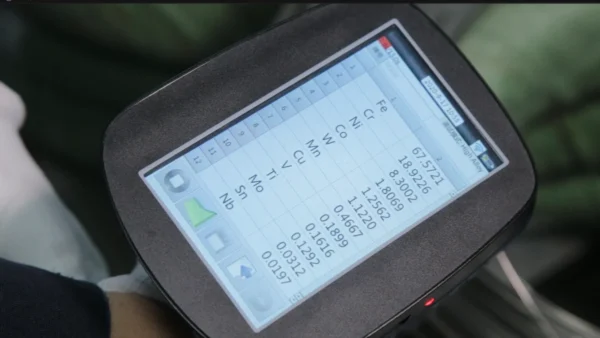
Handheld spectral screening of incoming SUS304 material. Cr, Ni and Mn are checked against the SUS304 range. Final grade confirmation, including carbon, relies on laboratory OES analysis.
A practical verification path looks like this:
- Define the grade in your RFQ. Write the grade and the standard you accept, for example SUS304 or AISI 304. If your application is magnetic-sensitive, say so at this stage.
- Ask how the supplier controls incoming material. At YIYI MESH BELT, incoming wire rod and bar are screened by spectral analysis, and we keep retained samples of wire and finished product.
- Ask for material documentation. Each order should come with material documentation and a traceable material record for the belt.
- Screen on arrival if you have a handheld analyser. Test a clean, flat spot on a cross rod and on the spiral wire. Look at Cr, Ni and Mn. SUS304 should show Cr in the 18–20% range and Ni of at least 8%, with Mn no higher than 2%.
- Use a laboratory test for disputes. Spark OES gives the full composition, including carbon. Send a sample that is large enough for the lab's method. Small wire pieces can give results the lab cannot classify.
For an RFQ checklist and what to ask a supplier before you order, see our guide on the conversion site: How to verify the stainless steel grade of a Spiral Freezer Belt before you order.
Does magnetism affect corrosion resistance or belt performance?
Once the grade is confirmed, the next worry is whether the magnetic areas will rust or fail early.
In typical spiral freezing, cooling and washdown service, the small amount of martensite in a cold-worked SUS304 Spiral Freezer Belt has little practical effect on corrosion resistance. Corrosion resistance mainly depends on the chromium content and a clean passive surface.
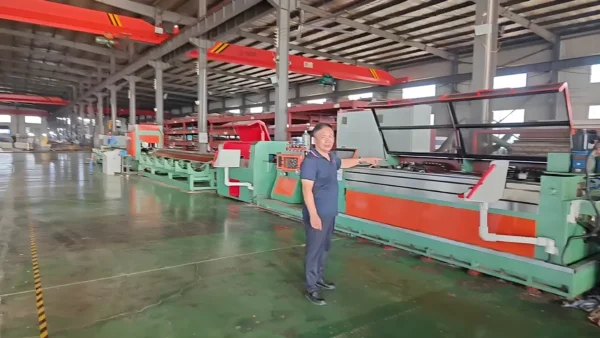
Round-bar drawing equipment at YIYI MESH BELT. Controlled drawing gives cross rods the strength they need.
Cold work also raises strength. That is the reason rods and wire are drawn in the first place. A Spiral Freezer Belt runs under tension around a drum, often for many hours a day, so rod and wire strength matter more than a magnet test.
There are limits. Very heavy cold work combined with an aggressive environment, such as strong chloride exposure or aggressive cleaning chemicals, can reduce pitting resistance. In those cases, the right step is to review the grade, for example SUS316, rather than to worry about the magnet.
| Question | Short answer |
|---|---|
| Does magnetism mean lower corrosion resistance? | Not in typical food-processing service; review the grade for chloride-rich environments |
| Does magnetism mean lower strength? | No. Cold work raises strength. |
| Can the magnetism be removed? | Solution annealing can reduce it. It adds cost and can change dimensions, so it is reviewed per project. |
| Should magnetism be an acceptance criterion? | Only if your application is genuinely magnetic-sensitive, and then it must be written into the RFQ |
When This Is Not the Right Choice
A standard cold-worked SUS304 Spiral Freezer Belt is not the right choice in every case:
- Magnetic-sensitive applications. If the belt runs near magnetic separation, a magnetic drive, or sensors affected by magnetic material, a standard cold-drawn belt may not meet your requirement. Tell us at RFQ stage so we can review the grade and any heat treatment.
- Chloride-rich or aggressive cleaning environments. Brine, salted products or strong sanitising chemicals may call for SUS316 instead of SUS304.
- When your acceptance test is a magnet. If your quality procedure rejects any magnetic response, a cold-formed stainless steel belt will fail it. Update the procedure to a composition check first.
From Our Engineering Experience
These are the points I explain most often when a customer calls about a magnetic belt.
The cross rods are more magnetic than the wire. In our Spiral Freezer Belts, the cross rods usually react more strongly than the spiral wire. The rods take heavy cold work when we draw them down to size, and that is where most of the magnetism comes from.
When a customer questions the material, we don't argue about the magnet. We understand the concern, because the customer has to answer to their own customer. So we send our spectral analysis results together with the results from the retained sample of that order, and let the customer judge for themselves.
We learned this the hard way. Years ago, we bought wire that was sold as 304. It looked fine at first. After longer service, spiral belts made from it started to rust, and the belt surface lost its flatness. A magnet would not have caught it. That is why we invested in our own wire-drawing and round-bar drawing equipment. We now buy wire rod in large batches from established stainless steel mills, check incoming material by spectral analysis, and draw wire and rods in-house. Clean chemistry and controlled drawing give us the tensile strength we need and flatter, more consistent belts.
— Sunny, Sales Director, YIYI MESH BELT
Evidence From Our Work
Case 1: A spiral cooling tower in Australia
| Step | Detail |
|---|---|
| Situation | An Australian distributor installed a 400 m SUS304 Spiral Freezer Belt in a bakery's spiral cooling tower. During start-up, a magnet held against the belt stuck to the rods. The sample sent before the order had not. The distributor asked whether a different grade had been used. |
| What we checked | We compared the SUS304 wire rod with the drawn 5 mm cross rods using the same magnet, and checked the rods with a handheld spectral analyser. |
| Why it matters | Drawing wire rod down to a 5 mm cross rod is heavy cold work. Cold work turns part of the austenite into martensite, and martensite responds to a magnet. A sample made with different deformation can behave differently. |
| What was verified | We checked the rods by spectral analysis and explained the source of the magnetism in a technical note. The customer accepted the explanation. |
| Buyer lesson | A magnet test cannot confirm or reject SUS304. If the grade matters for acceptance, specify a composition check in the RFQ. |
Case 2: Independent laboratory analysis in Brazil
| Step | Detail |
|---|---|
| Situation | A spiral freezer equipment manufacturer in Brazil wanted independent proof that a YIYI Spiral Freezer Belt was SUS304. |
| What we checked | The customer sent samples of the side link, spiral wire and cross rod to an independent laboratory for spark OES analysis (ASTM E1086 method). |
| Why it matters | Spark OES measures the full composition, including carbon, which a handheld analyser cannot measure reliably. |
| What was verified | For the side link and cross rod samples, the main elements (Cr, Ni, Mn, C) were within the ASTM A240 limits for type 304. The lab noted that the spiral wire sample, and one nitrogen reading, were affected by insufficient sample size. The customer confirmed the material was SUS304. |
| Buyer lesson | For a lab check, send samples large enough for the test method. Thin wire pieces may not give a classifiable result. |
FAQ
Is SUS304 stainless steel magnetic?
Annealed SUS304 is essentially non-magnetic. Cold-worked SUS304, such as drawn wire and rods in a Spiral Freezer Belt, can become partly magnetic because some austenite transforms into martensite. The grade does not change.
Why is my new SUS304 conveyor belt magnetic but the sample was not?
The sample and the production belt may have gone through different amounts of cold work, for example different rod diameters or drawing routes. More deformation creates more martensite and a stronger magnetic response.
Does a magnetic stainless steel belt mean it is 201 instead of 304?
No. Magnetism alone cannot identify the grade. A 200-series steel is identified by its composition, typically lower nickel and higher manganese. Use spectral analysis to check.
What is the best way to test a SUS304 Spiral Freezer Belt?
Use a handheld spectral analyser for screening and a laboratory spark OES test for final confirmation. Check chromium, nickel and manganese against the SUS304 range, and ask the supplier for material documentation.
Can a SUS304 belt be made non-magnetic?
Solution annealing can reduce the magnetism, but it adds cost and can affect dimensions. If your application needs low magnetism, state it in the RFQ so the grade and process can be reviewed for your project.
Which part of a Spiral Freezer Belt is most magnetic?
The cross rods usually respond most strongly, because they go through the heaviest cold work during rod drawing. Spiral wire, formed rod ends and weld zones follow.
Conclusion
Judge a SUS304 Spiral Freezer Belt by its composition, not by a magnet. Cold drawing and forming make parts of the belt magnetic, and weld zones add a little more. The real risk is a wrong grade that passes the magnet test. Before your next order, write the grade and the verification method into your RFQ.
Download the 304 Belt Material Verification Checklist
Get the one-page checklist we use with OEM customers: what to write in your RFQ, which documents to request, and how to screen a belt on arrival.
Prefer to talk to an engineer? Send your belt parameters and material requirements:
- RFQ form: www.yiyimeshbelts.com/contact.html
- Email: info@yiyimeshbelt.com
- Phone / WhatsApp: +86 134 5177 3742
Related pages: Spiral Freezer Belt · Industries we serve · Quality control · Manufacturing · How to test stainless steel: magnet or alloy gun?
External references: ASSDA Technical FAQ 3: Magnetic Effects of Stainless Steels · BSSA: Effect of cold work and heat treatment on the magnetic permeability of austenitic stainless steels · ASTM A240/A240M
Technical reviewer: Sunny, Sales Director, YIYI MESH BELT
Last updated: 2026-10-06
YIYI MESH BELT · Ningjin Yiyi Mesh Belt Co., Ltd. · www.yiyimeshbelt.com · www.yiyimeshbelts.com · info@yiyimeshbelt.com

