
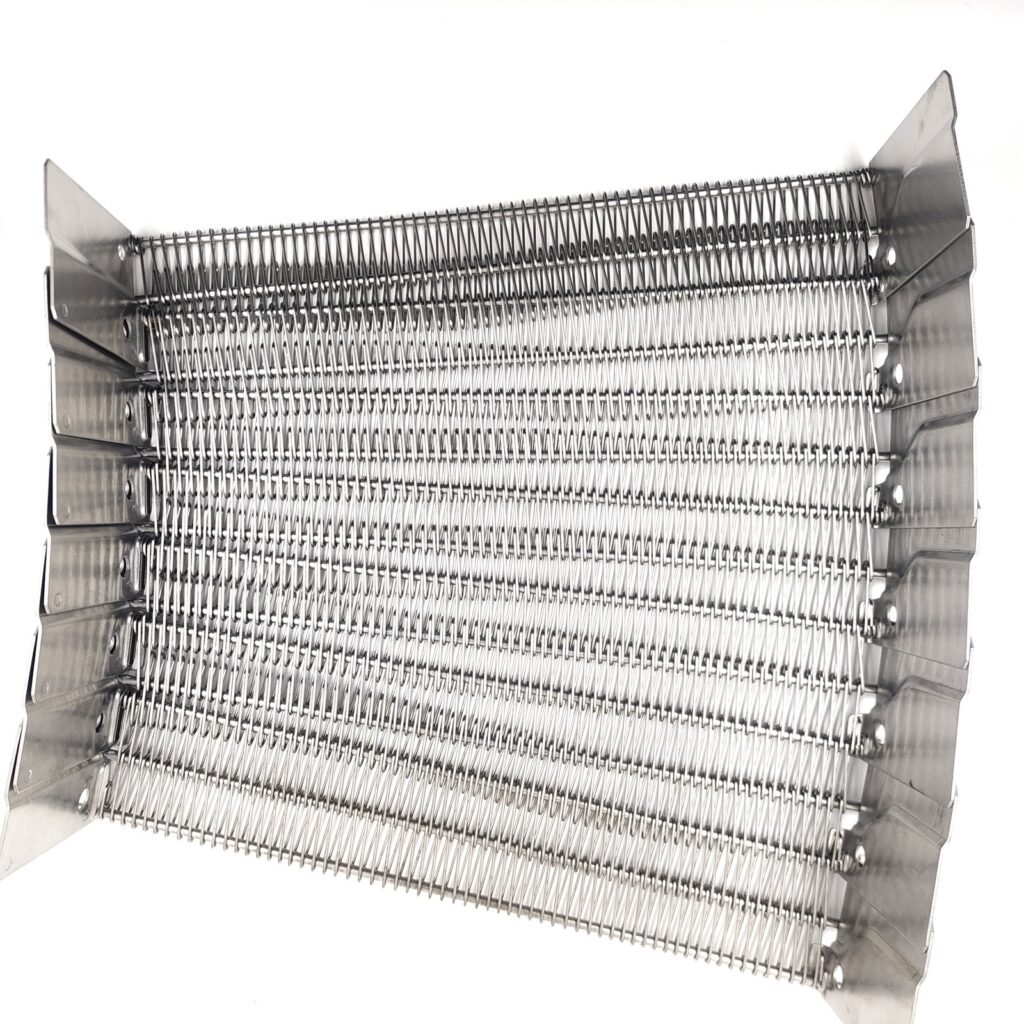
A self-stacking belt does two jobs at once. It carries the product, and its own side plates hold up the tier above.
A Self-Stacking Belt is a stainless steel spiral belt with stack plates on both edges. Each tier rests on the plates of the tier below, so the belt builds its own spiral stack without rails supporting every tier. It is used in self-stacking spiral freezers, coolers and proofers.
We are YIYI Mesh Belt (Ningjin Yiyi Mesh Belt Co., Ltd.), a manufacturer of engineered metal conveyor belts for equipment manufacturers, professional distributors and industrial end users, based in Ningjin, Shandong, China. Our manufacturing experience dates back to 1998; the current company was established in 2008. We make Self-Stacking Belts in SUS304 and SUS316. I am Sunny Ye. The older version of this article described a belt that stacks for storage. That was wrong, so here is what a Self-Stacking Belt really is.

At a Glance
| Product | Self-Stacking Belt in SUS304 or SUS316 |
|---|---|
| How it works | Stack plates on each edge carry the tier above, so the belt forms its own spiral stack |
| Used in | Self-stacking spiral freezers, coolers and proofers in food processing |
| Compared with | Spiral Freezer Belt on a drum-driven spiral with support rails |
| Key parameters | Guard height, rod pitch, spiral pitch, width, turn ratio, rod-end gap |
How Does a Self-Stacking Belt Build Its Own Spiral?
Each edge of the belt carries a row of stack plates, also called guards. As the belt climbs the spiral, the plates of one tier sit on the plates of the tier below. The stacked plates carry the weight of the tiers above, so the belt itself becomes the spiral structure that holds the product.

On a conventional spiral, a rotating drum turns the belt and rails support every tier. On a self-stacking spiral, the belt itself carries part of that load. The stack plates on each edge form a continuous wall, and the next tier rests on top of it.
| Part | Role |
|---|---|
| Mesh surface (spiral wire and rods) | Carries the product and lets air through |
| Stack plates (guards) | Carry the tier above and set the space between tiers |
| Rods | Tie the mesh and plates together across the width |
| Rod-end gap | A controlled clearance, with a reference of 1 to 2 mm |
Because the plates also close the sides of each tier, the stack forms a channel for air to flow through the product zone. The freezer builder designs that airflow; the belt has to hold its geometry so the channel stays even.
Sunny's view: The easiest way to picture it: each tier of the belt is a tray, and the stack plates are the walls that hold up the next tray.
How Is It Different From a Spiral Freezer Belt on a Drum?
A Spiral Freezer Belt runs on a drum-driven spiral, where the drum turns the belt and rails support each tier. A Self-Stacking Belt carries the tier above through its own stack plates. The two belts are not interchangeable. The freezer design decides which one you need, and the belt is chosen to match it.

| Spiral Freezer Belt | Self-Stacking Belt | |
|---|---|---|
| Tier support | Rails on the freezer frame | Stack plates on the belt |
| Drive | Drum, with the belt edge against the drum | Set by the self-stacking system design |
| Main geometry checks | Turn ratio, drum geometry, pitch, edge | Guard height, stack plate shape, rod gap, turn ratio |
| YIYI turn ratio reference | 1.10 to 2.5 (1.1 for small turning radius) | 1.6 / 1.7 |
| YIYI width reference | 300 to 2,900 mm or custom | 420 / 580 / 640 / 660 / 760 mm |
These are reference values. The approved drawing for your freezer controls the final design. You cannot put a Spiral Freezer Belt into a self-stacking freezer, or the reverse, without redesigning the machine.
For more on the drum-driven type, read how to choose a spiral freezer belt for IQF systems.
Sunny's view: When a buyer asks which is better, I ask which freezer they have. The machine has already answered the question.
When Is a Self-Stacking Spiral Worth Reviewing?
A self-stacking spiral is worth reviewing when the plant wants a compact spiral without rails supporting every tier, when the product suits a fixed space between tiers, and when the cleaning plan can reach plates and rods. The freezer builder makes that design choice; the belt supplier confirms the belt can hold the geometry.

We make belts, not freezers, so the system decision belongs to the freezer builder and the plant. From the belt side, these are the questions that shape the choice:
- Product height: the space between tiers is set by guard height. Products taller than that space do not fit.
- Product load: every tier adds weight to the plates below, so heavy products need the stack to be reviewed.
- Product size: spiral pitch sets how well small pieces are supported.
- Cleaning: stack plates, rods and joints all need to be reachable for washing.
- Replacement planning: the belt is a structural part, so spare sections and replacement data matter.
If a self-stacking freezer is already installed, the question is simpler: which belt matches its stack geometry. That is covered in how to select a self-stacking belt.
Sunny's view: Tell me the tallest and the heaviest product before anything else. Those two numbers decide guard height and how hard the stack is loaded.
Which Parameters Define a Self-Stacking Belt?
A Self-Stacking Belt is defined by material, spiral pitch, rod pitch, rod diameter, guard height, width, turn ratio, surface treatment and the rod-end gap. Our references cover SUS304 and SUS316, rod pitch 30 mm, rod diameter 5 mm and guard heights of 60 to 120 mm. The approved drawing controls the final belt.

| Parameter | YIYI reference |
|---|---|
| Material | SUS304 / SUS316 |
| Spiral pitch | 6 / 9 / 13 mm |
| Rod pitch | 30 mm |
| Rod diameter | 5 mm |
| Guard height | 60 / 80 / 90 / 100 / 120 mm |
| Width | 420 / 580 / 640 / 660 / 760 mm |
| Turn ratio | 1.6 / 1.7 |
| Surface | Pickling / electropolishing |
| Rod-end gap | 1–2 mm |
The values are not free combinations. Spiral pitch, guard height and width are confirmed together for each freezer. Pickling and electropolishing are carried out by specialist partners under our project specifications, where the project requires them.
Total width and carrying width are different numbers: the stack plates take up part of the total width. Confirm both before you compare quotes.
Guard height also sets the largest product the freezer can carry. Measure the tallest product, including any tray or packaging, and leave clearance for airflow above it.
Sunny's view: If two quotes show the same width but different guard heights, they are two different belts. Check the whole table.
How Do We Make Sure a Self-Stacking Belt Holds Its Geometry?
Geometry is controlled from material to final inspection. We draw our own stainless steel wire and round bar, form and weld the belt in our own workshop, check the spiral wire and a trial section, and inspect every belt before packing. Drum or geometry verification is carried out where the project requires it.

Core manufacturing and quality control are managed in our own factory, while selected specialist processes such as pickling and electropolishing are carried out by partners under our project specifications.
- Incoming material is checked against Material Documentation, with spectral and hardness testing.
- Wire and round bar are drawn in-house and checked for diameter.
- Spiral wire is formed and inspected in a trial run.
- A trial section and a complete first article are checked against the approved drawing.
- Every belt receives a 100% final inspection before packing: pitch, flatness, welding, width, length, structural dimensions and appearance.
A 100% final inspection is a check on every belt. It is not a promise that a belt can never fail, because running conditions, loading and maintenance also decide how a belt performs.
Sunny's view: Ask to see a photo of the trial section before mass production. It is the moment to catch a mistake cheaply.
When This Is Not the Right Approach
A Self-Stacking Belt is not a general conveyor belt. The older version of this article suggested it for warehouses, retail and logistics. That was wrong: it is a spiral belt for self-stacking freezers, coolers and proofers. For straight conveyors, flat belts such as a Flat Wire / Honeycomb Belt or a Balanced Weave Belt are the usual starting points.
It is also not interchangeable with a drum-driven Spiral Freezer Belt. If your freezer has a drum and support rails, read how to choose a spiral freezer belt instead.
From Our Engineering Experience
Most Self-Stacking Belt inquiries we receive are replacements for freezers that are already running. In those projects the first step is always the same: a section of the old belt, measured for width over the plates, plate height, plate strength and material, then a drawing for approval.
The question I hear most is whether the new belt will stack like the old one. My answer is that the stack is decided by measured geometry, confirmed on a drawing and checked on a trial section, not by matching the width on a purchase order.
FAQ
What is a self-stacking belt?
A stainless steel spiral belt with stack plates on both edges. Each tier rests on the plates below, so the belt builds its own spiral stack.
Where are self-stacking belts used?
In self-stacking spiral freezers, coolers and proofers, mainly in food processing.
Can a self-stacking belt replace a spiral freezer belt?
No. The two belts suit different freezer designs and are not interchangeable without changing the machine.
What guard heights are available?
Our references are 60, 80, 90, 100 and 120 mm. The value for your freezer is confirmed on the approved drawing.
Which materials do you use?
SUS304 or SUS316, with pickling or electropolishing where the project requires them.
Conclusion
A Self-Stacking Belt carries the product and the stack. Choose it by freezer design and stack geometry, confirmed on a drawing and a trial section.
Working on a self-stacking spiral?
Send the freezer data or a section of the old belt, with width, guard height and turning direction. We confirm the stack geometry on a drawing with you.
See Self-Stacking Belt specifications →WhatsApp Sunny📄 Self-Stacking Belt Technical Specification (PDF) · Email: info@yiyimeshbelt.com
Related reading: How to select a self-stacking belt · Self-stacker replacement: OEM or direct? · How a self-stacker belt works (yiyimeshbelts.com) · Spiral freezer belt vs self-stacking belt (yiyimeshbelts.com)

Sunny Ye
Global Sales Director, YIYI Mesh Belt · 15 years in metal conveyor belt projects
I work with spiral freezer builders, distributors and plant teams on belt selection and replacement. Questions about this article? Send them to me directly.
Follow Sunny on LinkedIn · Last updated: 2026-10-15

