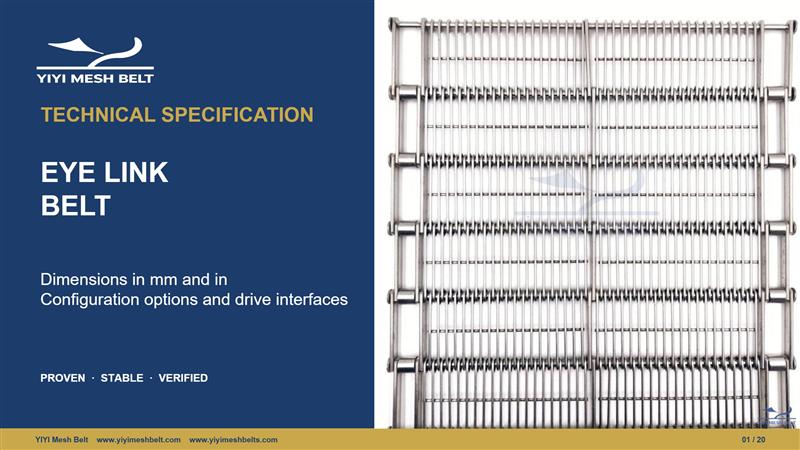
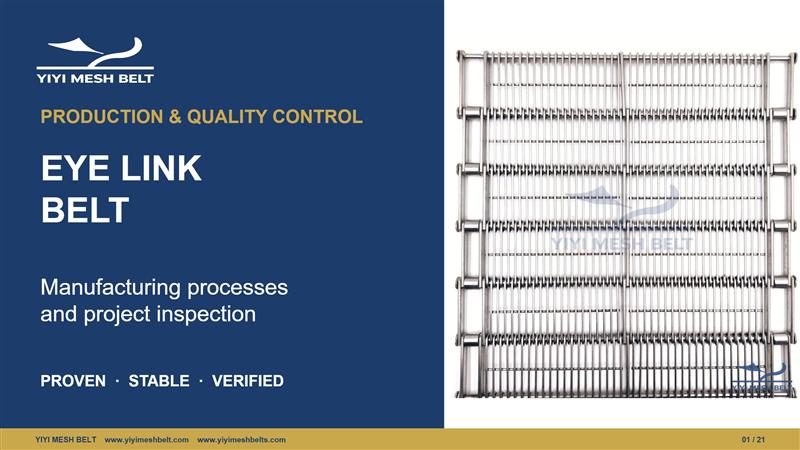
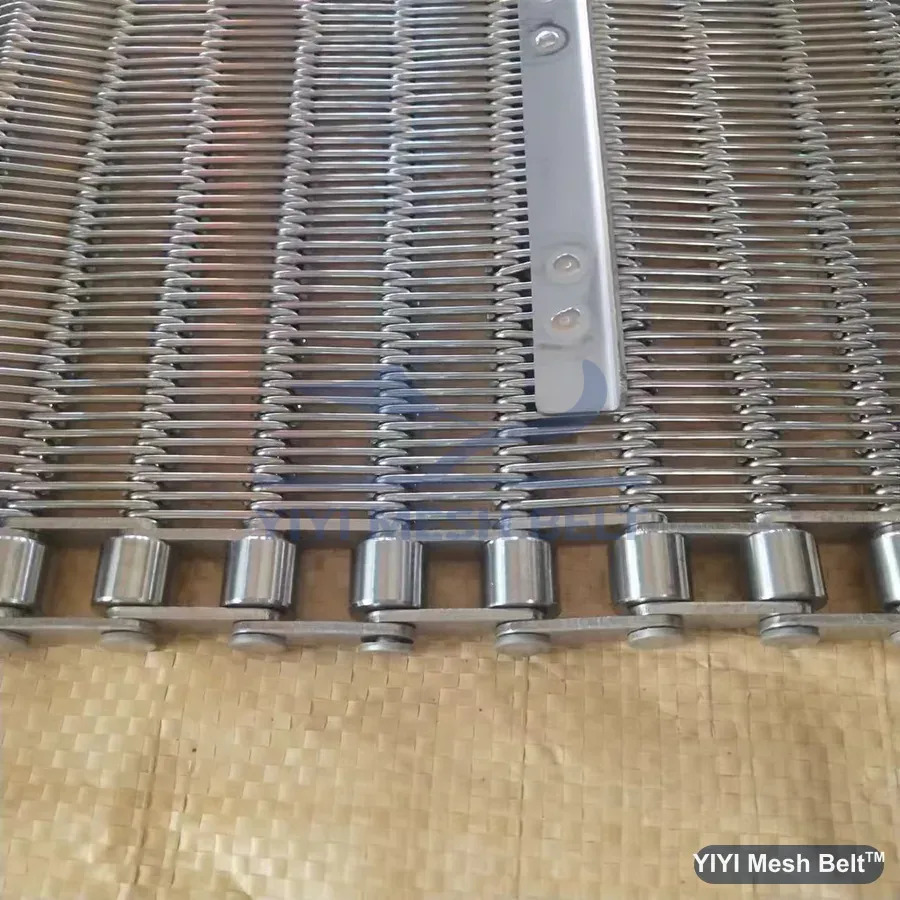
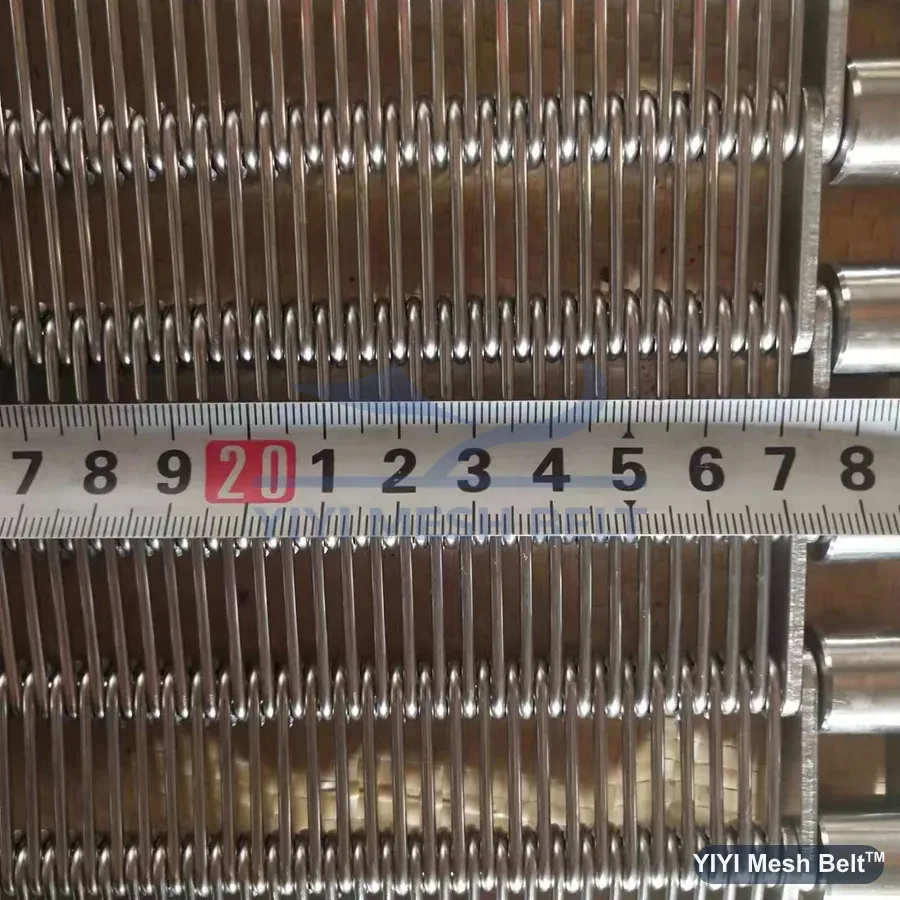
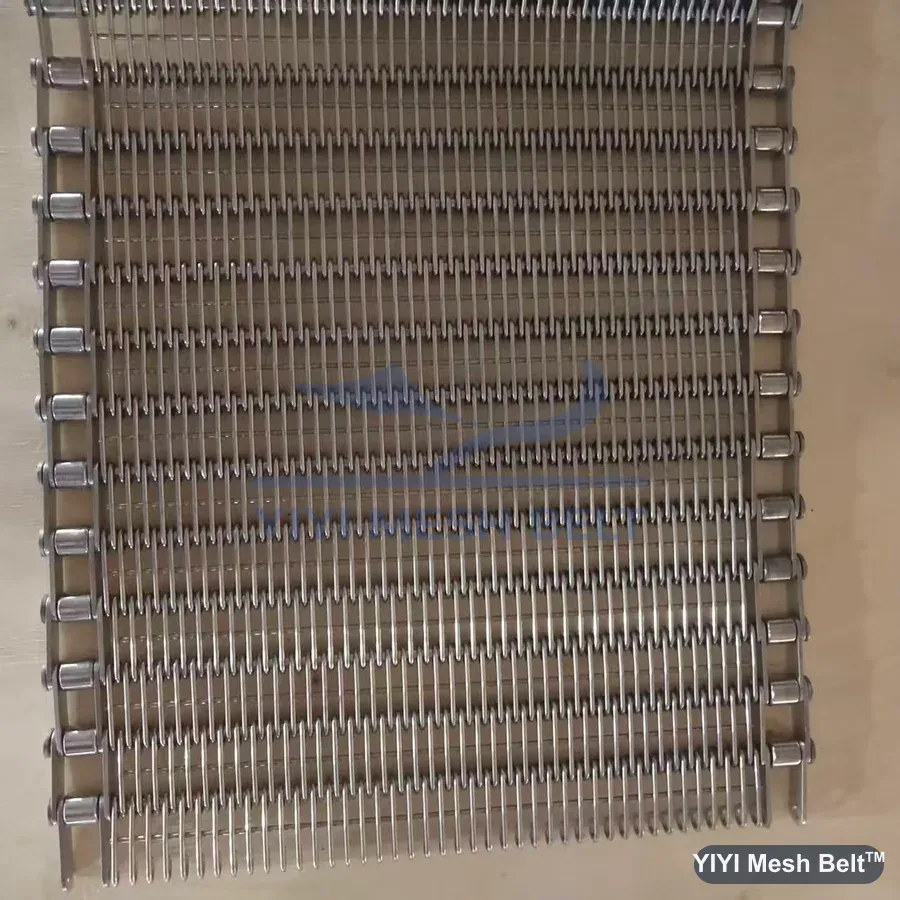
An eye link belt, also called an eyelink or wire loop belt, is an open metal conveyor belt made of eye-shaped wire links joined by cross rods. Its open structure drains water and lets air pass. Because link wire, reinforcement and edge decide how the belt carries load, we build each one to your drawing — with flights, plates or grooves where your line needs them.
Eye Link Belt documents
Documents from our Document Library: the dimensions and options to compare with your current belt, and how the belt is made and inspected at our factory in Ningjin, Shandong.

Link wire, reinforcement and edge decide how the belt carries load, so we build each one to your approved drawing.
Watch how a eye link belt is made and inspected at our Ningjin factory.
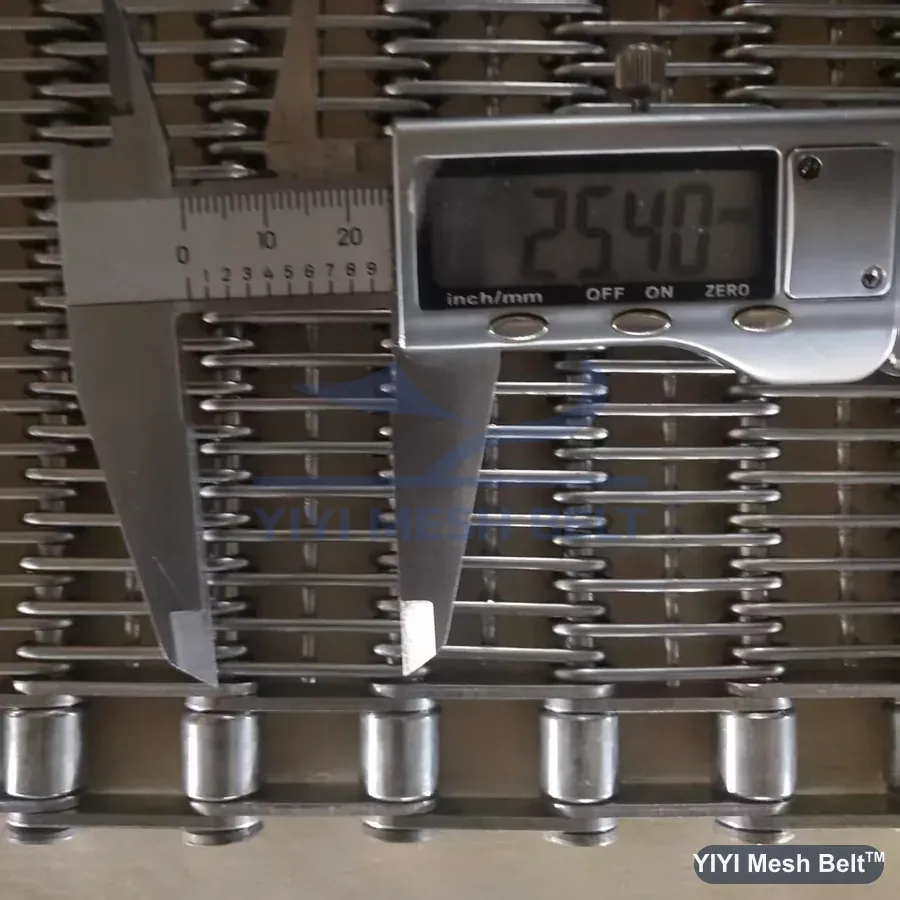
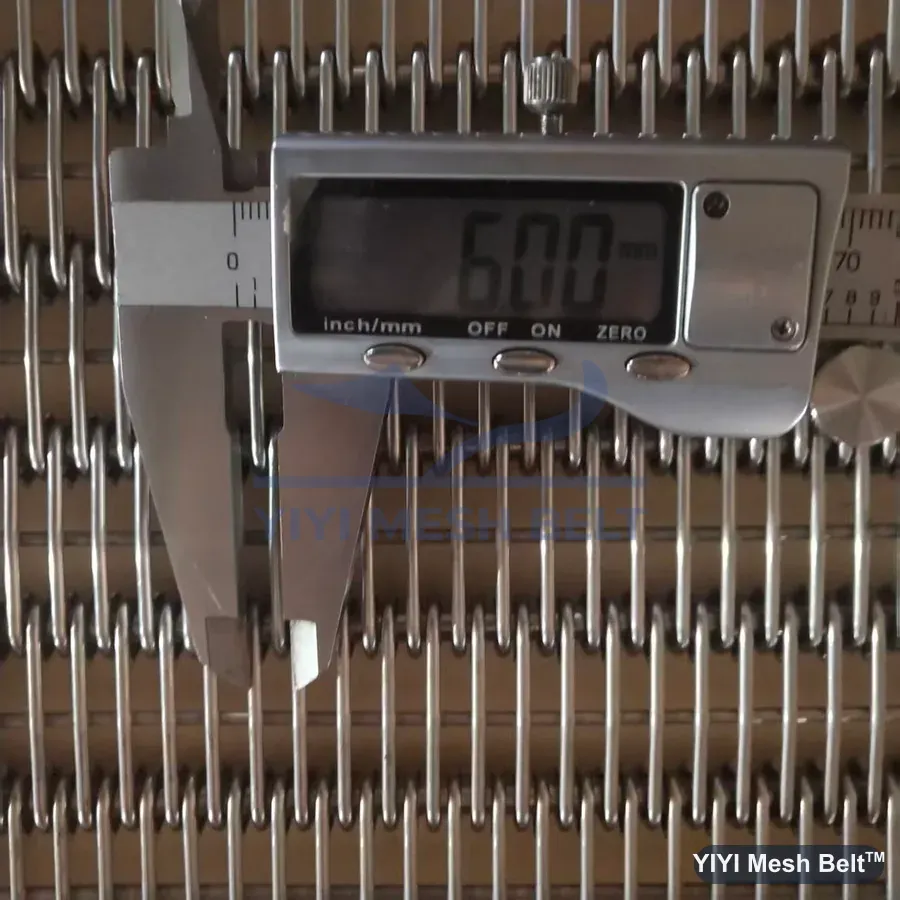
Eye-link pitch is the centre-to-centre distance between two adjacent eye links, measured along the cross rod, across the belt width. Buyers also call it lateral pitch or link spacing. Rod pitch is a different number, so we confirm both on your drawing.
| Material | Mild steel, SUS304 or SUS316, chosen for your process conditions |
| Surface | Open structure of eye-shaped wire links on cross rods |
| Open area | The open structure lets water drain and air pass; eye-link pitch and rod pitch set the opening on the approved drawing |
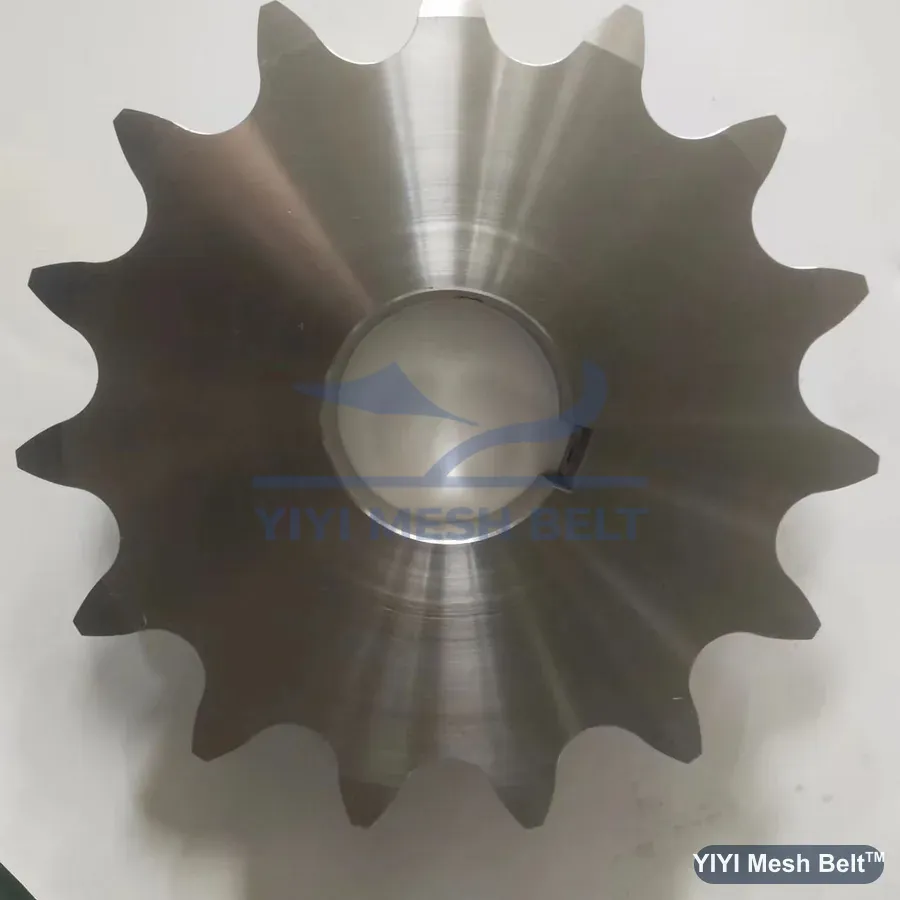
| Drive | Roller chain edge or reinforced plate edge; sprockets per project |
| Edge options | Roller chain or reinforced plate |
| Specifications | Eye-link pitch 3.6 / 5 / 6 / 8 / 10.5 / 12 mm; rod pitch 25.4 / 50 / 50.8 / 76.2 mm; link wire 1.6–2.5 mm; cross rod 5 / 6 / 8 mm; width 300–3000 mm |
| Applications | Food: meat and seafood, blanching lines. Industrial: washing and drying, heavy-duty lines |
Reference ranges in mm and inch, not free combinations. The approved drawing sets the final values.
| Parameter | Metric (mm) | Inch (in) |
|---|---|---|
| Material | Mild steel / SUS304 / SUS316 | — |
| Rod pitch | 25.4 / 50 / 50.8 / 76.2 mm / custom | 1.000 / 1.969 / 2.000 / 3.000 in |
| Eye-link pitch | 3.6 / 5 / 6 / 8 / 10.5 / 12 mm | 0.142 / 0.197 / 0.236 / 0.315 / 0.413 / 0.472 in |
| Eye / link wire | 1.6 / 2 / 2.5 mm | 0.063 / 0.079 / 0.098 in |
| Reinforcement wire | 2 / 2.5 mm, single or double | 0.079 / 0.098 in |
| Cross rod | 5 / 6 / 8 mm / custom | 0.197 / 0.236 / 0.315 in |
| Belt width | 300–3000 mm / custom | 11.81–118.11 in |
| Edge | Roller chain / Reinforced plate | — |
| Surface | Pickling, per project | — |

Every option is confirmed on the approved drawing before production.


Food: meat and seafood, blanching lines. Industrial: washing and drying, heavy-duty lines. Suitability depends on belt specification, temperature and equipment design. We confirm it during specification review. See all 15 applications →
Real photos from our Ningjin factory. Every formal belt passes final inspection against your drawing before packing.


Real orders, with customer details withheld.
Equipment project. Belts and sprockets for a new frying line, built from the customer’s drawings: four widths with reinforcing bars across the belt, a roller chain edge and five sprocket sets machined to the same drawings.
| Material | SUS304 |
| Widths | 325 / 1,482 / 2,052 / 2,582 mm |
| Eye-link / rod pitch | 6.5 / 50 mm |
| Cross rod / eye-link wire | 5 / 2.5 mm |
| Reinforcing bars | 2.5 × 12 mm |
| Chain edge | 50 mm pitch, washer welded |


Equipment maker, Europe. This customer builds tunnel freezers and has ordered belts and sprockets from us for 13 years. Each repeat order is built to the approved drawings of the previous one.
| Material | SUS304, pickled, cleaned and dried |
| Widths | 300 / 543 / 1,100 / 1,500 mm |
| Belt pitch | 25.4 mm and 50 mm |
| Eye-link pitch / wire / cross rod | 6 / 2 / 5 mm |
| Chain edge | Roller chain, roller Ø 12 mm, washer welded |
| Reinforcing plates | 2–3 × 10.5 mm |


The questions we hear most, answered from how we actually build and check this belt.
Yes. Eye links are formed on our own machines in Ningjin, Shandong, wire and round bar are drawn in-house, and first pieces are checked before the batch runs.
Eye-link pitch and rod pitch are two different numbers, and we confirm both. For a replacement, pitch is measured over several pitches from your old-belt sample before quoting, not read from one link or a worn section.
Cross rod diameter and reinforcement wire are set for the load on the approved drawing, and reinforcing plates or bars are added where your project needs them.
Chain pitch, roller diameter and inner plate width are checked on the drawing. When belt and sprockets are supplied together, they are made to the same drawing and run together. Sprockets are made by specialist partners to our specification, and we check the finished parts.
Chain, rollers and edge joints are checked before the belt is closed. Rollers are checked by eye and touch, and rough rollers are replaced before assembly.
After pickling we wipe the belt with a white glove along its length, to catch black powder or oil before shipment.
We draw wire and round bar in-house, and each incoming batch is checked for composition and hardness. Buyers often ask for a mill test report (MTR) or mill test certificate (MTC). Tell us which documents your order needs and we confirm them in the quotation.
Clean and dry, in waterproof film and plywood or fumigated wooden cases, with an English shipping list, for sea, air or rail.
It does not go to packing. It is recorded, reworked or remade, and inspected again. A 100% final inspection is not a zero-defect or lifetime guarantee, but you see measured photos and the inspection report of your own belt before shipment.
Lead time is confirmed per order in the quotation. Progress updates are agreed for each order, covering material and tooling status.
An open conveyor belt built from eye-shaped wire links connected by cross rods, with optional reinforcement wire and chain or plate edges.
Widths from 300 to 3000 mm, with rod pitches of 25.4, 50, 50.8 or 76.2 mm, or to your drawing.
Yes. Single or double reinforcement wire of 2 or 2.5 mm, chosen for your load and confirmed on drawing.
Roller chain edges or reinforced plate edges.
Yes. Flights, reinforced plates and grooves are added to the drawing and built in.
Yes. Third-party inspection is supported on request, and customer factory visits are welcome.
Buyers often ask for a mill test report (MTR) or mill test certificate (MTC). Each incoming batch of wire and rod is checked against steel-mill material documentation, with spectral and hardness testing. Tell us which documents your order needs and we confirm them in the quotation. Read more about material documentation.
Send your drawing, a photo or a worn sample. An engineer reviews it before we quote.
We reply as soon as we see your message, within 8 working hours.
We reply as soon as we see your message, within 8 working hours · No obligation · Your details are used only to reply to you.