
A grade on a quotation is a claim. Documentation is how the claim is linked to the steel in your belt.
A metal conveyor belt should be backed by Material Documentation from the steel mill for the batches used, the supplier's own material verification, including spectral and hardness testing, and records that trace the belt from raw material to finished product. Agree at the inquiry stage which documents your order needs.
We are YIYI Mesh Belt, a metal conveyor belt manufacturer in Ningjin, Dezhou City, Shandong Province, China. Our manufacturing experience dates back to 1998, and we work on a 27,000 m² site with about 280 units of production and supporting equipment, including 9 welding robots. I am Sunny Ye. Buyers ask for "a material certificate" in many different ways. This article explains what we provide, what stands behind it, and how to ask for what your customer needs.

At a Glance
| What we call it | Material Documentation |
|---|---|
| For each incoming batch | Steel mill Material Documentation, material confirmation, spectral testing, hardness testing |
| Traceability | raw material → material verification → drawing and processing → wire and bar dimension checks → product manufacturing → inspection records → finished product |
| Boundary | Test capability does not mean every order receives every test or every document |
| Ask in advance | Any specific document, format or third-party test your customer requires |
What Is Material Documentation?
Material Documentation is the record from the steel mill describing the batch of stainless steel, typically its grade and chemical composition. On its own it describes the steel as supplied. A belt maker adds its own verification and records so the documentation can be linked to the material actually used in your belt.

Buyers use many names for these papers. We use the general term Material Documentation, because the exact document type depends on the mill and the material. If your customer needs a specific document type, tell us so we can confirm what is available for your order.
| Layer | What it shows |
|---|---|
| Steel mill Material Documentation | Grade and composition of the batch as supplied |
| Supplier material verification | That the batch received matches the documents |
| Traceability records | That this batch went into this belt |
Sunny's view: A document is useful as far as it links to your belt. Ask how the supplier connects the two.
How Is Incoming Material Verified?
Each incoming batch is checked against the steel mill Material Documentation, the material is confirmed, and spectral and hardness testing are carried out before production. Spectral testing confirms chromium, nickel and, for SUS316, molybdenum. Hardness testing confirms the material suits drawing and forming. Results are kept with the batch record.

- Batch received with steel mill Material Documentation
- Material confirmation against the documents
- Spectral testing of composition
- Hardness testing
- Batch released to drawing or production, with its record
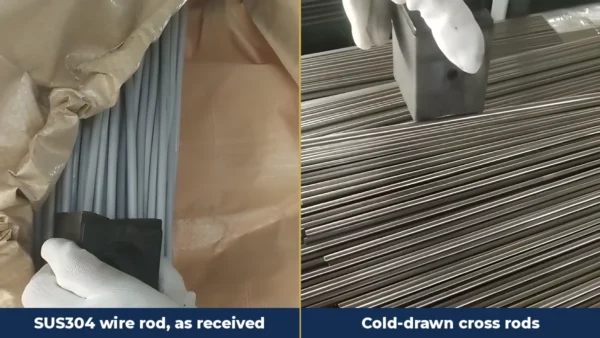
We also draw our own stainless steel wire and round bar, so wire and rod diameters are checked after drawing. Not every size for every order is drawn in-house; purchased wire or rod goes through the same incoming checks.
Read magnet test or spectral analysis and SUS304 or SUS316.
Sunny's view: Ask your supplier: who checks the steel, with what, and when? A clear answer is worth more than a stamp.
How Is Material Traced to Your Belt?
Traceability links each step: raw material, material verification, drawing and processing, wire and bar dimension checks, product manufacturing, inspection records and the finished product. Records may include material, processing, production and inspection records and order identification, so a question about your belt can be answered from the records.

Our traceability chain: raw material → material verification → drawing and processing → wire and bar dimension checks → product manufacturing → inspection records → finished product.
- Material records: mill documentation and verification results
- Processing records: wire drawing and dimension checks
- Production records: belt manufacturing for the order
- Inspection records: first article and 100% final inspection
- Order identification: linking the belt to your order
This is what lets us review a material question after delivery, rather than rely on memory.
Sunny's view: Keep your order number with the belt. It is the key that opens every record on our side.
What Does Documentation Not Include by Default?
Test capability does not mean every order receives every available test, or that every shipment includes all test documents or a third-party report. What is provided for an order is agreed at the inquiry stage. If your customer requires an independent laboratory test or a specific format, it is confirmed for that order in advance.

| Available | Agreed per order |
|---|---|
| Mill Material Documentation for batches used | Which documents are sent and in what form |
| Spectral and hardness testing on incoming batches | Whether results are shared for the order |
| Tensile testing capability | Whether a test is carried out for the order |
| Inspection records | Which photos and measurements are shared |
We do not issue documents that claim food-contact or other certifications we have not obtained. Our quality management system is certified to GB/T 19001-2016 / ISO 9001:2015, which certifies how we manage quality, not a product.
Sunny's view: Tell me what the auditor at your customer will ask for. It is easier to plan the documents than to produce them after shipment.
How Should You Check the Documentation You Receive?
Check that the grade on the documentation matches the order, that the composition fits the grade, for example molybdenum present for SUS316, that the documents can be linked to your order, and that anything your customer asked for is included. If something does not match, ask before installation, while the records are easy to review.
- Grade on the documents matches the order
- Composition fits the grade: chromium, nickel, molybdenum for SUS316
- Order identification links the documents to your belt
- Any agreed extra documents or photos are included
If the grade on the documents and the order differ, stop and ask before installation. Most differences are paperwork errors that are quickly corrected, but they must be cleared while the belt is still in its crate.
If you want an independent check, an external laboratory can test a sample of the belt. A magnet cannot tell SUS304 from SUS316; read why a SUS304 belt can be magnetic.
Sunny's view: If your customer is strict about material, plan an independent test of a spare section. It answers the question once and for all.
What Do Distributors and OEMs Need From Documentation?
Distributors and equipment builders usually need documentation they can pass on: the grade confirmed for the order, records that link it to the belt, and inspection evidence they can show their own customers without exposing confidential details. Agree the format once and reuse it for repeat orders, so every shipment looks the same.
- Grade confirmation: for each order, in a format your customers recognise.
- Order link: order identification on the documents.
- Inspection evidence: photos or measurements from the final inspection.
- Neutral presentation: no end-user information where you need to keep it confidential.
- Consistency: the same set for repeat orders.
Some distributors also keep a copy of the documentation for each plant they supply. When that plant reorders or has a question, the records for its belt are ready, and the answer does not depend on finding an old email.
For OEM supply programs, the approved drawing, first article records and material documentation together form the reference for future orders. Read how trial production and first article approval reduce risk.
If your customers ask about food-contact approvals, tell them what the documents show: grade and composition. We do not claim food-contact certification for our belts.
Sunny's view: Set up a documentation template with us once. Every repeat order then arrives with the same papers in the same place.
What Should You Ask For at the Inquiry Stage?
State the grade, the documents you need, the format or language your customer expects, whether spectral results or photos should be shared, and whether an independent laboratory test is required. With that agreed in advance, the documentation can be prepared with the order rather than requested after shipment.
Put this in the inquiry
- Grade: SUS304 or SUS316
- Documents needed: Material Documentation, inspection photos, others
- Format and language your customer expects
- Whether test results should be shared
- Whether an independent laboratory test is required
For grade choice, read SUS304 or SUS316 for a conveyor belt; for how we make belts, how we manufacture stainless steel conveyor belts.
Sunny's view: One line in the inquiry, "documents required:", saves a lot of back and forth later.
When This Is Not the Right Approach
Documentation cannot fix a wrong specification. A belt with perfect material records can still be the wrong design for the machine. Material comes after structure in a belt review.
And it does not replace correct cleaning: the right grade can still stain if residue and chemicals are left on it.
From Our Engineering Experience
When buyers ask for a "certificate", we ask what their customer will check. Most need to know the grade is right and that the documents link to the belt; a few need an independent test. Agreeing that early keeps the order simple.
Our founder Aries Zhang says finding a good supplier is harder than finding a good customer. Material control is how we try to be that supplier.
FAQ
What material documentation comes with a YIYI belt?
Material Documentation for the steel batches used, backed by our incoming verification, spectral and hardness testing, and traceability records.
Is it the same as the certificate my customer asked for?
We use the general term Material Documentation; the exact document type depends on the mill. Tell us if your customer needs a specific type.
Does every order include test reports?
Not by default. What is shared for an order is agreed at the inquiry stage.
Can I get an independent laboratory test?
Yes, if agreed in advance; it is confirmed for that order.
How do I check the grade myself?
Use spectral analysis; a magnet cannot distinguish SUS304 from SUS316.
Conclusion
Ask for Material Documentation linked to your order, backed by incoming testing and traceability, and agree any extra documents before production.
Need specific documents?
Tell us the grade, the documents and format your customer expects, and whether an independent test is needed. We confirm what your order includes.
See our raw material control →WhatsApp Sunny📄 Spiral Freezer Belt Production & Quality Control (PDF) · Email: info@yiyimeshbelt.com
Related reading: Magnet test or spectral analysis · SUS304 or SUS316 · How we manufacture conveyor belts · 304, 316 and 310S in an RFQ (yiyimeshbelts.com)

Sunny Ye
Global Sales Director, YIYI Mesh Belt · 15 years in metal conveyor belt projects
I work with spiral freezer builders, distributors and plant teams on belt selection and replacement. Questions about this article? Send them to me directly.
Follow Sunny on LinkedIn · Last updated: 2026-10-15

