
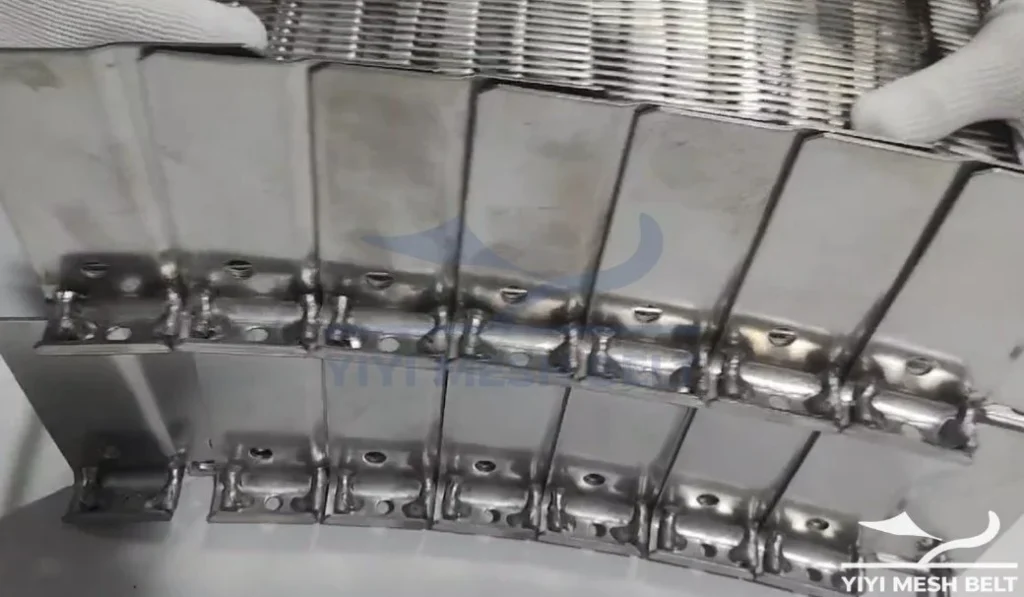
A self-stacking belt has no rails holding each tier in place. Each tier rests on the stack plates of the tier below. If the tiers do not engage, a problem found at installation costs far more than one found in the factory. So we run a self-stacking belt stacking test before the belt leaves us.
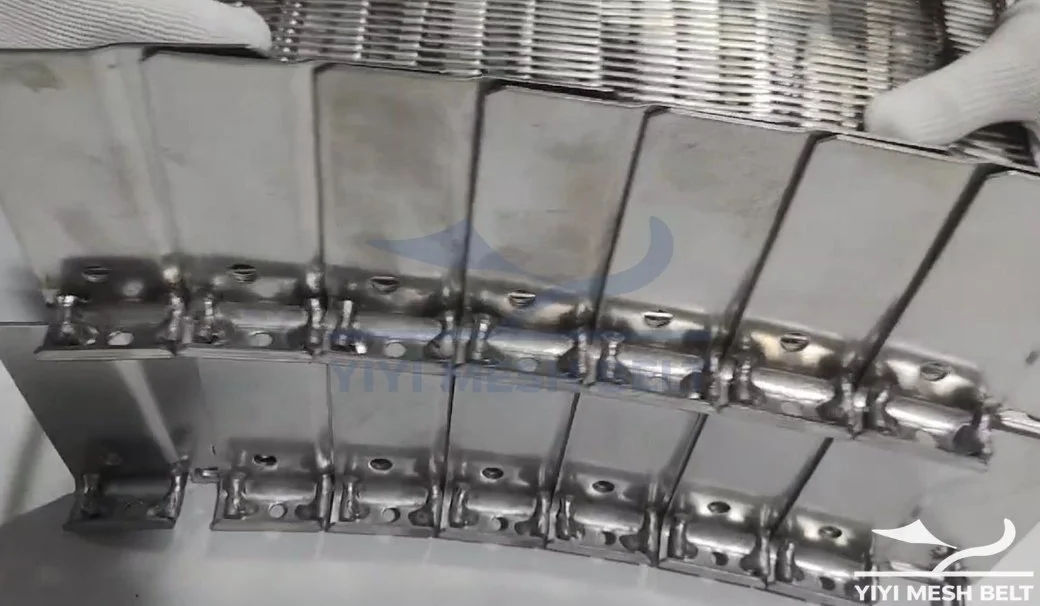
We test self-stacking belt stacking by hand in our factory. Once about 3.3 m of belt is made, workers stack it in a circle about 10 times and check how the upper and lower tiers engage. If they do not, we adjust the tooling, then check the finished belt again before shipment.
I am Sunny Ye, Global Sales Director at YIYI Mesh Belt (Ningjin Yiyi Mesh Belt Co., Ltd.). Below I explain what we do in our factory in Ningjin, what we look for, what happens when tiers do not engage, and what you can ask to see.
Contents
- What happens in a self-stacking belt stacking test?
- What do we check before the tiers are stacked?
- What do we look for when the tiers are stacked?
- What happens if the tiers do not engage?
- What is checked again before shipment?
- What can this test not tell you?
- What can you ask to see?
- Where have we used this test?
- What do buyers ask about this test?
- What should you take from this?
- What have I learned from this test?
What happens in a self-stacking belt stacking test?
It is mainly a hand test in our factory. Once about 3.3 m (10.8 ft) of belt is made, workers stack it by hand into a circle, so one tier sits on the tier below. They do this about 10 times and look at how well the upper and lower tiers engage.
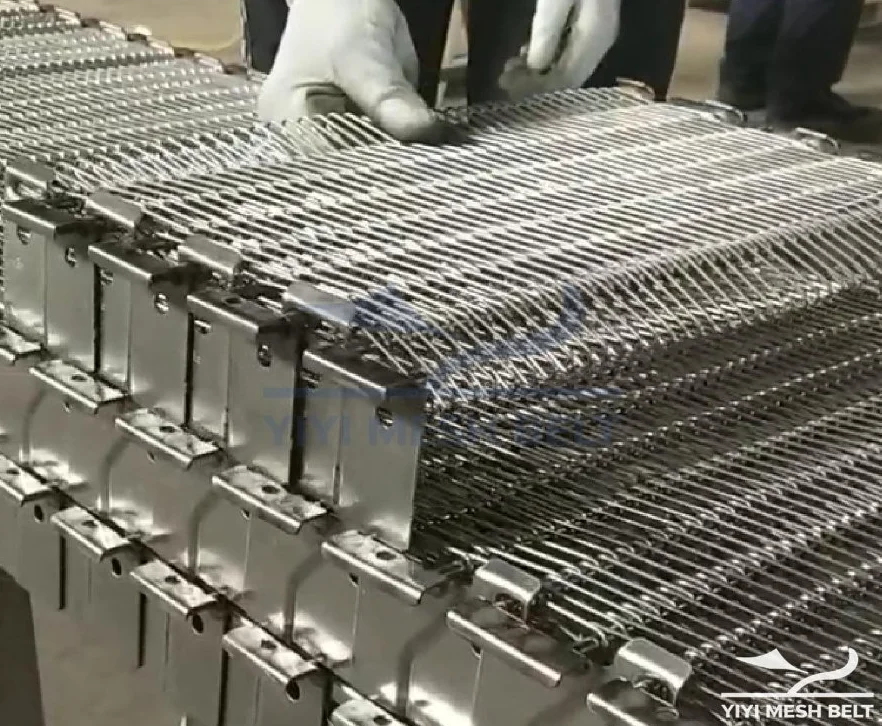
The purpose is simple. Measuring tells us each part matches the drawing. Stacking shows us how the tiers meet.
| Item | Details |
|---|---|
| Product | Self-Stacking Belt, stainless steel SUS304 / SUS316 |
| Where | In our factory in Ningjin |
| Method | Mainly by hand; tiers stacked in a circle |
| When | Once about 3.3 m (10.8 ft) of belt is made |
| How often | About 10 times |
| What we judge | How well the upper and lower tiers engage |
| If tiers do not engage | The tooling is adjusted |
| Before shipment | Stacking checked on the finished belt; every self-stacking belt order checked at the turning diameter |
What do we check before the tiers are stacked?
Before stacking, we check the parts. Wire and rod diameters are measured against the approved specification. Formed spirals are checked against the approved geometry. The stack plate angle is checked with an angle gauge. Customized orders then go through trial production and first-article inspection.
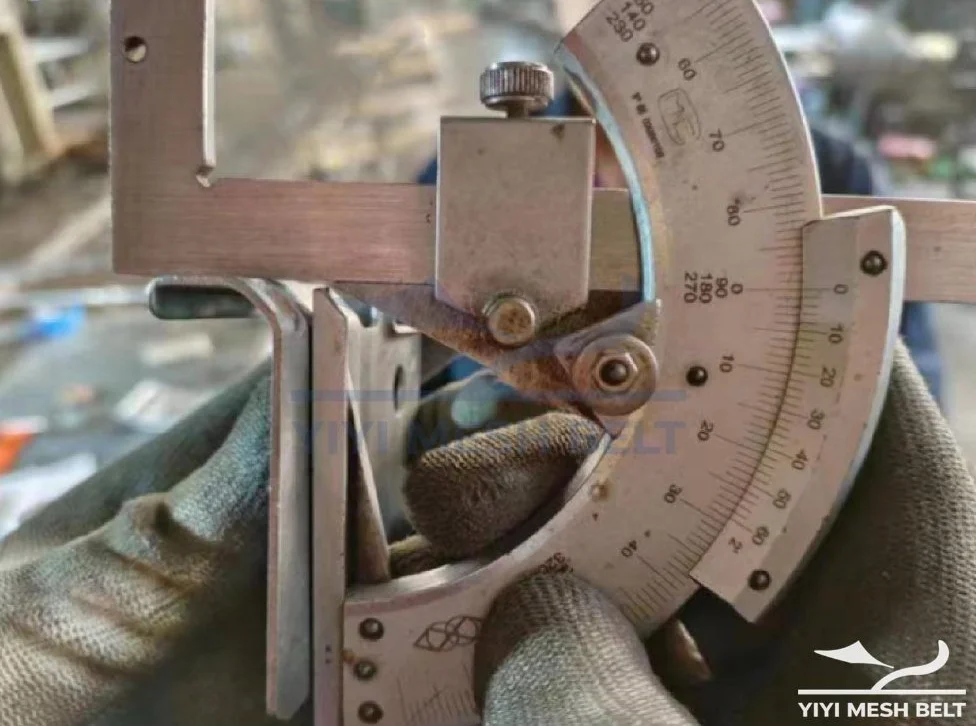
I wrote more about this step in how we check the stack plate angle. To see what we measure on the first section, read how we inspect a self-stacking belt trial section. For the material itself, read how we check wire and rod.
| Stage | Check | How |
|---|---|---|
| Material | Wire and rod diameters against the approved specification | Measured |
| Spiral forming | Trial pieces against the approved geometry | Measured |
| Stack plates | Stack plate angle against the approved geometry | Angle gauge |
| Trial section | All specifications against the drawing | Measured, then photos sent to you |
| Stacking test | Engagement of the upper and lower tiers | By hand, in a circle |
What do we look for when the tiers are stacked?
We look at how the upper and lower tiers engage at the stack plate height. We also watch the edge. Weld slag on the back of the edge is especially important, because it affects how the belt stacks. So it is inspected and ground by hand during welding.
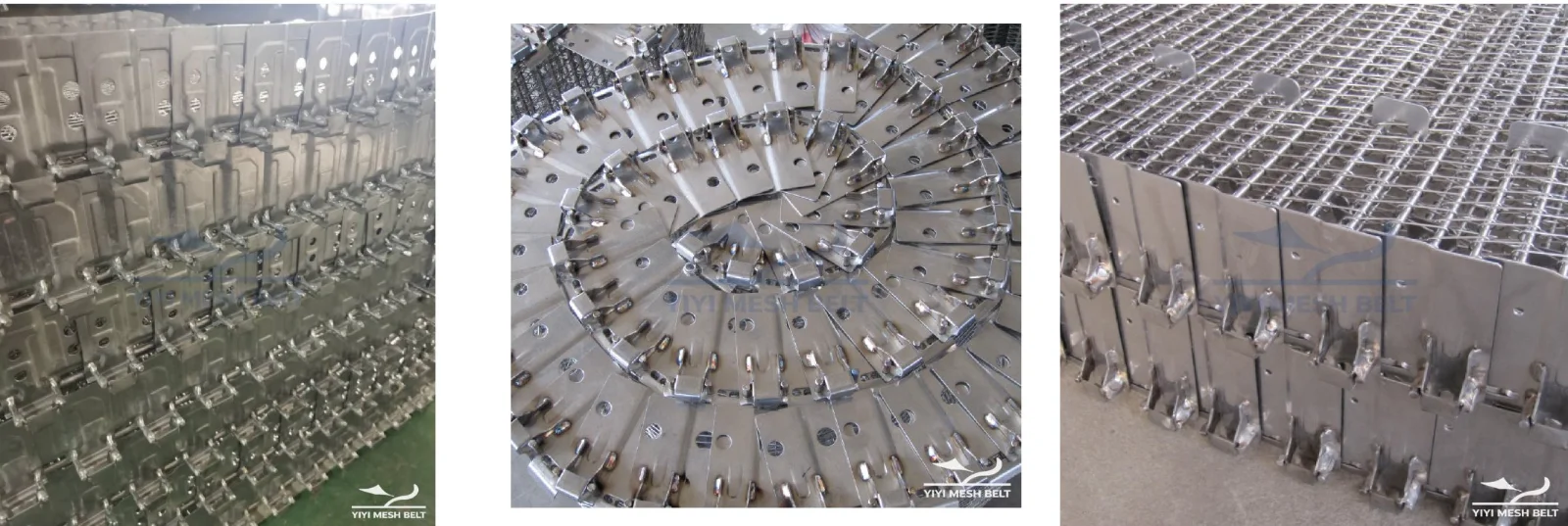
We also have an SOP for checking weld slag, and every finished belt goes through 100% final inspection before packing. Weld cracks are a separate problem: read why weld cracks appear on self-stacking belt links.
| Point | What we check |
|---|---|
| Engagement | The upper and lower tiers catch at the stack plate height |
| Weld slag | The back of the edge is checked, because slag there affects stacking |
| Weld points | Each weld pressed by hand; position centred, no loose points |
| Rods | Every rod straight, so the stack plates stay vertical |
| Stack plates | Vertical and in line along the belt |
What happens if the tiers do not engage?
With the fixtures set, most sections engage. When one does not, we adjust the tooling, so the upper and lower tiers catch at the stack plate height. We find this in the factory, and we do not promise that every section passes first time.
On a heavy-duty belt for an equipment manufacturer in South Korea, for example, we adjusted the link tooling on the trial order. You can read that project below.
What is checked again before shipment?
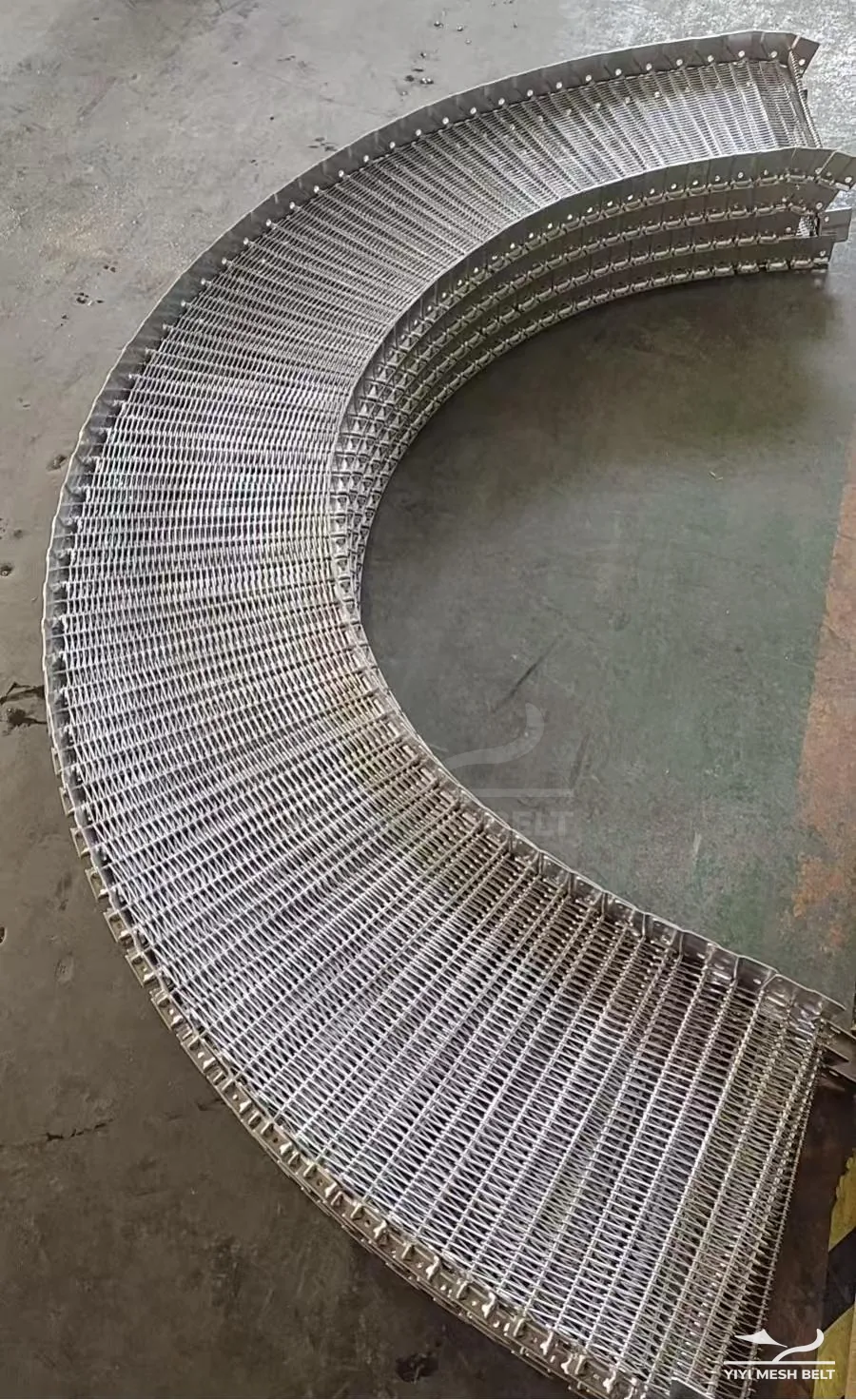
The finished belt is checked again. We check the stacking and measure the stack plate height. Every self-stacking belt order is also laid out in a full circle on the workshop floor and checked at the turning diameter. Every finished belt then goes through 100% final inspection before packing.
| Check | What we do |
|---|---|
| Tier stacking | Tiers nested in a turn and checked |
| Stack plate height | Measured again on the finished belt |
| Turn | Belt laid out in a full circle on the workshop floor and the turn measured |
| Final inspection | 100% final inspection before packing |
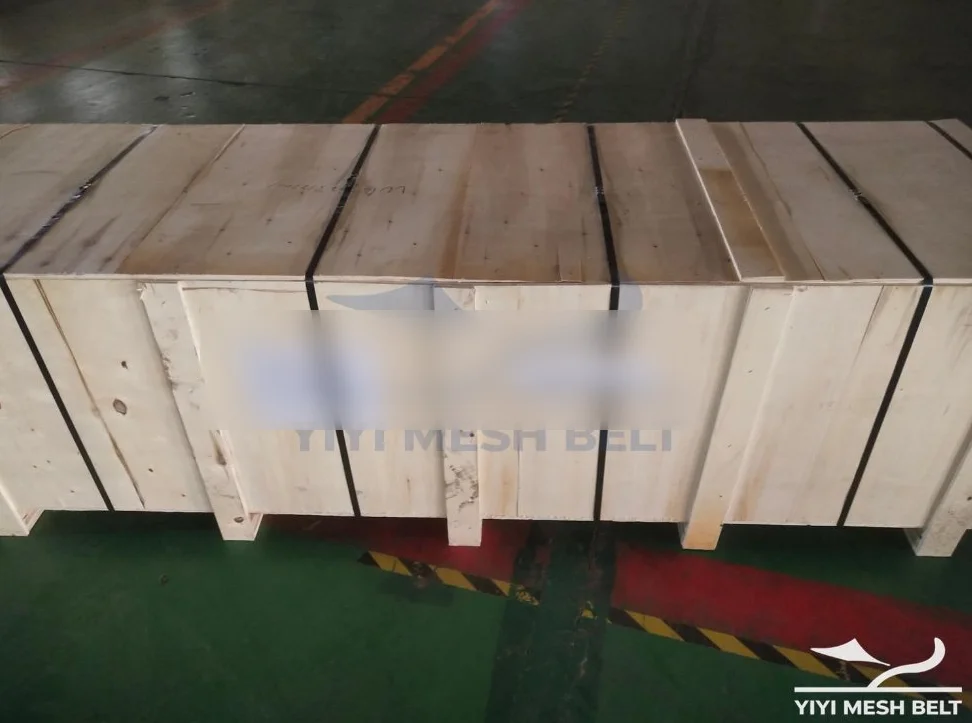
| Packing | Belt coiled so the tiers nest, then packed in wooden cases |
For the next step, read how we pack a self-stacking belt for export.
What can this test not tell you?
This is a hand test in our factory. It is not a run on your equipment, and it does not replace the equipment data on your drawing. The stacking geometry follows the approved equipment and belt design, so please confirm your equipment details with us before production.
The test applies only to self-stacking belts. A Spiral Freezer Belt runs on rails and has no stack plates. See where our belts are used on our applications page.
What can you ask to see?
Ask for the first-article photos of your belt, sent with the measured values. Before shipment, ask for photos of the belt in a turn, the turning-test photos, and final-inspection and packing photos. You can also visit our factory or book a video tour.
| Stage | Ask for |
|---|---|
| First section | First-article photos with the measured values |
| Finished belt | Photos of the belt in a turn |
| Finished belt | Turning-test photos |
| Packing | Final-inspection and packing photos |
You can see these steps in our Self-Stacking Belt Production and Quality Control document. Our wider checks are on the QA and quality control page, and our certificates are on the certification page.
Where have we used this test?
We use it on standard and heavy-duty belts, and on new designs and belts made to a sample. Three projects show different parts of the test: tall stack plates in Australia, a new heavy-duty design in South Korea, and a belt built to an original sample in Spain.
| Item | Details |
|---|---|
| Situation | A belt distributor needed a SUS304 belt, 760 mm (29.92 in) wide, with 1.5 × 120 mm (0.06 × 4.72 in) stack plates, made to their sample |
| What we checked | Stack plate height, shape and stacking on the first section; stacking and engagement before, during and after welding |
| Before packing | Tiers nested in a turn, and the stack plate height measured again |
| What you can ask for | Photos of your belt in a turn before shipment |
| Item | Details |
|---|---|
| Situation | An equipment manufacturer needed a heavy-duty belt in 420 mm (16.54 in) and 660 mm (25.98 in) widths, with 7 mm (0.28 in) rods, 1.5 × 80 mm (0.06 × 3.15 in) stack plates and 4 × 15 mm (0.16 × 0.59 in) reinforcing bars |
| What we did | Adjusted the link tooling on the trial order; laid both widths out in a full circle; measured and improved the turn over three rounds |
| Before packing | Rod, spiral pitch and stack plates measured again; the coiled belt checked for nesting |
| What you can ask for | Turning-test photos of your belt |
| Item | Details |
|---|---|
| Situation | A belt distributor sent a section of the original belt, and we built a belt to it |
| What we checked | Stack plate shape, height and the link joint on the first section, with a photo report sent to the buyer |
| Extra check | We joined the original sample to the new belt, ran them together in the workshop and sent the buyer the video |
| What you can ask for | Send a section of your belt, and we can film it running with the new belt |
Inch and foot values are rounded references. Options are not free combinations; the approved drawing governs.
What do buyers ask about this test?
How do you test that a self-stacking belt stacks?
Mainly by hand, in our factory. Once about 3.3 m (10.8 ft) of belt is made, workers stack it in a circle about 10 times and check how well the upper and lower tiers engage.
What do you do if the tiers do not engage?
We adjust the tooling, so the upper and lower tiers catch at the stack plate height.
Why does weld slag matter for stacking?
Weld slag on the back of the edge affects how the belt stacks. It is inspected and ground by hand during welding, and we have an SOP for checking it.
Is every self-stacking belt order checked before shipment?
Yes. Every self-stacking belt order is checked at the turning diameter before shipment, and every finished belt goes through 100% final inspection before packing.
Does this test prove the belt will work on my equipment?
No. It is a hand test in our factory. The stacking geometry follows the approved equipment and belt design, so your equipment details still have to be confirmed before production.
What should you take from this?
A self-stacking belt has to be checked as a stack. We stack the tiers by hand, adjust the tooling if they do not engage, and check the stacking and the turn again on the finished belt before shipment.
Next step: Send your drawing for review. You can also reach me at info@yiyimeshbelt.com or on WhatsApp at +86 134 5177 3742. Related reading: how a self-stacking belt is made, from wire to the stack check.
What have I learned from this test?
In our factory, this test is mainly done by hand. We put the belt in a circle and look at how well the tiers engage. Once the fixtures are set, most sections pass. When a section does not, we adjust the tooling so the upper and lower tiers catch at the stack plate height. The other thing I watch is weld slag on the back of the edge. It is especially important, because it affects how the belt stacks. — Sunny Ye
Product page: Self-Stacking Belt
Technical Reviewer: Sunny Ye, Global Sales Director, YIYI Mesh Belt (Ningjin Yiyi Mesh Belt Co., Ltd.) · Last updated: 2026-11-05
© 2026 Ningjin Yiyi Mesh Belt Co., Ltd. All rights reserved. Photos, drawings and data on this page belong to YIYI Mesh Belt and may not be copied or reused without written permission.

