
Most spiral belts are pushed round by a drum. A side driven belt is driven at its edge, through drive components fitted along one side.
A Side Driven Belt carries drive components along its edge, which engage a drive in the spiral or turning conveyor, so the belt is driven at the edge rather than by drum friction. It suits side-drive and side-guidance systems. Confirm the side drive components, rod pitch, width, turn ratio and the equipment interface before ordering.
We are YIYI Mesh Belt, a metal conveyor belt manufacturer in Ningjin, Dezhou City, Shandong Province, China. Our manufacturing experience dates back to 1998, and we work on a 27,000 m² site with about 280 units of production and supporting equipment, including 9 welding robots. I am Sunny Ye. The Side Driven Belt is one of our 12 product families, and it is often confused with the Spiral Freezer Belt. This article explains how it works and what we need to supply one.
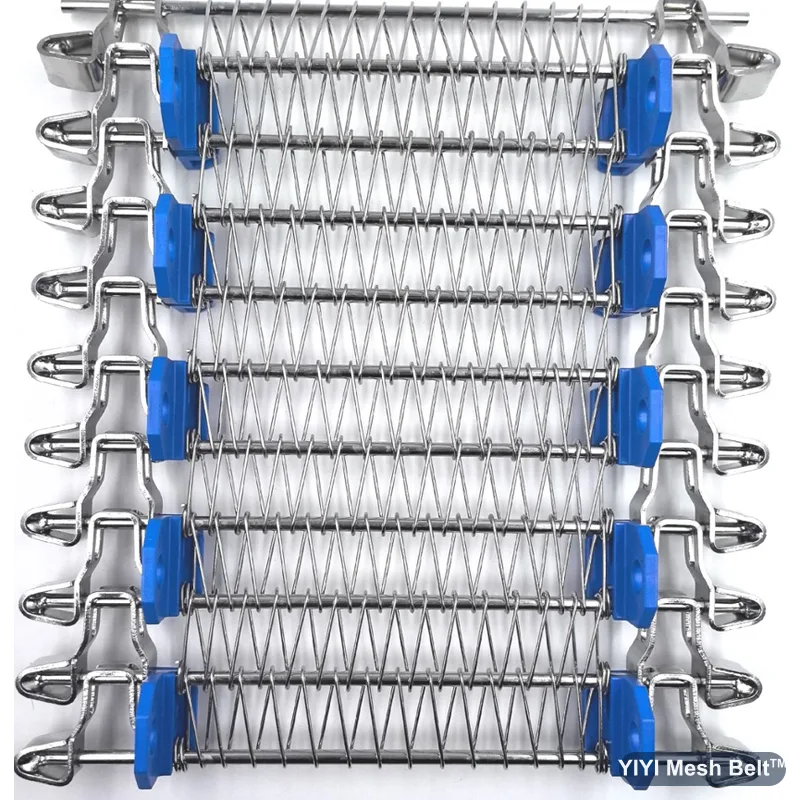
At a Glance
| Product | Side Driven Belt in SUS304 or SUS316 |
|---|---|
| How it is driven | At the edge, through side drive components engaging the equipment drive |
| YIYI references | Spiral pitch 5–23 mm, rod pitch 31.75 / 34 mm, rod 6 mm, spiral wire 1.2–1.8 mm, width 300–1,100 mm, turn ratio 1.63 |
| Boundary | Plastic side component material, geometry and temperature are confirmed per project |
| What to send | Equipment, drawing, width, pitch, rod data, side drive component photos and operating conditions |
How Is a Side Driven Belt Driven?
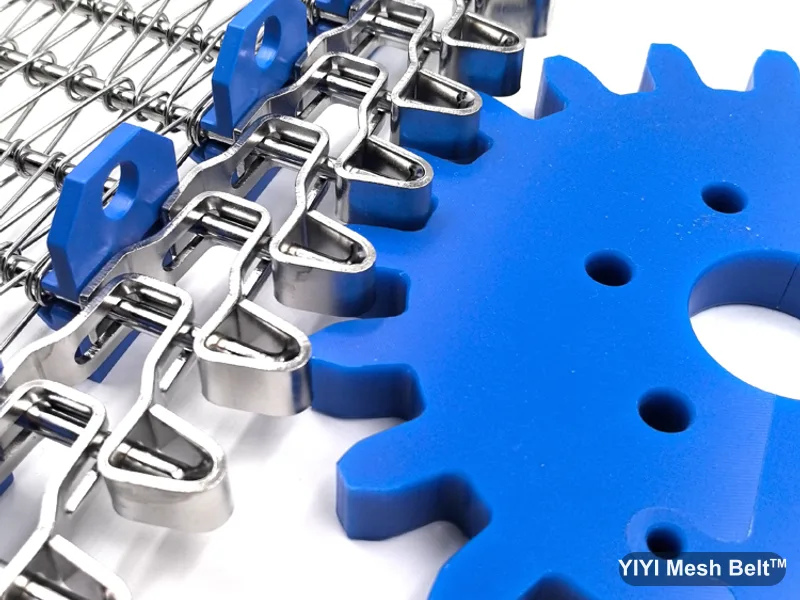
Drive components are fitted along one edge of the belt at regular intervals. In the conveyor, a drive engages those components and pushes or pulls the belt along the path, including through turns. Because the drive acts at the edge, the belt does not rely on friction against a rotating drum to move.
| Drum-driven Spiral Freezer Belt | Side Driven Belt | Self-Stacking Belt | |
|---|---|---|---|
| Drive | Friction from a rotating drum at the inner edge | Drive engages components on the edge | Set by the self-stacking system |
| Tier support | Rails | Set by the equipment | Stack plates on the belt |
| Key match | Drum geometry, turn ratio, edge | Side drive components and equipment interface | Stack geometry |
The equipment design decides which belt is needed. The three are not interchangeable without changing the machine.
Side driving is often chosen where the layout or the product makes a large rotating drum impractical, or where the equipment builder wants positive drive at the edge. Those are design decisions for the builder; our job is to make a belt that fits the drive and the path exactly.
Sunny's view: If your spiral has no big rotating drum, ask the builder how the belt is driven. If the answer is "from the side", this is your belt family.
What Are the Reference Specifications?
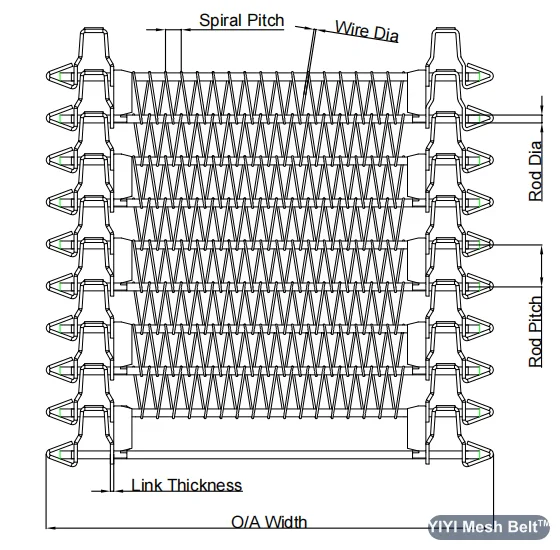
Our Side Driven Belt references are SUS304 or SUS316, spiral pitch 5 to 23 mm, rod pitch 31.75 or 34 mm, rod diameter 6 mm, spiral wire 1.2 to 1.8 mm, widths of 300 to 1,100 mm or custom, turn ratio 1.63, welded joining, and electropolishing where applicable. The approved drawing controls the final belt.
| Parameter | YIYI reference |
|---|---|
| Material | SUS304 / SUS316 |
| Spiral pitch | 5–23 mm |
| Rod pitch | 31.75 / 34 mm |
| Rod diameter | 6 mm |
| Spiral wire | 1.2–1.8 mm |
| Width | 300–1,100 mm or custom |
| Turn ratio | 1.63 |
| Joining | Welded |
| Surface | Electropolishing where applicable |
These are reference values, not free combinations. Rod pitch in particular must match the side drive components and the equipment drive.
Spiral pitch and spiral wire are chosen for the product, as on other spiral belts: a closer pitch supports small pieces, a more open pitch lets more air through. Tell us the smallest and the heaviest product the line runs, so pitch and wire can be checked for both.
Sunny's view: Measure rod pitch over ten rods on your old belt. 31.75 and 34 mm look similar on one rod and very different over ten.
What About the Side Drive Components?
The side drive components are what the equipment drive engages, so their shape, spacing and fit to the rods decide whether the belt runs. Their material, geometry and temperature suitability are confirmed for each project, especially where plastic components are used. We match them to the equipment interface on the drawing.
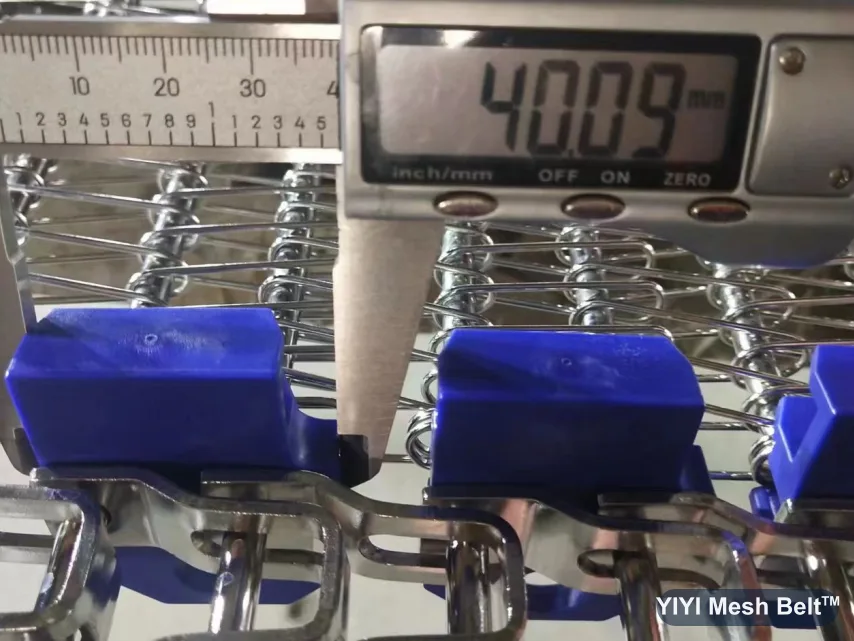
- Shape and spacing: matched to the equipment drive.
- Attachment: how the component fits on the rod and edge.
- Material: plastic or metal, confirmed per project with the operating temperature and cleaning.
- Wear: components wear where they meet the drive; photos of old components show how the drive engages.
We do not quote a general temperature limit for plastic side components. If the belt runs in a freezer or a heated process, tell us the temperature range so the component material can be reviewed.
Side guards, side pulleys and spare rods can be supplied on a project basis.
When components wear, the belt can start to slip, jump or run unevenly in the turn. Check components at planned stops and replace worn ones with parts matched to the original, rather than mixing types on one belt.
Sunny's view: Send me a close-up of one old drive component from three sides. Shape decides more than any catalogue number.
How Does a Side Driven Belt Behave in a Turn?
Like other spiral belts, a Side Driven Belt collapses on the inner edge and stays extended on the outer edge in a turn. Its reference turn ratio is 1.63. The drive components and rod spacing must allow that collapse while still engaging the drive, so the turn and the drive are reviewed together.

- Confirm the inside turning radius and belt width, so the turn ratio can be checked.
- Confirm which edge carries the drive components and which is inside the turn.
- Confirm turning direction, viewed from above at the infeed.
On a replacement, compare the wear on the inner and outer edges of the old belt; uneven wear shows whether it was turning as designed.
Drum or geometry verification is carried out where the project requires it, and Side Driven Belts are one of the belt types where it is often worth asking for. Read what geometry verification checks.
Sunny's view: Tell me which side the drive is on and which way the spiral turns. Together they decide how the belt is built.
How Is a Side Driven Belt Made and Checked?
We draw wire and round bar in-house, form the spiral wire, assemble and weld the belt, fit the side components and inspect against the approved drawing. QA covers dimensions, welding, the relationship between side components and the belt, and a 100% final inspection before packing.

- Incoming material checked against Material Documentation, with spectral and hardness testing
- Wire and round bar drawn and checked for diameter
- Spiral wire formed and inspected in a trial run
- Belt assembled and welded; side components fitted
- Trial section and complete first article checked against the drawing
- 100% final inspection: dimensions, welding, side component relationship, flatness, appearance
Electropolishing is available where the project requires it, carried out by a specialist partner under our specifications. Ask about it if your hygiene audits look closely at weld areas.
Selected components may be sourced from partners under our project specifications and finished-product quality requirements; they are checked with the belt.
Sunny's view: Ask to see the first article with the side components fitted. That is where most fit questions are answered.
What Should You Send for a Side Driven Belt?
Send the equipment type and builder, a drawing if available, belt width, spiral pitch, rod pitch and rod diameter, photos of the side drive components from several angles, the turning direction and inside radius, and the operating temperature and cleaning. A section of the old belt with components attached is the strongest evidence.
Checklist
- Equipment and builder; drawing if available
- Width, spiral pitch, rod pitch (over ten rods), rod diameter
- Side drive components: photos from three sides, spacing
- Turning direction and inside radius
- Operating temperature range and cleaning method
- A section of the old belt with components
Photos and basic dimensions support a preliminary quote. For a formal order, we prepare a drawing for your approval, run trial production and a first article, and inspect every belt before packing.
If the equipment builder can share the drive arrangement, send that as well. Knowing where the drive engages the belt helps us check component spacing and the turn together.
Sunny's view: A short section of the old belt with two or three drive components on it answers almost every question.
When This Is Not the Right Approach
A Side Driven Belt is not a replacement for a drum-driven Spiral Freezer Belt or a Self-Stacking Belt. If your freezer has a rotating drum and rails, read how to choose a spiral freezer belt; if it is self-stacking, read what a self-stacking belt is.
All-plastic modular belts are not part of our range.
From Our Engineering Experience
Side Driven Belt inquiries are usually replacements, and the side components are the part buyers describe least. Clear photos of the components and rod pitch measured over several rods resolve most questions.
We do not have a Side Driven Belt case we can publish here, so this article explains our review.
FAQ
How is a side driven belt different from a spiral freezer belt?
A side driven belt is driven at the edge through drive components; a spiral freezer belt is driven by friction against a rotating drum.
What rod pitches do you make?
Our references are 31.75 mm and 34 mm, with 6 mm rods; the value is confirmed on the drawing.
What turn ratio does a side driven belt have?
Our reference is 1.63; the final value is confirmed for your equipment.
Are the side components plastic?
They can be; material, geometry and temperature suitability are confirmed per project.
What should I send for a quote?
Equipment, drawing, width, pitch, rod data, side component photos, direction, radius and operating conditions.
Conclusion
A Side Driven Belt is driven at its edge. Match the side components, rod pitch and turn to your equipment, and confirm them on a drawing.
Replacing a side driven belt?
Send photos of the side drive components, rod pitch, width and equipment details. We match the belt and components to your system.
See Side Driven Belt specifications →WhatsApp Sunny📄 Side Driven Belt RFQ Application Sheet (PDF) · Email: info@yiyimeshbelt.com
Related reading: What geometry verification checks · How to choose a spiral freezer belt · What is a self-stacking belt? · Side Driven Belt specifications (yiyimeshbelts.com)

Sunny Ye
Global Sales Director, YIYI Mesh Belt · 15 years in metal conveyor belt projects
I work with spiral freezer builders, distributors and plant teams on belt selection and replacement. Questions about this article? Send them to me directly.
Follow Sunny on LinkedIn · Last updated: 2026-10-15

