
A spiral freezer belt built for the wrong direction cannot be fixed on site. One clear photo and one written word on the drawing prevent that.
Confirm direction by looking at the spiral from above and noting whether the belt travels clockwise or counter-clockwise, which edge runs against the drum, and whether the belt climbs or descends. Write it on the drawing as words and a sketch, not as left or right alone.
We are YIYI Mesh Belt, a metal conveyor belt manufacturer in Ningjin, Shandong, China, manufacturing since 1998 on a 27,000 m² site with 280 units of equipment, including 9 welding robots. I am Sunny Ye. For every new spiral freezer belt, the first engineering question we ask is which way it turns. Below is how to answer that question so the belt we build is the belt your freezer needs.
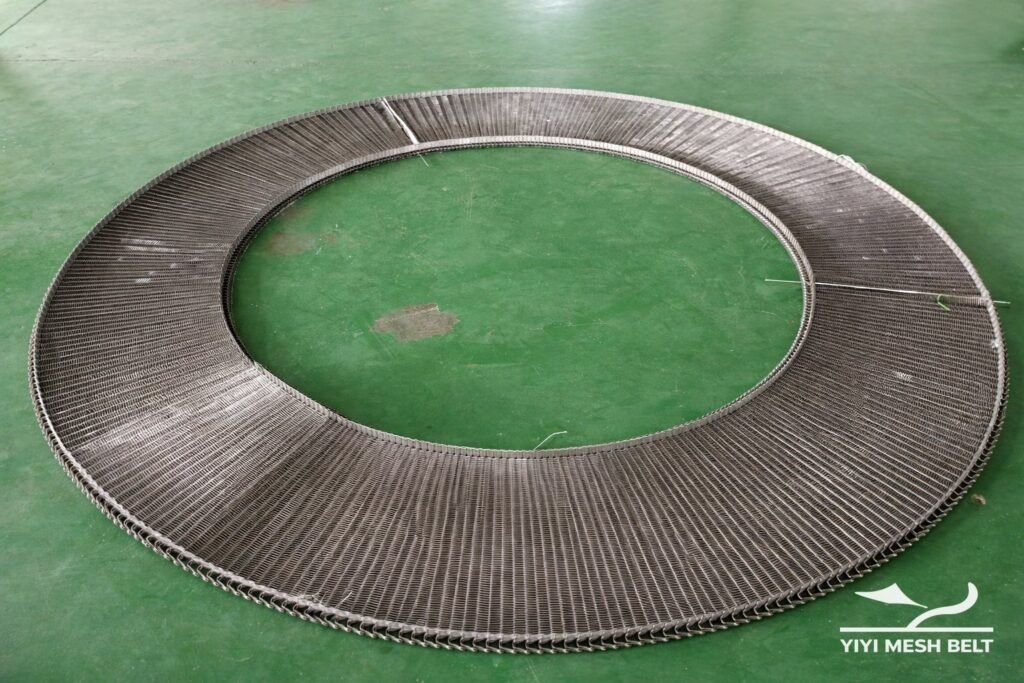
At a Glance
| Product | Spiral Freezer Belt in SUS304 or SUS316 |
|---|---|
| The question | Which way the belt turns, which edge collapses, which side carries product |
| Common mistake | Writing "left-hand" or "right-hand" with no reference point |
| Buyer type | Spiral freezer OEMs, plant maintenance teams, professional distributors |
| What to send | Top-view photo of the spiral with travel direction marked, inner and outer edge photos, infeed and discharge photos |
Why Does Direction Matter on a Spiral Freezer Belt?
A spiral freezer belt bends in one plane and collapses on one edge. The inner edge runs against the drum and folds together in the turn, while the outer edge stays open. If the belt is built to collapse on the wrong edge, it cannot follow the drum and cannot be installed.

On a straight run, a spiral belt looks symmetrical. In the turn, it is not. The links on the inner edge slide together so the belt can follow the smaller radius around the drum. The links on the outer edge stay extended and carry most of the tension.
That is why the edge design is not the same on both sides of many spiral belts. Some constructions can collapse on either edge. Many are built to collapse on one edge, for one turning direction. The approved drawing must say which.
Direction also affects how the belt is assembled. The rods, links and mesh overlay go together in a set order, and the belt has a top side for product and a bottom side for the rails. A belt that is correct in every dimension can still be wrong if it is built as a mirror image of what the freezer needs.
Sunny's view: For a new belt, we always ask which way it turns. Clockwise or counter-clockwise changes how the belt is built. It is one question, and it has to be answered before production.
Turning Direction or Spiral Wire Hand: Which One Is Meant?
Buyers use left-hand and right-hand for two different things. One is the turning direction of the belt in the freezer. The other is the winding direction of the spiral wire in the mesh overlay. Both can appear on a drawing, so every RFQ should say which one it means.

The confusion is common because both answers sound the same in an email:
| Turning direction | Spiral wire hand | |
|---|---|---|
| What it describes | Which way the belt travels around the drum | Which way each spiral wire coil is wound |
| What it decides | Which edge collapses and runs against the drum | How the overlay sits on the rods and how it tracks |
| How to state it | Clockwise or counter-clockwise, seen from above | Left-hand, right-hand or alternating, as on the drawing |
| How to check it | Top-view photo of the spiral with travel marked | Close photo of the mesh, or a sample of the old belt |
When a customer writes "we need a right-hand belt", we ask a follow-up question before quoting. Most of the time they mean the turning direction. Sometimes they mean the wire. Getting this wrong costs a full belt.
Sunny's view: I never accept "left" or "right" as a complete answer. I ask the customer to add the reference: seen from above, travel direction, and which edge touches the drum.
How Do You Confirm the Turning Direction on Site?
Stand where you can see the drum from above, or use the freezer layout drawing. Follow the product from the infeed: note whether it moves clockwise or counter-clockwise, and whether it climbs or descends. Mark the travel direction on the belt with tape and photograph it with the drum in view.

Use the same reference every time. We suggest this short routine:
- Find the infeed. Note whether product enters at the bottom of the spiral and climbs, or enters at the top and descends.
- Look from above. Seen from above, does the belt travel clockwise or counter-clockwise? If you can see it from below and not from above, say so, because the direction reverses.
- Find the inner edge. Which edge of the belt runs against the drum? Photograph it.
- Mark the belt. Put an arrow of tape on the belt in the travel direction, then photograph the arrow, the inner edge and the drum together.
- Check the layout drawing. If the freezer maker's layout drawing is available, send it too. It often shows the direction clearly.
Do not assume two freezers of the same model turn the same way. Freezers are often built as mirror images to fit the room and the line.
Sunny's view: The tape arrow costs nothing and settles every argument. When a customer sends that one photo, our engineers can confirm the direction in minutes.
What Does the Old Belt Tell You About Direction?
The old belt records how it ran. The inner edge shows nested links and wear on the side that touched the drum, and the outer edge shows stretched pitch. A short section of the old belt, with its top side and travel direction marked, is the most reliable reference for a replacement.

When there is no drawing, the old belt is the drawing. Before you cut a sample, mark three things on it with a paint pen:
- an arrow for the travel direction;
- "TOP" on the product side;
- "DRUM" on the edge that ran against the drum.
Then photograph both edges up close. On the inner edge, look for links that are polished or worn on the drum side and for rods that slide fully in their slots. On the outer edge, look for links that are open and for any pitch growth from tension.
If the old belt was ever installed the wrong way or turned over, the wear pattern will look mixed. Tell us that history. It explains marks that otherwise make no sense.
Sunny's view: When a distributor sends me an old belt sample with no markings, we can still measure it, but we lose the direction. A paint pen saves a week of questions.
How Should Direction Be Written on the Drawing and RFQ?
Write direction in words and show it in a sketch. State clockwise or counter-clockwise seen from above, climbing or descending, which edge collapses, and which side carries product. Add the spiral wire hand separately. The approved drawing then becomes the single reference for production and inspection.

We recommend these lines on every spiral belt RFQ and drawing:
| Field | Example entry |
|---|---|
| Turning direction | Counter-clockwise, seen from above |
| Spiral path | Infeed at bottom, belt climbs |
| Collapsing edge | Left edge in direction of travel, against the drum |
| Product side | Mesh overlay up |
| Spiral wire hand | As on the drawing, or as on the old belt sample |
| Reference photos | Top view with tape arrow, inner edge, outer edge |
For customized orders, we build to the approved drawing and make a trial section first. The direction on that drawing is the reference for production, and where the project requires a turning check, it is checked in that direction on the trial section.
Sunny's view: I ask customers to sign a drawing that shows direction as a picture. A picture is harder to misread across two languages than a word.
What Happens If a Belt Is Built for the Wrong Direction?
A belt built for the wrong direction tries to collapse on the outer edge and stay open on the inner edge. It will not follow the drum, it can lift off the rails, and forcing it can bend rods and links. It usually has to be rebuilt, so the check before production matters.

Sometimes a wrong-direction belt is not noticed until installation. The signs are clear:
- the belt will not bend around the drum in the turn;
- the inner edge stays open and the outer edge tries to fold;
- the belt rides up or lifts off the rails;
- rods bow and links twist if the belt is forced.
Turning a belt over does not fix it. That puts the product side on the rails and the mesh overlay upside down. The safe answer is to stop, photograph the belt and the drum, and review the drawing with the supplier.
If you already see a belt flipping or climbing the drum, direction is one possible cause among several. Our article on why a spiral freezer belt flips or rides up covers the others.
Sunny's view: The most expensive mistakes I have seen in spiral belts were simple ones made before production. Direction is the first box I tick on every spiral order.
When This Is Not the Right Approach
This checklist is for drum-driven spiral freezer belts. A Self-Stacking Belt also turns in one direction, but its side plates carry the tiers above, so stacking and side plate engagement add their own checks. See how to select a Self-Stacking Belt.
Straight conveyors, such as tunnel freezers or ovens, do not have a turning direction. They still have a travel direction and a product side, which matter for chain-driven and flat wire belts.
From Our Engineering Experience
In our replacement work, direction questions come up more often than any dimension question. Width and pitch can be measured from a sample. Direction cannot, unless someone marks the sample before it is cut.
So our routine is fixed: before quoting a spiral belt, we confirm the turning direction, the collapsing edge and the product side in writing, and the approved drawing shows all three. Where the project requires it, the turn is checked in that direction on the trial section before full production starts.
FAQ
What does left-hand or right-hand mean on a spiral freezer belt?
It can mean the turning direction of the belt in the freezer or the winding direction of the spiral wire in the mesh. Always state which one, and give the turning direction as clockwise or counter-clockwise seen from above.
How do I check which way my spiral freezer belt turns?
Look at the spiral from above, follow the product from the infeed, and note clockwise or counter-clockwise and whether the belt climbs or descends. Mark the travel direction on the belt with tape and photograph it with the drum.
Can a spiral freezer belt run in both directions?
Some constructions can collapse on either edge, and many are built for one direction. The approved drawing must state the direction, so check it before ordering a replacement.
Can I turn a wrong-direction belt over to make it fit?
No. Turning the belt over puts the product side on the rails and the mesh overlay upside down. The belt usually needs to be rebuilt to the correct direction.
What photos should I send to confirm direction?
A top view of the spiral with a tape arrow on the belt, a close photo of the edge against the drum, a photo of the outer edge, and photos of the infeed and discharge.
Conclusion
Direction is one question with a costly wrong answer. State it in words, show it in a photo, put it on the approved drawing, and mark any old belt sample before you cut it.
Not sure which way your belt turns?
Send a top-view photo of the spiral with the travel direction marked, plus photos of both belt edges. We confirm the direction with you before anything is built.
Start a spiral belt fit check →WhatsApp Sunny📄 Spiral Freezer Belt RFQ Application Sheet (PDF) · Email: info@yiyimeshbelt.com
Related reading: What is turn ratio on a spiral freezer belt? · Why a spiral freezer belt flips or rides up · Spiral freezer belt replacement checklist · How to photograph an old belt (yiyimeshbelts.com)

Sunny Ye
Global Sales Director, YIYI Mesh Belt · 15 years in metal conveyor belt projects
I work with spiral freezer builders, distributors and plant teams on belt selection and replacement. Questions about this article? Send them to me directly.
Follow Sunny on LinkedIn · Last updated: 2026-10-13

