
A cross rod looks like a plain piece of stainless steel. In a spiral freezer, it carries belt tension around the drum on every turn. How it was drawn matters.
Cold drawing pulls stainless steel bar through dies to reach the final cross rod diameter. It raises strength and hardness, tightens the diameter and smooths the surface, but it lowers ductility. The right reduction gives a rod that stays straight under tension and still heads and bends without cracking.
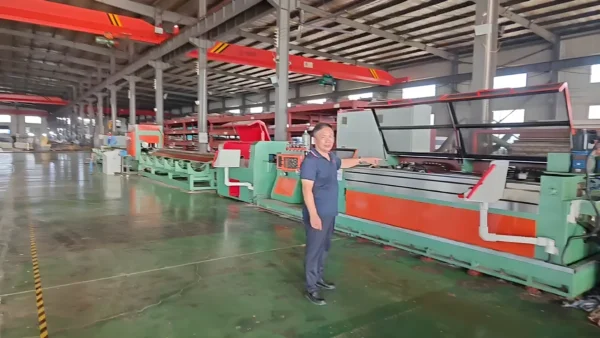
We are YIYI Mesh Belt, a metal conveyor belt manufacturer in Ningjin, Shandong, China, manufacturing since 1998 on a 27,000 m² site with 280 units of equipment, including 9 welding robots. Our round-bar drawing line takes 12 mm bar down to rod sizes as small as 4 mm, so we see every step from bar to finished cross rod. I am Sunny Ye. Below is what cold drawing does to a rod, and what you should check before you approve a belt.
At a Glance
| Product | Cross rods for Spiral Freezer Belts in SUS304 or SUS316 |
|---|---|
| Reference rod diameter | 5 mm or 6 mm, or custom to the approved drawing |
| Where drawing matters | Strength under tension, fit in the link slots and spiral wire, straightness, heading and welding |
| Buyer type | Spiral freezer OEMs, plant maintenance teams, professional distributors |
| What to send | Belt drawing or old belt sample, rod diameter and pitch, turn ratio, material grade |
What Does a Cross Rod Do in a Spiral Freezer Belt?
The cross rod is the backbone of a spiral freezer belt. It holds the spiral wire overlay, joins the edge links and carries belt tension around the drum. In a turn, the outer edge takes most of the pull, so the rod must resist bending while the inner edge collapses.

In a drum-driven spiral freezer, the belt runs as a helix around the drum. On every turn, the inner edge collapses so the belt can follow the smaller radius, and the outer edge stays extended. Tension moves toward the outer edge, so each rod works like a small beam loaded between the links.
A rod in a spiral belt has four jobs at the same time:
- Hold the mesh. The spiral wire overlay sits on the rods and carries the product.
- Set the pitch. Together with the edge links, the rods fix the rod pitch along the belt.
- Carry tension. Drive and drum friction pull the belt through the rods and links.
- Keep the belt flat. A straight rod keeps the carrying surface level across the full width.
If a rod is too weak, it bows. A bowed rod changes the pitch at the edge, the inner edge stops nesting evenly, and the belt can start to run rough on the rails. That is why the way a rod is made matters as much as its diameter.
Sunny's view: When a buyer compares two quotes, I ask them to look at the rods first. Two belts with the same width and mesh can behave very differently if the rods are different.
What Happens to Stainless Steel During Cold Drawing?
During cold drawing, the bar is pulled through a series of dies at room temperature. Each pass reduces the diameter and work-hardens the steel. Tensile strength and hardness rise, ductility falls, and in SUS304 part of the structure changes into martensite, which reacts to a magnet.

Drawing is plastic deformation. The grains of the steel stretch along the length of the rod, and the metal becomes harder to deform further. Engineers call this work hardening. The amount of change depends on how much the diameter is reduced in total and how the passes are arranged.
| Property | Effect of more cold reduction |
|---|---|
| Tensile strength | Rises |
| Hardness | Rises |
| Ductility (elongation) | Falls |
| Diameter accuracy | Improves when the dies are in good condition |
| Surface | Smoother and brighter |
| Magnetic response in SUS304 | Rises |
None of these changes alter the chemical grade. A cold-drawn SUS304 rod is still SUS304. If a magnet test worries you, read why a SUS304 spiral freezer belt can be magnetic; the short answer is that the drawing, not the steel, makes the difference.
Sunny's view: Customers sometimes worry when our rods react to a magnet. I explain that this comes from the drawing, not from the grade, and we review the incoming spectral check for that steel with them.
How Much Cold Work Is Right for a Cross Rod?
There is no single correct number. The reduction depends on rod diameter, belt load, turn ratio and how the rod ends are formed. Too little cold work leaves a soft rod that bows under tension. Too much leaves a hard rod that can crack when the head is formed or the rod is bent.

Rod drawing is a balance between strength and formability. The table shows what each extreme looks like in a running belt.
| Rod too soft | Rod too hard | |
|---|---|---|
| In the turn | Rods bow between the links; the outer edge pitch opens | Rods hold their shape |
| Under load | The carrying surface dishes | Less tolerance to shock loads |
| At the rod ends | Heads form easily | Splits or cracks can appear when heads are formed |
| Typical sign on an old belt | Bent rods, uneven belt surface | Cracked heads, broken rod ends |
We set the drawing route for each rod size and check the drawn rod before forming. Tensile testing, hardness testing and dimensional inspection are available in our own factory. Which of these checks a given order receives is agreed on the approved drawing, so the record matches what the project needs.
Sunny's view: If a customer's old rods are bowed, I do not simply suggest a thicker rod. A thicker rod changes the link holes, the pitch and the belt weight. We first ask why the old rod bowed.
Why Do Rod Diameter and Straightness Matter for Fit?
A spiral freezer belt is assembled from hundreds of rods that must pass through the link slots and spiral wire at a fixed pitch. If the diameter varies, rods fit loose or tight. If rods are not straight, the belt will not lie flat and the edge pitch drifts along the belt.

On the inner edge of a spiral belt, rods slide in slotted links when the belt collapses into the turn. That slide needs a controlled clearance. A rod that is too thick for the slot binds, and the inner edge cannot collapse freely. A rod that is too thin wears the slot faster and lets the belt move sideways.
Straightness matters for a different reason. A rod with a slight curve still fits, but every curved rod lifts the mesh in one place. Over hundreds of metres, small curves add up to a belt that does not sit evenly on the rails.
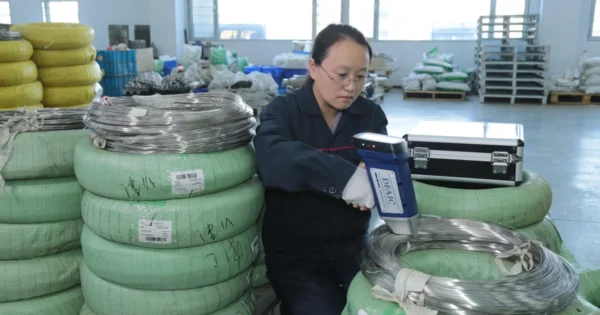
In our factory, drawn rods are checked for diameter before assembly. After assembly, the belt is checked for pitch, dimensions, flatness and welds before shipment. The photo above shows a rod diameter reading taken during that inspection.
Sunny's view: For replacements, I always ask for a rod diameter measured with a caliper, not a ruler. A tenth of a millimetre matters when the rod has to slide in the link slot.
How Does Cold Drawing Affect Rod Heads and Welds?
Rod ends are where cold-drawn steel is tested hardest. Button and flat-hat heads are formed by upsetting the rod end, and welded edges add heat to a small zone. A rod with the right drawing route forms a clean head without splits, and the weld stays sound on the edge link.

Our reference edges for Spiral Freezer Belts are button, flat-hat, rod welded, button cap and clinched. Each one asks something different of the rod end:
- Button and flat-hat heads are a second round of cold forming at the very end of the rod. A rod that is already very hard has less room left to deform.
- Welded edges heat a small zone of the rod and link. The heat softens the drawn steel locally, so weld size and position must be controlled.
- Clinched edges bend the rod end, which again needs enough ductility.
Weld quality also affects hygiene. Burrs and spatter at the edge catch product and are hard to clean. We explain how we control this in how to avoid weld burrs on a spiral freezer belt.
When you inspect an old belt, look at the rod ends first: cracked heads, missing heads, broken welds or rods walking out of the links all point to a rod or edge problem.
Sunny's view: When I see cracked heads on an old belt, I ask for close photos of three or four failed ends. The pattern tells us whether the cause was the rod, the weld or the way the belt ran.
What Should a Buyer Check About Cross Rods?
Ask where the rods come from, how they are drawn and how the diameter is controlled. Ask for Material Documentation for the steel, and check a sample rod for diameter, straightness and a clean head. For a replacement, send an old rod so the new one can be compared directly.
These are the questions we suggest you ask any supplier, including us:
| Question | Why it matters | How YIYI Mesh Belt answers |
|---|---|---|
| Where do the rods come from? | Bought-in rod adds a supplier you cannot see | In-house round-bar drawing from 12 mm bar for our standard rod sizes; ask which route your order uses |
| What steel is used? | The grade sets corrosion resistance | Steel mill Material Documentation for each incoming batch |
| How is incoming steel checked? | Paperwork alone can be wrong | Spectral and hardness testing for each incoming batch |
| Is there stock behind the order? | Raw material shortages delay production | About 50 t of 5.0 mm wire rod and 50 t of 12 mm bar held in stock |
| Is a trial section made first? | Errors are found before full production | Customized orders follow an approved drawing, trial production and first-article confirmation |
| What is checked before shipment? | Problems should stay in the factory | 100% final inspection of pitch, dimensions, flatness and welds |
For a replacement, an old rod is worth more than any description. Measure it, photograph its ends, and send it with the belt sample if you can.
Sunny's view: Distributors ask me how they can explain our rods to their customer. I suggest they keep one sample rod from each order. It makes the next comparison easy.
When This Is Not the Right Approach
Cold-drawn rod is the standard choice for spiral belts, but a stronger rod does not solve every rod problem. If the old rods bowed because the belt was overloaded, ran at the wrong tension, or the turn ratio was too tight for that belt, a new rod will bow again.
Check load, tension and turn ratio first. Our guide on turn ratio on a spiral freezer belt explains how to measure it. For very heavy loads, a different construction, such as a larger rod with matched links or a chain-driven belt, may fit better. That is an engineering review of the whole belt, not a rod upgrade.
From Our Engineering Experience
We moved rod and wire drawing in-house so that the rod on the drawing and the rod in the belt come from one controlled route. Bar comes from our own stock, is drawn on our own line, is checked, and is then formed and welded in the same factory.
That route also helps after delivery. When a customer asks about a rod, we can trace it back through the material record, the drawing and processing step, the inspection record and the finished belt. In my experience, that traceability is what buyers value most once a belt is running.
FAQ
Are cold-drawn cross rods stronger than annealed rods?
Yes. Cold drawing work-hardens the steel, so a drawn rod has higher tensile strength and hardness than the same grade in the annealed state. It also has lower ductility, which is why the drawing route must suit the rod heads and bends.
Why do SUS304 cross rods attract a magnet?
Cold drawing changes part of the austenite in SUS304 into martensite, which is magnetic. The grade does not change. A spectral analysis, not a magnet, confirms the material.
What rod diameters are used on spiral freezer belts?
Our reference sizes are 5 mm and 6 mm, with custom diameters to an approved drawing. The diameter is chosen together with rod pitch, belt width, load and turn ratio, not on its own.
Can a bowed cross rod be replaced with a thicker one?
Not directly. A thicker rod changes the fit in the link slots and spiral wire, the belt weight and sometimes the drive. Find out why the rod bowed first, then review the whole belt.
Does YIYI Mesh Belt draw its own cross rods?
Yes. Our round-bar drawing line takes 12 mm bar down to 4 mm, which covers our standard spiral belt rod sizes. Not every round component is drawn in-house, so ask us which route your order uses.
Conclusion
A cross rod is drawn, cut, headed and welded before it carries any product. Ask how that route is controlled, check a sample rod, and send an old rod when you replace a belt.
Want us to check your cross rods?
Send your belt drawing, rod diameter and pitch, or a short piece of the old belt. We compare it with our rod route and tell you what we would build.
See Spiral Freezer Belt specifications →WhatsApp Sunny📄 Spiral Freezer Belt Production & Quality Control (PDF) · Email: info@yiyimeshbelt.com
Related reading: Why is a SUS304 spiral freezer belt magnetic? · How to avoid weld burrs · Choosing a spiral freezer belt for IQF · Why in-house wire drawing matters (yiyimeshbelts.com)

Sunny Ye
Sales Director, YIYI Mesh Belt · 15 years in metal conveyor belt projects
I work with spiral freezer builders, distributors and plant teams on belt selection and replacement. Questions about this article? Send them to me directly.
Follow Sunny on LinkedIn · Last updated: 2026-10-12

