

Two spiral freezer belts can share width, pitch and steel grade, and one still fails in the turn. Turn ratio is usually the reason.
Turn ratio is the inside turning radius of a spiral freezer belt divided by its width. A belt 600 mm wide turning on a 1,200 mm inside radius has a turn ratio of 2.0. The lower the ratio, the tighter the turn and the more the inner edge must collapse.
We are YIYI Mesh Belt, a metal conveyor belt manufacturer in Ningjin, Shandong, China, manufacturing since 1998 on a 27,000 m² site with 280 units of equipment, including 9 welding robots. I am Sunny Ye. We build Spiral Freezer Belts for turn ratios from 1.15 to 2.5, and a Small Radius variant at 1.1. Below is how turn ratio works, how to calculate it from your freezer, and why it decides the belt design.

At a Glance
| Product | Spiral Freezer Belt in SUS304 or SUS316 |
|---|---|
| Definition | Turn ratio = inside turning radius ÷ belt width |
| Our reference range | 1.15 to 2.5; Small Radius variant at 1.1 |
| Buyer type | Spiral freezer OEMs, plant engineers, professional distributors |
| What to send | Drum diameter, inside radius to the belt edge, overall belt width, old belt photos or drawing |
What Is Turn Ratio on a Spiral Freezer Belt?
Turn ratio compares how tight the turn is with how wide the belt is. It is the radius measured from the drum centre to the inner edge of the belt, divided by the overall belt width. It tells the belt maker how much the inner edge must collapse in every turn.
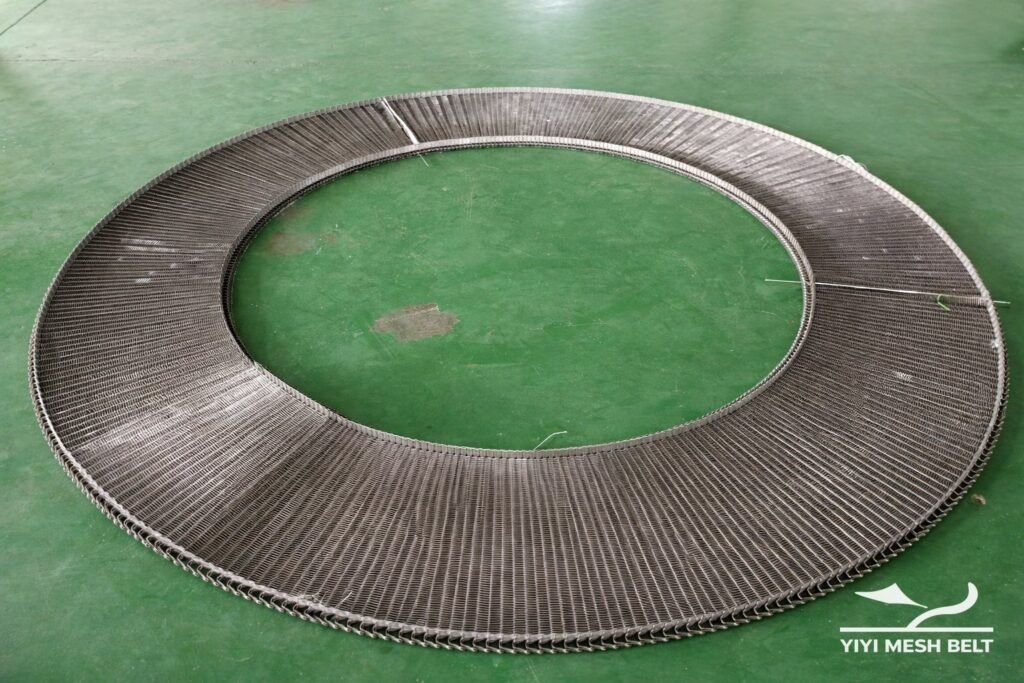
A spiral belt in a turn behaves like a fan. The inner edge travels a short path, and the outer edge travels a long one. The belt has to make up that difference in every turn. It does this by collapsing the pitch on the inner edge while the outer edge stays open.
Turn ratio puts a number on that difference. A high ratio means a gentle turn: the inner and outer paths are close in length. A low ratio means a tight turn: the inner edge must collapse a lot.
Because turn ratio is a ratio, it does not depend on units. A belt 24 in wide on a 48 in inside radius has the same 2.0 ratio as a belt 600 mm wide on a 1,200 mm inside radius.
Sunny's view: When a buyer gives me width and length, I thank them and ask for the drum. Without the turn ratio, I cannot tell whether the belt they describe can turn on their freezer.
How Do You Calculate Turn Ratio?
Divide the inside turning radius by the overall belt width. Measure the radius from the drum centre to the inner edge of the belt, not to the drum surface. If you know the turn ratio the belt needs, multiply it by the width to find the inside radius it requires.

The formula is simple. The measurement is where mistakes happen.
| Belt width | Inside radius | Turn ratio | What it means |
|---|---|---|---|
| 600 mm | 1,200 mm | 2.0 | A moderate turn |
| 800 mm | 1,200 mm | 1.5 | Same drum, wider belt, tighter ratio |
| 1,000 mm | 1,150 mm | 1.15 | The tight end of our standard range |
| 1,000 mm | 1,100 mm | 1.1 | Small Radius territory |
These are worked examples, not recommended sizes. Notice the second row: if you put a wider belt on the same drum, the ratio drops. A belt that ran well at 600 mm may not be the right construction at 800 mm.
Measure the inside radius at the belt edge, because there is a clearance between the drum surface and the belt. If you can measure the drum diameter but not the belt edge, send both the drum diameter and photos, and we work out the rest with you.
Sunny's view: I ask customers to send the numbers and not the ratio. If they send drum diameter, inside radius and belt width separately, we can check the arithmetic together.
Why Does Turn Ratio Matter for the Belt?
Turn ratio decides how far the inner edge must collapse, how much tension the outer edge carries, and which link and rod design will work. A belt built for a turn ratio of 2.0 cannot simply run on a tighter turn. Its inner edge runs out of collapse and the belt lifts or binds.

Every spiral belt design has a limit to how far its inner edge can fold. That limit comes from the link shape, the slot length and the rod pitch. Inside the limit, the belt turns smoothly. Past it, the belt has nowhere to go.
A tighter turn also moves more of the load to the outer edge. The outer links and the outer part of each rod carry most of the pull. That is why a low turn ratio often goes together with stronger edge links and a carefully chosen rod.
- Too tight for the belt: the inner edge binds, the belt rides up on the drum or lifts off the rails, and rods and links wear fast.
- Much gentler than the belt was built for: usually no problem in the turn, but the belt may be heavier and more complex than the freezer needs.
Turn ratio is also why a "standard" spiral belt does not exist. The construction follows the ratio.
Sunny's view: When a belt rides up on the drum, I check the turn ratio before anything else. It is the fastest way to tell a design mismatch from a running problem.
How Do Drum Diameter and Belt Width Set the Turn Ratio?
The drum fixes the inside radius, and the belt width fixes how far the outer edge sits from it. For a given drum, a wider belt gives a lower turn ratio. For a given belt width, a smaller drum gives a lower turn ratio. Both numbers must be confirmed on the actual freezer.

When freezer builders design a spiral, they choose the drum size and the belt width together. When plants replace a belt, both are already fixed, and the new belt has to suit them.
Three situations come up again and again in our work:
- Like-for-like replacement. Same drum, same width. The new belt must match the turn ratio of the old one, and the old belt is the most reliable evidence.
- Wider belt on the same drum. The plant wants more capacity. The turn ratio drops, so the belt construction usually has to change, sometimes toward a small radius design.
- New freezer. The OEM sets the drum and belt width. We confirm the ratio on the approved drawing before quoting.
For one repeat order in South America, the belt was built to the customer's 3,610 mm drum, and the turning check was made against that drum dimension before shipment. The lesson for buyers: the drum is part of the specification, so send its dimensions with the RFQ.
Sunny's view: If a plant asks for a wider belt on an existing drum, I treat it as a new design project, not a replacement. The turn ratio has changed, so the belt must change too.
What Turn Ratios Can a Spiral Freezer Belt Be Built For?
YIYI Mesh Belt builds Spiral Freezer Belts for turn ratios from 1.15 to 2.5, and a Small Radius variant at 1.1. These are reference values, not free combinations. Rod pitch, rod diameter, link design and width are chosen together, and the approved drawing controls the final belt.

Our reference specification for the Spiral Freezer Belt covers:
| Parameter | Reference |
|---|---|
| Turn ratio | 1.15–2.5; Small Radius variant 1.1 |
| Belt width | 300–2,900 mm or custom |
| Rod pitch | 19.05 / 25.4 / 27 / 27.4 / 38.1 / 40 mm |
| Rod diameter | 5 / 6 mm or custom |
| Spiral wire | 1.2 / 1.4 / 1.5 / 1.6 / 1.7 / 1.8 mm |
| Material | SUS304 / SUS316 |
A reference range is not a menu where any width goes with any ratio. A very wide belt at a very tight ratio may need a different construction altogether. For turns tighter than our standard range, read when you need a small turning radius belt.
Sunny's view: I would rather tell a customer early that a combination needs a different design than promise a belt that struggles in the turn.
What Should You Measure Before Ordering?
Measure the drum diameter, the inside radius to the belt edge, the overall belt width and the carrying width. Photograph the inner and outer edges in the turn. If you have the old belt, send a sample with the drum edge marked. These items let the turn ratio be confirmed before production.

Use this list for any spiral freezer belt RFQ:
| Item | How to measure |
|---|---|
| Drum diameter | Across the drum cage bars, or from the freezer drawing |
| Inside radius | Drum centre to the inner edge of the belt in the turn |
| Overall belt width | Outside edge to outside edge, including links |
| Carrying width | The usable mesh width for product |
| Rod pitch | Over 10 pitches on a straight section, then divide by 10 |
| Direction | Clockwise or counter-clockwise seen from above; see how to confirm direction |
| Photos | Inner edge and outer edge in the turn, drum, rails |
Measure on the freezer if you can. Worn belts stretch, so a used belt can show a longer pitch than it was built with. We compare the measurements with the sample and confirm the design on the drawing before a trial section is made.
Sunny's view: Measure rod pitch over ten pitches, never one. On a worn belt, a single pitch can mislead you by a full millimetre.
When This Is Not the Right Approach
Turn ratio applies to belts that turn around a drum or in a curve. Straight conveyors, such as tunnel freezers or ovens, do not need it.
A Self-Stacking Belt also turns, but its side plates build the stack and carry the tiers above. Its selection adds stacking height and side plate checks; see how to select a Self-Stacking Belt. Turn ratio alone also does not explain every running problem: tension, drum drive and rails matter too.
From Our Engineering Experience
In our quotation reviews, the turn ratio is the number we check first on every spiral inquiry, because it tells us which constructions are possible before we look at mesh or material.
When customers send width and length with no drum data, we ask for the drum diameter, the inside radius and edge photos before quoting. It slows the first reply a little and saves weeks later.
FAQ
How is turn ratio calculated for a spiral freezer belt?
Divide the inside turning radius, measured from the drum centre to the inner edge of the belt, by the overall belt width. A 600 mm belt on a 1,200 mm inside radius has a turn ratio of 2.0.
What is a typical turn ratio for a spiral freezer belt?
It depends on the freezer. YIYI Mesh Belt builds Spiral Freezer Belts for turn ratios from 1.15 to 2.5, and a Small Radius variant at 1.1.
Does a lower turn ratio mean a tighter turn?
Yes. A lower ratio means the inside radius is small compared with the belt width, so the inner edge must collapse more in every turn.
Can I fit a wider belt on my existing spiral drum?
Sometimes, but the turn ratio drops when the belt gets wider on the same drum. The belt construction usually has to change, so treat it as a new design review.
Why does my spiral belt ride up on the drum?
A turn ratio tighter than the belt was built for is one common cause. Tension, drum drive, rails and a damaged inner edge are others.
Conclusion
Turn ratio links your drum to your belt. Measure the inside radius and width, state the ratio on the drawing, and let the belt design follow it.
Want us to check your turn ratio?
Send the drum diameter, the inside radius, the belt width and two photos of the belt in the turn. We confirm the ratio and the constructions that fit it.
See Spiral Freezer Belt specifications →WhatsApp Sunny📄 Spiral Freezer Belt Technical Specification (PDF) · Email: info@yiyimeshbelt.com
Related reading: How to confirm spiral belt direction · When you need a small turning radius belt · Choosing a spiral freezer belt for IQF · How to measure a belt for an enquiry (yiyimeshbelts.com)

Sunny Ye
Sales Director, YIYI Mesh Belt · 15 years in metal conveyor belt projects
I work with spiral freezer builders, distributors and plant teams on belt selection and replacement. Questions about this article? Send them to me directly.
Follow Sunny on LinkedIn · Last updated: 2026-10-13

