
Many buyers ask for SUS316 to be safe. Sometimes that is right. Often SUS304 does the job, and the real risk lies elsewhere.
Choose SUS304 for most freezing, cooling and general food conveying. Review SUS316 where salt, brine, seafood or chlorinated cleaners are present, because its molybdenum improves chloride resistance. SUS316 is not a high-temperature grade, and neither grade fixes a belt that does not fit the machine.
We are YIYI Mesh Belt (Ningjin Yiyi Mesh Belt Co., Ltd.), a manufacturer of engineered metal conveyor belts for equipment manufacturers, professional distributors and industrial end users, based in Ningjin, Shandong, China. Our manufacturing experience dates back to 1998; the current company was established in 2008. We build stainless belts in SUS304 and SUS316, and we draw our own stainless steel wire and round bar in-house. I am Sunny Ye. Here is what changes in the belt between the two grades.

At a Glance
| Topic | Choosing between SUS304 and SUS316 for a metal conveyor belt |
|---|---|
| SUS304 | The usual starting point for freezing, cooling and general food lines |
| SUS316 | Worth reviewing for salt, brine, seafood and chlorinated cleaning |
| How we verify | Material Documentation, spectral and hardness testing on each incoming batch |
| What to tell us | Product, salt or brine exposure, cleaning chemicals, temperature, drawing or old belt |
What Is the Difference Between SUS304 and SUS316?
Both are austenitic stainless steels with chromium and nickel. The key difference is molybdenum: SUS316 contains about 2 to 3 percent, while SUS304 has none. Molybdenum improves resistance to pitting by chlorides. SUS316 also carries a little more nickel and slightly less chromium than SUS304.
SUS304 and SUS316 are the Japanese (JIS) names for the grades usually called 304 and 316. Typical composition ranges in common standards look like this:
| Element | SUS304 | SUS316 |
|---|---|---|
| Chromium (Cr) | about 18–20% | about 16–18% |
| Nickel (Ni) | about 8–10.5% | about 10–14% |
| Molybdenum (Mo) | none | about 2–3% |
| Carbon (C) | max 0.08% | max 0.08% |
The older version of this article said SUS304 contains manganese and SUS316 does not, and that SUS316 differs by nitrogen. Both grades contain small amounts of manganese, and the difference that matters for a conveyor belt is molybdenum.
Low-carbon versions (304L, 316L) exist for welding-heavy applications. Tell us if your customer's specification calls for an L grade, so we can review the material before quoting.
Sunny's view: When someone asks me for "food-grade stainless", I ask which grade and why. The answer usually leads straight to the real requirement.
When Is SUS316 Worth Reviewing for a Belt?
Review SUS316 when the belt meets chlorides regularly: seafood, brine and salted products, marinated meat, or chlorinated cleaning and sanitising. In those conditions the molybdenum in SUS316 helps the passive film resist pitting. Where none of these conditions exist, SUS304 usually runs well and keeps cost down.

| Line | Usual starting point | Why |
|---|---|---|
| IQF meat, poultry, vegetables | SUS304 | Low chloride exposure in most plants |
| Bakery cooling and freezing | SUS304 | Dry products, mild cleaning |
| Shrimp, fish and seafood | Review SUS316 | Salt water, brine and frequent washing |
| Brined or marinated products | Review SUS316 | Salt stays on the belt surface |
| Chlorinated sanitising every shift | Review SUS316 and rinsing | Chlorides from the chemical itself |
For a seafood freezing line, read which metal belt fits shrimp and fish quick freezing. If you already see marks on a belt, read why stainless steel belts rust before changing the grade.
Also check what your own customer expects. Some equipment specifications call for SUS316 whatever the product. In that case the specification decides, and we build to it. Where the specification is open, we recommend a grade from the working conditions and explain the reason in the quotation, so your team can compare quotes on the same basis.
Sunny's view: I would rather spend ten minutes on your cleaning routine than sell you SUS316 you do not need.
Is SUS316 Better Than SUS304 at High Temperature?
Not in a way that matters for most belts. The older version of this article said SUS316 is far more heat resistant. That is misleading. Both grades behave similarly at the temperatures of most food lines. High-temperature ovens and furnaces need a separate material review, not an automatic switch to SUS316.
SUS316 keeps its strength slightly better than SUS304 at elevated temperature, but the difference is small compared with the design of the belt, the load and the tension. For freezing and cooling lines, temperature is rarely the reason to choose SUS316.
For ovens, dryers and heat treatment, the questions are different: continuous temperature, peak temperature, load at temperature, scaling and the cleaning or atmosphere in the oven. These need a specific review with the equipment data. We do not publish a general temperature limit for a grade, because the safe working condition depends on the whole belt and the machine.
If your line runs hot, send the oven type, temperature profile, product and the old belt details. We will tell you what we can review and what needs further confirmation.
Mechanical properties
For room-temperature strength, the two grades are close. Belt strength depends much more on wire and rod diameter, pitch, edge design and welding than on choosing SUS316 over SUS304. That is why grade comes after structure in our reviews.
Sunny's view: If a quote changes the grade to solve a load problem, ask what happened to the rod diameter. That is where strength comes from.
Why Can a SUS304 or SUS316 Belt Attract a Magnet?
Both grades are basically non-magnetic when annealed, but cold work during wire drawing, forming and straightening can make parts of the steel slightly magnetic. Cold-worked SUS304 shows this more than SUS316. A magnet pull therefore does not prove the wrong grade. Spectral analysis does.

This is one of the most common worries we hear after delivery. A buyer touches the belt with a magnet, feels a pull and fears the steel is fake. In most cases the pull comes from cold work, not from the wrong alloy.
To verify the grade, check the chemistry. A spectral analyser reads chromium, nickel and molybdenum directly. If SUS316 is ordered, molybdenum must be present. If you need a formal result for a dispute or an audit, an independent laboratory can test a sample.
The full explanation is in why a SUS304 spiral belt can be magnetic and magnet test or spectral analysis.
Sunny's view: A magnet is a fine tool for finding carbon steel. It is the wrong tool for telling SUS304 from SUS316.
How Do We Make Sure the Grade in the Belt Is the Grade Ordered?
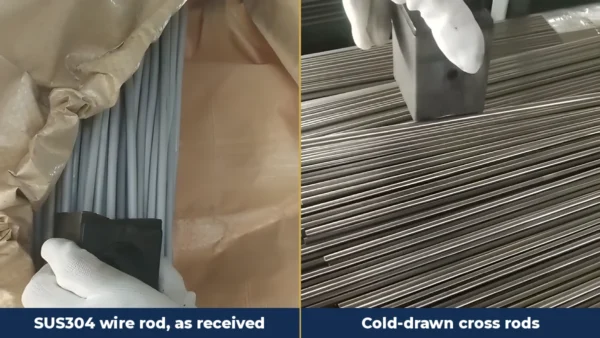
Material control starts before production. Each incoming material batch is checked against steel mill Material Documentation, with material verification, spectral testing and hardness testing. We draw our own stainless steel wire and round bar, so the wire and rods in the belt come from controlled material with traceable records.

The grade written on a quotation is useful just if the belt really contains that steel. Our traceability chain runs from raw material, through material verification, drawing and processing, wire and bar dimension checks, product manufacturing and inspection records, to the finished product.
- Steel mill Material Documentation for each batch
- Spectral testing to confirm chromium, nickel and molybdenum
- Hardness testing
- Wire diameter and round bar dimension inspection after drawing
Having test capability does not mean every order includes every test or a third-party report. If your customer needs a specific document or an independent test, tell us at the inquiry stage and we will confirm what can be provided for that order.
Why does this matter so much to us? Our founder, Aries Zhang, puts it simply: finding a good supplier is harder than finding a good customer. Drawing our own wire and rods is how we control the material our customers depend on.
Sunny's view: Ask any supplier how they confirm molybdenum in a SUS316 order. The answer tells you how seriously they treat material.
When This Is Not the Right Approach
Grade selection is not the right tool for every problem. If a belt rubs, lifts, tracks to one side or breaks rods, changing from SUS304 to SUS316 will not fix it; the structure, the drive and the machine have to be reviewed. For a spiral freezer, start with how to choose a spiral freezer belt.
And where the process is more aggressive than chlorides in normal food processing, such as strong acids or high-temperature atmospheres, neither grade should be assumed suitable. Send the full process conditions for a specific review.
From Our Engineering Experience
In our quotation reviews, material comes after structure. We first confirm what the belt must carry, how it runs and how it is driven, then we ask about salt, brine, cleaning chemicals and temperature. After that we recommend SUS304 or SUS316.
Most of our Spiral Freezer Belt, Self-Stacking Belt and Trapezoidal Mesh Belt references are available in both grades. When a buyer asks for SUS316 "to be safe", I ask what they are protecting against. If the answer is salt or chlorinated cleaning, SUS316 is a good choice. If it is a fit or strength problem, we look elsewhere.
FAQ
Is SUS316 always better than SUS304 for a conveyor belt?
No. SUS316 resists chlorides better. In lines without salt, brine or chlorinated cleaning, SUS304 usually runs well and costs less.
Does SUS316 handle higher temperatures than SUS304?
Not significantly for most food lines. High-temperature applications need a specific material review with the equipment data.
How can I check that my belt is really SUS316?
Use spectral analysis to confirm molybdenum is present. For a formal result, an independent laboratory can test a sample.
Why does my stainless belt attract a magnet?
Cold work during drawing and forming can make SUS304 slightly magnetic. It does not prove the grade is wrong.
Which grades do you offer?
We build stainless belts in SUS304 and SUS316. The grade for your belt is confirmed with the drawing and the working conditions.
Conclusion
SUS304 suits most lines; review SUS316 for salt, brine and chlorinated cleaning. Verify the grade by chemistry, and fix fit problems with structure, not grade.
Not sure which grade you need?
Tell us your product, salt or brine exposure, cleaning chemicals and temperature. We will recommend SUS304 or SUS316 and explain why.
Ask about material selection →WhatsApp Sunny📄 Spiral Freezer Belt Production & Quality Control (PDF) · Email: info@yiyimeshbelt.com
Related reading: Why stainless steel belts rust · Magnet test or spectral analysis · Why a SUS304 spiral belt can be magnetic · How to specify belt material in an RFQ (yiyimeshbelts.com)
Product pages: Wire mesh conveyor belt types · Metal conveyor belt materials (specifications, photos and quote request)

Sunny Ye
Global Sales Director, YIYI Mesh Belt · 15 years in metal conveyor belt projects
I work with spiral freezer builders, distributors and plant teams on belt selection and replacement. Questions about this article? Send them to me directly.
Follow Sunny on LinkedIn · Last updated: 2026-10-15

