
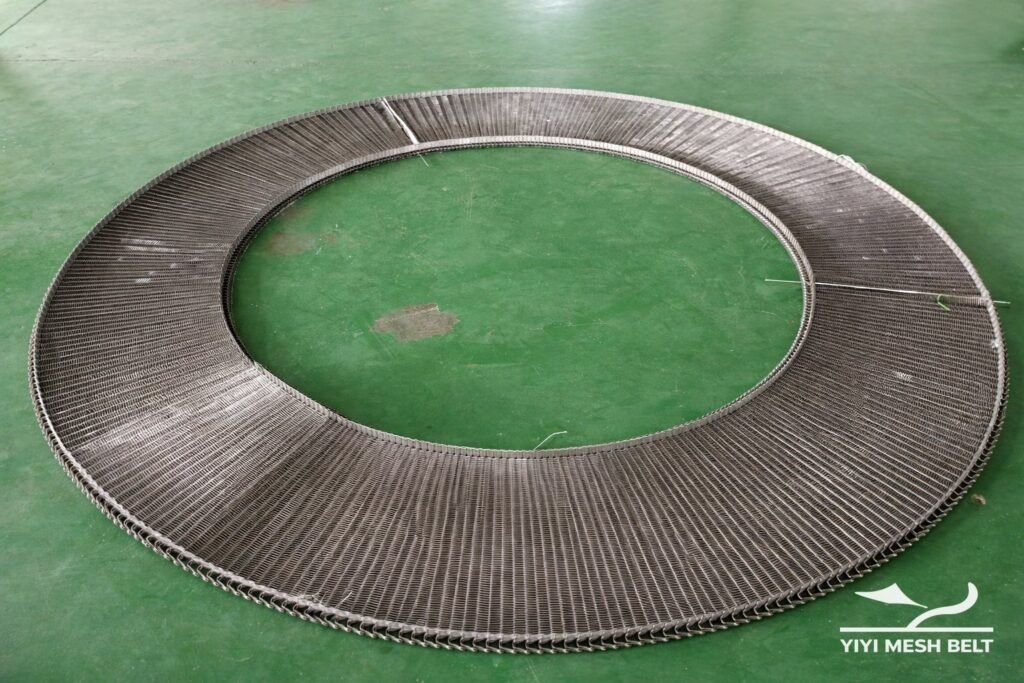
A spiral belt can pass every straight-line measurement and still turn badly. Geometry verification looks at the belt where it matters: in the turn.
Drum or geometry verification checks how a spiral belt behaves in a turn: whether the inner edge collapses evenly to the required radius, the belt stays flat, the edge meets the drum or guides correctly and the outer edge carries tension without distortion. It is done where the project requires it.
We are YIYI Mesh Belt, a metal conveyor belt manufacturer in Ningjin, Dezhou City, Shandong Province, China. Our manufacturing experience dates back to 1998, and we work on a 27,000 m² site with about 280 units of production and supporting equipment, including 9 welding robots. I am Sunny Ye. Buyers often ask whether we "drum test" every belt. The honest answer is that we verify drum or geometry behaviour where the project requires it. This article explains what that check looks at and when it is worth asking for.

At a Glance
| Applies to | Spiral Freezer Belt, Self-Stacking Belt, Side Driven Belt and approved spiral or turning structures |
|---|---|
| What it checks | Turning to the required radius, inner edge collapse, flatness in the turn, edge contact, stacking where relevant |
| When | Where the project requires it, agreed in advance |
| Not claimed | A drum test on every belt, or fixed hours or turns of testing |
| Related checks | 100% final inspection of pitch, flatness, welding and dimensions on every formal belt |
Why Check a Spiral Belt in a Turn?
Straight measurements, such as pitch, width and flatness, describe a belt lying flat. In a spiral freezer the belt spends most of its life turning, with the inner edge collapsed and the outer edge under tension. Problems with turn ratio, edge structure or welds often appear in the turn and nowhere else.

| Measured flat | Seen in the turn |
|---|---|
| Pitch and spiral pitch | Whether the inner edge collapses evenly |
| Width | Whether the belt reaches the required inside radius |
| Flatness | Whether the belt lifts or twists in the turn |
| Weld quality | Whether welds and edges hold under turning tension |
Our standard Spiral Freezer Belt references a turn ratio of 1.15 to 2.5, and the small turning radius version references 1.1. Whether a particular belt reaches the turn its freezer needs is what geometry verification shows.
A turning check also shows how the belt behaves at the start and end of the turn, where it changes from straight running to turning. Problems with edge structure often show there first.
Read what turn ratio means.
Sunny's view: Flat measurements tell me the belt was made to the drawing. The turn tells me the drawing was right for the freezer.
What Exactly Is Checked?
The check looks at whether the belt turns to the required inside radius, whether the inner edge links collapse evenly without binding, whether the belt stays flat and does not lift at the edge, how the edge meets the drum bars or guides, and, for self-stacking belts, whether tiers stack evenly.

- Turning radius: the belt reaches the inside radius on the drawing.
- Inner edge collapse: links close evenly, without binding or gaps.
- Flatness in the turn: no lifting or twisting of the carrying surface.
- Edge contact: edge and welds meet drum bars or guides as designed.
- Stacking (self-stacking belts): plates seat evenly on the tier below.
- Direction: the belt turns the way the freezer turns.
Findings are recorded with photos and, where useful, short videos of the belt moving through the turn. For spiral belts we look closely at the inner edge, because that is where links must close evenly; for self-stacking belts we look at how each plate seats on the tier below.
If something in the turn does not look right, the trial section is the place to correct it. Adjustments to edge structure, pitch or weld position are made on the drawing and checked again before mass production.
We do not publish a fixed number of turns or hours for this check, because what is meaningful depends on the belt and the freezer. The scope is agreed with the customer for the project.
Sunny's view: Ask to see the photos of the belt in the turn, with the inner edge visible. That is the evidence that matters.
When Does a Project Need It?
Geometry verification is most useful for new designs, replacements made without an original drawing, belts with a small turning radius, belts for a freezer the supplier has not built for before, self-stacking belts where stacking must be confirmed, and side driven belts. Repeat orders to a proven drawing usually need less.

| Situation | Verification worth asking for? |
|---|---|
| New belt design or new freezer | Yes |
| Replacement without the original drawing | Yes |
| Small turning radius | Yes |
| Self-stacking belt | Yes, including stacking engagement |
| Repeat order to an approved, proven drawing | Usually not; first article and final inspection |
For repeat orders to an approved drawing that has already run well in the same freezer, the first article and the 100% final inspection usually give enough confidence, and geometry verification adds little.
Ask for it at the inquiry stage, so it is planned into the project and the lead time we confirm.
Sunny's view: If you are replacing a belt from another supplier for the first time, ask for a turning check. It is simple insurance against a costly mismatch.
What Geometry Verification Does Not Mean
Verification shows that the belt turns, stacks and meets the edge as designed. It does not mean every belt is drum-tested, it does not replace installation checks in your freezer, and it does not predict service life. Tension, drum bar condition, loading and cleaning in your plant still decide how the belt runs.

- Not universal: we carry it out where the project requires it, and we say so in writing.
- Not a running test in your freezer: our check uses our equipment and set-up; your drum, guides and drive are different.
- Not a life prediction: service life depends on load, speed, cleaning and maintenance.
The older wording "every belt is drum-tested before shipment" appeared on some pages in the past. We removed it, because it was not accurate. What is accurate: every formal belt receives a 100% final inspection, and drum or geometry verification is added where the project requires it.
Sunny's view: I would rather tell you exactly what we checked than promise a test we did not do.
How Does It Fit With Final Inspection?
Final inspection and geometry verification answer different questions. Final inspection checks every formal belt against the drawing: pitch, flatness, welding, smooth and rounded weld points, width, length, structural dimensions and appearance. Geometry verification checks behaviour in the turn for projects that need it. Together they cover both the drawing and the freezer.

| Check | Question it answers | Applies to |
|---|---|---|
| Trial section and first article | Did we read the drawing correctly? | Formal custom orders |
| 100% final inspection | Is this belt made to the drawing? | Every formal belt |
| Drum or geometry verification | Does it turn and stack as the freezer needs? | Where the project requires it |
Read what 100% final inspection checks.
Sunny's view: Think of it as two questions: is it made right, and is it right for the machine? Final inspection answers the first; the turn answers the second.
How Should You Ask for Verification?
State in the inquiry that you need drum or geometry verification, describe the freezer (drum diameter, inside radius, direction, number of tiers), and agree what will be recorded: photos and measurements of the belt in the turn, inner edge collapse and, for self-stacking belts, stacking engagement. Confirm it on the order documents.
Put this in the inquiry
- "Drum or geometry verification required"
- Drum diameter and inside radius, or self-stacking stack data
- Turning direction, viewed from above at the infeed
- Number of tiers and belt speed
- What records you need: photos, video, measurements
We confirm the scope with you and include it in the plan for the order. Results are shared before shipment.
If you cannot visit, ask for the results as photos and a short video taken from above the turn, with the inner edge in view and the direction marked. That gives your engineers the same view our inspectors had.
For spiral belt selection, read how to choose a spiral freezer belt.
Sunny's view: Write it in the inquiry, not after the order. Then it is part of the plan rather than an extra.
When This Is Not the Right Approach
Geometry verification is not needed for straight conveyors, and it adds little for repeat orders to a drawing already proven in the same freezer. Asking for it everywhere adds time without adding information.
It is also not a substitute for installing the belt correctly. Follow the freezer builder's installation and tension instructions.
From Our Engineering Experience
When customers ask about drum testing, we explain what we check, when we check it, and what we record. Most appreciate a clear scope more than a broad promise.
The turning checks shown in this article are carried out in our own workshop. For self-stacking belts, stacking engagement between tiers is part of the check.
FAQ
Is every YIYI spiral belt drum-tested?
No. Every formal belt receives a 100% final inspection; drum or geometry verification is carried out where the project requires it.
What does geometry verification check?
Turning to the required radius, inner edge collapse, flatness in the turn, edge contact and, for self-stacking belts, stacking.
How long is the test?
We do not publish fixed hours or turns; the scope is agreed for each project.
When should I ask for it?
For new designs, replacements without a drawing, small turning radius belts, self-stacking and side driven belts.
Does it prove the belt will run in my freezer?
No. It checks the belt; installation, tension, drum condition and loading in your plant still matter.
Conclusion
Geometry verification shows how a spiral belt behaves in the turn. Ask for it where the project needs it, and agree the scope in advance.
Need a verified spiral belt?
Tell us the drum diameter, inside radius, direction and tiers, and what records you need. We agree the verification scope with you before production.
See Spiral Freezer Belt specifications →WhatsApp Sunny📄 Spiral Freezer Belt Technical Specification (PDF) · Email: info@yiyimeshbelt.com
Related reading: What is turn ratio? · What 100% final inspection checks · When you need a small turning radius · How a belt is inspected before shipment (yiyimeshbelts.com)

Sunny Ye
Global Sales Director, YIYI Mesh Belt · 15 years in metal conveyor belt projects
I work with spiral freezer builders, distributors and plant teams on belt selection and replacement. Questions about this article? Send them to me directly.
Follow Sunny on LinkedIn · Last updated: 2026-10-15

